Welcome to our blog!


It's better than a bat in the eye with a burnt stick!


This blog makes liberal use of AB's journals, letters, travel notes, and other sources.


And make sure to visit The Arnold Bennett Society for expert information and comment on all aspects of the life and work of AB.

Sunday, 7 July 2013

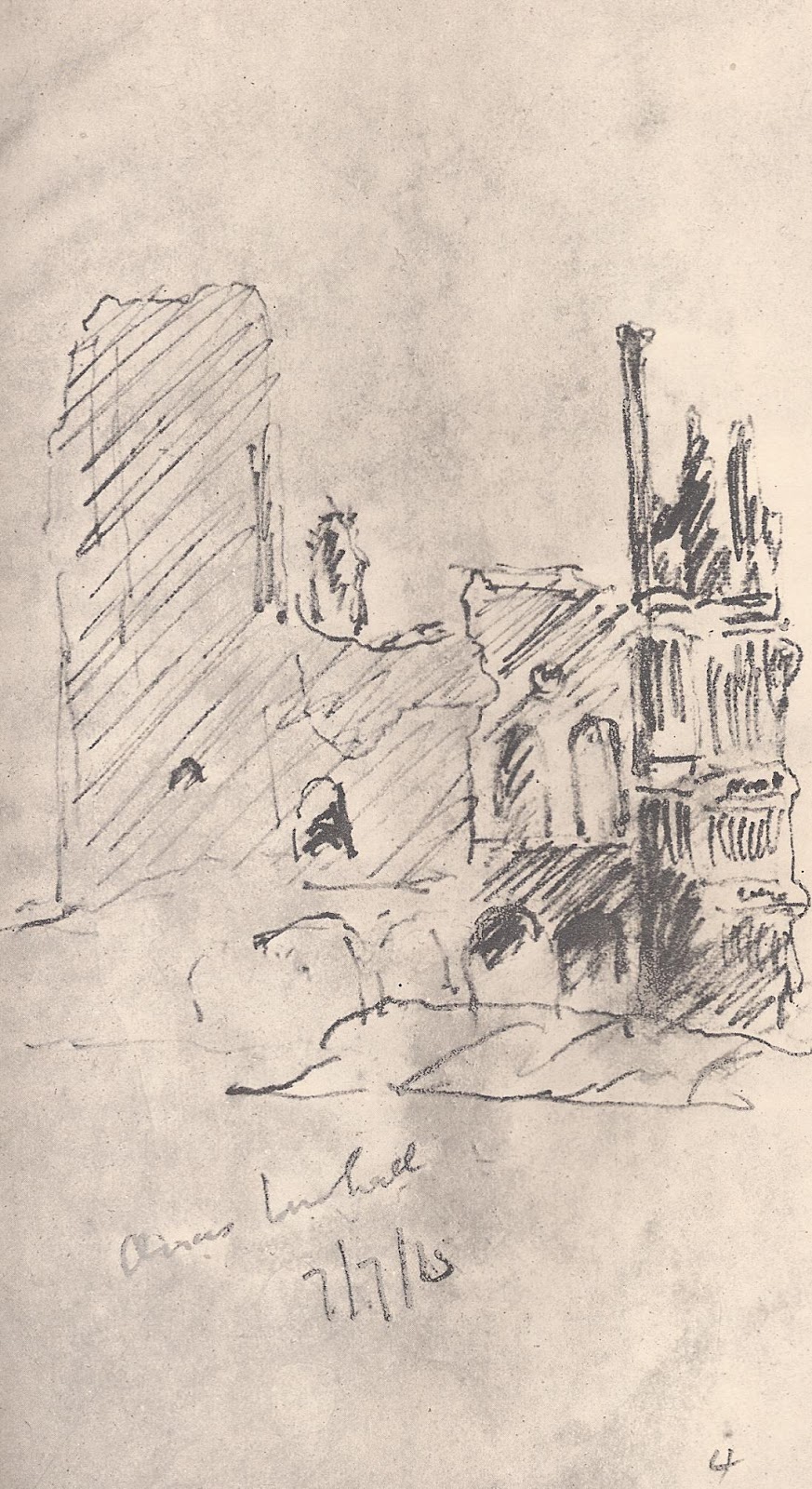
In Arras

Wednesday, July 7th., Near Arras.

When you actually reach Arras you cannot be deceived for an instant as to what has happened to the place. The first street you see is a desolation, empty and sinister. Everywhere the damage of shells is visible. In the brief intervals of the deafening cannonade can be heard one sound - blinds and curtains fluttering against empty window frames. As we went further into the city we saw sights still stranger. Of one house nothing but the roof was left, the roof made a triumphal arch. All the streets were covered with powdered glass.

In one street we saw a postman in the regulation costume of the French postman, with the regulation black, shiny wallet-box hanging over his stomach, and the regulation pen behind his ear, smartly delivering letters from house to house. He did not knock at the doors; he just stuck the letters through the empty window frames. He was a truly remarkable sight.

Then we arrived by a curved street at the Cathedral of St. Vaast. It is the most majestic and striking ruin at the Front. It is superlatively well placed on an eminence by itself, and its dimensions are tremendous. It towers over the city.. The pale simplicity of its enormous lines and surfaces renders it better suited for the martyrdom of bombardment than any Gothic building could possibly be. Photographs and pictures of Arras Cathedral ought to be cherished by German commanders, for they have accomplished nothing more austerely picturesque, more idiotically sacrilegious, more exquisitely futile than their achievement here. And they are adding to it weekly.


To the right of the Town Hall, looking at it from the rear, we saw a curving double row of mounds of brick, stone and refuse. Understand, these had no resemblance to houses; they had no resemblance to anything whatever except mounds of brick, stone and refuse. The sight of them acutely tickled my curiosity. "What is this?" "It is the principal street in Arras." German gunnery has brought that street to an end past all resuscitation. It may be rebuilt - it will never be the same street.

Arras is not in Germany. It is in France. I mention this fact because it is notorious that Germany is engaged in a defensive war, and in a war for the upholding of the highest civilisation. The Germans came all the way across Belgium, and thus far into France, in order to defend themselves against attack. They defaced and destroyed all the beauties of Arras, and transformed it into a scene of desolation so that the highest civilisation might remain secure and their own hearths intact. Having seen Arras, I would honestly give a year's income to see Cologne in the same condition. And to the end of my life I shall feel cheated if Cologne or some similar German town is not in fact ultimately reduced to the same condition. This state of mind comes of seeing things with your own eyes.

The defence of German soil is a mighty and far-reaching affair!


Saturday, 6 July 2013

Fellow travellers

Friday, July 6th., Charlton Arms, Ludlow.


I came to Ludlow today. Fat female aristocrat in train. Dust cloak. Flower outside it. Jewel to fasten it. Many rings. Manicured. Queen, Tatler. Ethel M. Dell's latest novel. 3 cushions in a decided leather 'envelope'. Elaborate lunch basket. Greedy. When ticket collectors came, she referred them, with an apprehensive gesture, to her maid, lest she might be bothered. Two of them knew of her maid. The third said roughly: "I suppose your maid has your ticket?" Her fear about being worried about anything was obvious. At Shrewsbury she held 'envelope' whilst maid put cushions into it. Maid got her out of train and transferred her to Ludlow train. There was another and older and worse woman, with an aged maid in the same compartment. very hard. She was met by a companion sort of girl at Birmingham.

Friday, 5 July 2013

Mundane matters

Friday, July 5th., Yacht Club, London.

Eleventh anniversary of our wedding yesterday. We dined at the Cafe Royal.

Raymond Needham came and lunched with me at Yacht Club, and told me much about Lord Beaverbrook and much as to his own private affairs.


"Right Ho Jeeves" by P.G. Wodehouse was dedicated "To Raymond Needham K.C. with affection and admiration"; Needham was a barrister who successfully defended Wodehouse in a tax case brought by the Inland Revenue.


On Wednesday night Eadie came to the flat and read two acts of "The Title" very well. The first act, though, I thought, consistently good, seemed a hell of a length.


Dennis Eadie (1869–1928) was a British stage actor who also appeared in three films during the silent era. Eadie was a leading actor of the British theatre, appearing in plays by Edward Knoblauch and Louis N. Parker. In 1916 he became the first man to play the British Prime Minister Benjamin Disraeli in a feature film.


I lost my food card.

Thursday, 4 July 2013

Americana

Sunday, July 4th., Comarques, Thorpe-le-Soken.

Edgar Selwyn has been here for the weekend. Edgar gave me some good tips about screen-writing. He said: "You haven't got to write for London, you have to write for Thorpe." I added to this and said: "You have to write for a Thorpe man who can't hear and who can only read simple words." I see that any projected revolution in the film can only be done gradually.

Edgar told me that the rents of N.Y. theatres ran from 40 to 70 thousand dollars p.a., and that the Morosco was $45,000. I already knew how much the Morosco holds. It held $16,000 a week for "Sacred and Profane Love". Edgar read two acts of "The Bright Island" while he was here and I doubt if he saw anything in it at all. He said that political plays always failed in U.S.A., and that you could not interest the U.S.A. people even in politics themselves, to say nothing of plays about politics. I don't believe either of these statements.

Speaking of the labour question in U.S.A., Edgar said that for the big Labour meetings the streets were always choked with cars - and not Fords either. It is obvious of course that if there are 12 million cars in use in U.S.A. a vast number of working men must possess cars. It means one to less than every nine of the total population, men, women and children.

See also, 'Sailing for home' - November 30th., http://earnoldbennett.blogspot.co.uk/2012/11/sailing-for-home.html

Wednesday, 3 July 2013

Bibliophile's delight.

Monday, July 3rd., Fulham Park Gardens, London.

The Academy sent me the MS. of an article by Elizabeth Robins on Ibsen, to which I am to write a companion article. I was struck by the lack of "literari-ness" which the MS. disclosed: large, slow calligraphy, uncertainty in spelling and punctuation, and a hundred little things which mark the beginner. Yet she has written several books, one of them quite first rate and notable.

I have bought the hundred books which Bells allows you to select from the six hundred volumes of Bohn's Libraries. They stand in a long beautiful row, houseless on the top of my shelves. Arriving late last night from Witley, eager to view them - they had been delivered in my absence - I cut several of them and looked through Juvenal, Suetonius, and da Vinci. I found that the celebrated and marvellous passage in Beaumont and Fletcher's "Philaster", about marrying "a mountain girl", in which occur lines

                                                        And bear at her big breasts
                                                        My large coarse issue

must certainly be based on a passage in Juvenal's Sixth Satire.

Today I began to read "Benvenuto Cellini". He seems to have been less absolutely reprobate than I had imagined. The mark of the truly great man is on every page. I was enchanted with a phrase attributed to Benvenuto's father. Benvenuto was in trouble with the magistrates, and his father was defending him with moral support. "My father, in answer to these menaces, said, 'You will do what God permits you and nothing more.' The magistrate replied that nothing could be more certain than that God had thus ordered matters. My father then said boldly to him, 'My comfort is that you are a stranger to the decrees of providence!' "

What strikes me regarding the book technically, is its literary naivety and lack of art. It must have been written without any prearranged plan, currente calamo. Evidently much of primary interest has been left out - some by design but more by accident.

Tuesday, 2 July 2013

Feeling better

Saturday, July 2nd., Cadogan Square, London.

I wrote 400 words of "Accident" before going out; then forty minutes' activity in the streets of London; then another 300 words. Then lunch with Dorothy. Then a sleep - not deep or reposeful. Then another 400 words, finishing another chapter.


I was then in a state of nerves. But having the scheme of the prefatory note which Bertie Sullivan and Newman Flower  desired me to write for their biography of Arthur Sullivan, I decided to write it at once, and I did so, getting it off my chest. 400 words.


Sprightly. I then went out for a walk in the fair but unsatisfactory weather. Returned by bus. Dined alone with Dorothy. We played the greater part of Schubert's Octet - pianoforte 4 mains. Great noise and fun, which did me much good, for I had been depressed.

Monday, 1 July 2013

Inexcusably late

Friday, July 1st., Cadogan Square, London.

Appointment for 6 o'clock with Edward Newton, the American bibliophile, apropos of a suggested introduction by him to the reproduced MS. of "The Old Wives' Tale". I was 25 minutes late. A shameful position and inexcusable. Newton and I agreed that a preface by him seemed neither practical nor useful, and we gave up the idea, especially as I had already written an introduction myself and the sheets were already printed and signed by me.

Alfred Edward Newton (1864—1940) was an American author, publisher, and avid book collector. He is best known for his book "Amenities of Book Collecting" (1918) which sold over 25,000 copies. At the time of his death, it was estimated that he had approximately 10,000 books in his collection, focusing on English and American literary works, the major part of which were auctioned by Parke-Bernet Galleries, New York in April, May, and October 1941. Highlights of the sale included the autograph manuscripts of Thomas Hardy's novel "Far From the Madding Crowd" and Charles Lamb's essay "Dream Children".

Dined at home with Dorothy and we went to Playroom Six, 6 New Compton Street, to see d'Annunzio's "The Honeysuckle". The play had form, interest, and power in a voluptuous way, but the performance was simply terrible. The theatre only holds about 100 people. It has a nice atmosphere, and the bar, etc., is sympathique, especially the gas ring lodged on a chair.

The Players'Theatre was a London theatre club that opened in 1927 as Playroom Six at No. 6, New Compton Street, with the aim of presenting a wide range of entertainment.However, in 1936 it moved into the former Evans's Supper Room (also known as Evans's (late Joy's)) in Covent Garden and soon began to concentrate on recreating the type of music hall entertainment originally seen on these premises.