Welcome to our blog!


It's better than a bat in the eye with a burnt stick!


This blog makes liberal use of AB's journals, letters, travel notes, and other sources.


And make sure to visit The Arnold Bennett Society for expert information and comment on all aspects of the life and work of AB.

Monday, 14 October 2013

Baseball impressions

Saturday, October 14th., New York.

Going down change at 155th on to Elevated.
No crush. First view of baseball ground.
The effect of millions of staircased windows of apartment houses, with glimpses every now and then of complicated lines for washing.
Street after street, dirty streets, untidy, littered.

Baseball game. Grants v. Athletics. N.Y. v. Phila.

Polo Grounds stadium
Again cigarettes, chewing gum, programmes.
Cheers for kid practising, sharp sort of cheers.
Advertisements around arena.
Drive through Central Park, and then past Carnegie, etc. houses.
Pitcher lifting left leg high. Tip on right toe.
Applause for a run. First red man near to me in joy.
Members of audience being turned out.
The catching seemed to be quite certain,
as rare as a woman in a ball match,
as difficult as to make a first base.
The eagles on top of stand.
The yellow ushers against the dark mass.
The blue men against a red-bordered mat N.Y. police. 
The blue purple shadow gradually creeping up to the sign.
"The three dollar hat with the five dollar look".
a two base hit is the height of applause, real applause.
chewing gum.
combined movement of jaws
obstinacy of chewing gum at end
The pitcher is the idol of the affair, as may be seen when he comes in to strike.
The hunchback mascot of Philadelphia.

In the 1911 World Series, the Philadelphia Athletics beat the New York Giants four games to two.
GameDateScoreLocationTimeAttendance
1October 14Philadelphia Athletics – 1, New York Giants – 2Polo Grounds 2:1238,281

Additionally for October 14th., see 'Domestic disturbances' -
http://earnoldbennett.blogspot.co.uk/2012/10/domestic-disturbances.html

D. having been much disturbed by revelations of character during a visit to Brighton with me on Monday, could not go to sleep. 

Sunday, 13 October 2013

Strike fears

Thursday, October 13th., Villa des Nefliers.

Weather still very mild. But today, owing to heavy rains, we had to lunch indoors. This is our first indoor autumn lunch.

Railway strike since Monday night, but we are not affected. Each evening I have gone to the station to get Le Temps and each evening the crowd and the anxiety of the crowd waiting for the papers have increased. Yesterday evening, as the news was disquieting, I went again to the station after dinner to post a letter to Cook's asking for bank-notes.

An omnibus slowly overtook me on its way to the station. Even on this line the strike had been announced to begin at 8 p.m. last night. There were a few dim figures in the fearfully badly lighted omnibus that went very slowly along - decrepit horses, etc. A mediaeval vehicle even at best and the impression last night was of the saddest and most wistful vehicle that ever lumbered along. The voyageurs seemed wrapped up in sadness. Where were they going? would they ever arrive? Where would they spend the night? The worst of these awful omnibuses is the lamp and the deafening rattle of the windows as the thing jolts along ...

However, there has been no strike on this line.

The present unrest among the French wage-workers, as with the increasingly bitter struggle for more wages in other countries, has been quickened by the general increase in the cost of living. For a considerable time the railway workers, especially, have been in ferment. Many meetings have been held, and innumerable resolutions passed. The chief of their demands were (and are) the establishment of a minimum wage of 5 francs (barely 4s.) a day – a large number of them receive, in fact, as little as 5Frs. 75 (3s) per day! The whole of their modest demands, and their entire procedure, were distinctly professional in character, despite the lying statements of the renegade Briand that it is a political insurrectional movement. Many thousands of arrests have been made, nevertheless, and terms of imprisonment have fairly rained upon the unfortunate strikers.

The play goes on steadily. I ought to finish the second act on Saturday. Although there are four acts, this means that at least two thirds of the actual work is done.

Additionally for October 13th., see 'Arriving in the New World' -
http://earnoldbennett.blogspot.co.uk/2012/10/arriving-in-new-world.html

I was interviewed by two journalists apparently on behalf of the crowd. This was while ship was manoeuvring into dock. And at last we were on shore, after I had been interviewed by three other people.


Saturday, 12 October 2013

Women-shoppers

Saturday, October 12th., Cadogan Square, London.

I was noticing the faces and the demeanour of the middle-aged or ageing women-shoppers in Sloane Street. It was painful to observe how few of them can use powder and paint with effectiveness and discretion. Some of the lips were dreadful sights. Then the haughty, hard, harsh expression on some of the faces! The sort of expression that says savagely, during strikes: "Shoot them down!" or "They ought to be made to work!" or "Unions ought to be made illegal." A large percentage of these ladies must surely be rather unpleasant to live with. You seldom see such expressions as theirs on the faces of men. I suppose this is because men go about more, and arrive at a notion of the real facts of existence. 

Thinking about the extension of suffrage to women I imagined that a woman like this might conceivably become Prime Minister one day and would inevitably proceed to wreak havoc on the organised labour movement in this country. As regards politics and industry, a lot of these women are living in the 1880's. They are probably one of the origins of the servant problem. They don't realise that they have nothing whatever to be haughty or self-complacent about. Most of them have done nothing for society at large, and little for the other immortal souls who menially serve them: though of course all, or nearly all, of them have patronised the poor.

The truth is that Sloane Street during the shopping hours is not an entirely agreeable spectacle. I much prefer Oxford Street, where the social salt of the earth do not occupy the pavements. I prefer even Bond Street which is more international than Sloane Street and less conscious of a sublime superiority. But for a man with eyes to see - naturally I mean myself - the most interesting shopping street is the despised Strand. Nevertheless the Strand is losing its most endearing and picturesque characteristics. It will soon be widened from end to end. What is worse it will soon consist solely of 'edifices', and the last of the high narrow shop-houses will have vanished. And what is even worse, it will soon be tidy. Withal there are but few frills on the Strand - yet.

I have been re-reading "Mr. Prohack" and enjoyed it. It does occur to me though that I could have taken a little more trouble and either made it more overtly satirical, or made it more frankly farcical, like "The Card"; it is not an entirely happy compromise. Prohack is I think an engaging character, but the rest are slight.  Speaking of engaging characters, I have also been re-reading "Silas Marner" and think Dolly Winthrop delightful. George Eliot had a surprising facility for gentle humour, and some of her minor character dialogue rivals Hardy at his best.

Additionally for October 12th., see 'News from Germany' -
http://earnoldbennett.blogspot.co.uk/2012/10/news-from-germany.html

Spender (see 'Writing for Victory' September 3rd.) spoke about the poverty of Germany, and of a great struggle between inhabitants of 2 room tenements in poorer quarters and the police. The police laid down that it was unsanitary for people to sleep in a room where cooking was done. This of course would have put the whole family into one room to sleep. They could not enforce the decree practically. Then they had kitchens constructed in new tenements, in such a manner, so full of corners, that beds could not be put into them! He also spoke of seeing a highly respectable-looking long row of tenements in Munich, as to which a guide friend said to him: "You see those houses? There isn't a w.c. in the whole row. When the tenants want a w.c. they go to that beer hall there and have a drink in order to use a w.c." 

Friday, 11 October 2013

Out and about

Monday, October 11th., Cadogan Square, London.

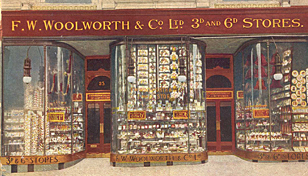
We stopped in Harbour Street, at Hyland's and at Woolworth's. I had long been in need of a new cigarette-case (second) and I got one here for 6d. Dorothy received from me a pink pearl necklace with ear-rings to match, and 1 hat-pin and two morocco (?) books to hold snapshots of Virginia - the whole costing 8s. 6d. No wonder that this shop has a great fascination for the majority of human beings.

We hired a car and drove to Canterbury. I was rather overwhelmed by the size and the grandeur of the cathedral. Unfortunately we got in while a service was going on. This service, as far as I heard it, was unaccompanied choral, with bursts of organ. I never heard any other words but 'Amen', and I must have heard this 20 or 30 times. The composer had made a speciality of sustained notes, and some of these were certainly droned for quite a minute at a time. The music seemed to me to be banal, but the singing was good. The organ music played later was far more banal. As soon as the service was over, the people waiting to inspect the place were let loose, Dorothy and I among them. Yes, I was much impressed. The choir is original (William of Sens). Stained glass often fine. Also the place is full of history. The town also is 'pullulating' with history and antiquity. We got home just after six.


Additionally for October 11th., see 'Sincere, artistic ladies' -
http://earnoldbennett.blogspot.co.uk/2012/10/lively-ladies.html

An evening of strong contrasts; at eight o'clock I left, the musical, emotional atmosphere of Sharpe's, where Sharpe, Weist Hill, Mrs. Sharpe, Werg and Alcock were playing to a very mixed audience, Cherubini, Saint-Saens, Stanford and Schumann; raced home on my bicycle, rushed out again, took the bus and was having supper with Miss Symonds and her mother at Thurloe Square in exactly half an hour. At Putney, music, loud laughter, undiluted emotionalism, and sincere artistic purpose. At South Kensington, literature, quietude, the restraint of an eighteenth century demeanour, - and sincere artistic purpose , too.

Thursday, 10 October 2013

Exploring 'Lucy'

Tuesday, October 10th., Lusitania, at sea.

Conversational phrases, etc.
2 Stewards in corridor 8.5 a.m.
1. One coffee with milk in 87. I couldn't take it in because he hadn't gone into his bath. Take it in will you as soon as he has gone into his bath. He hadn't gone into his bath.
2. One coffe with milk in 87?
1. That's it.

http://www.rmslusitania.info/lusitania/

Visiting ship with Chief Officer.
Chart Room. "Holy of holies" Brass and mahogany effect. Dodge for detecting and putting out fires in inaccessible holes. fan to draw out smoke and steam attachment to drown it. All same pipes. 4 or 500 feet of piping at least.
Sounding tubes? Wire draws out water from a tube. Even the wire so drawn in by an electric motor. It can be done at full speed.

Bridge. 75 ft. above the sea. The house was carried away and wheel carried away once by a wave - one wave. One dent, made by glass, left in wood, to commemorate the day.
Subterranean signalling. A bell sounds through it like tapping a pencil on wood. Nantucket bell heard 16 miles off

Down below, forward of steerage, capstan gear. The cables will each break only at 265 tons. That is, they could hold in suspension 26 10-ton trucks of coal. The capstan gear is so strong that it will break the cable if it is overwound.
Imagine 265 tons of M.P.'s dropped into the sea.
Well may all this powerful machinery be encaged, just like wild beasts in a menagerie.
7 different steering gears. The last by hand wheel almost direct. Auxiliary engines, etc. We went down two or three stories from lowest passenger deck and saw the tremendous gear actually at work slowly and apparently capriciously moving to and fro at intervals in obedience to sailor on bridge 5 or 600 feet away and 70 foot higher up.

Up and down steel ladders. Climbing over moving chain (like a bike chain) of steering gear, through stray jets of steam, in a forest of greasy machinery, guarded by steel rails, grease on floor: all apparently working alone under electric lights, but here and there a man in brown doing nothing in particular. Dials everywhere showing pressures, etc.
Up a flight to dynamo room. 
Machines revolving 1,200 to the minute.

Then to stokehold. Vast. Terrible. 190 colossal furnaces, opened and fed every 10 minutes, and coal flung in. Mouths of furnaces seemed to me to be very high for coal to be flung into them. This effect was like that of a coal-mine with the addition of hell.
This was the most impressive part of the ship. It stretched away with occasional electric lights into infinite distance. 1,000 tons of coal a day. Finest coal. very hot. An inferno, theatrical. Above, confectioners making petits fours, and the lifts going for 1st class passengers.

Invited into the Captain's room. He showed us his photograph after being invested C.B. by King.
The Englishman's reverence for his old institutions, of all kinds, and his secret sentimentality comes out all over the ship the whole time.

Marvellous after-sunset exactly ahead, as we came out. Sea like slightly uneasy oil.

The trip from England to the US (and vice versa) required no less than 6,000 tons of coal (1,000 tons a day!). The coal required 22 coal trains of 30 trucks each, each truck weighing approximately 10 tons each, to reach the dock. Once there was loaded into the bunkers via hatches on the hull. It was a dirty process that covered nearly everything on deck and in many cases below decks with coal dust that had to be wiped, washed or hosed off before passengers boarded. Her massive steam turbines required 65,000 gallons of water per minute for cooling purposes. The crew of nearly 900 saw to the operations of the ship, from actually navigating the vessel from the bridge, shovelling coal into the furnaces that pressurized the boilers or tending to individual passengers' needs and tasks. The sailing department; seamen, officers and such numbered around 70. There were 390 engineers, more than nearly 400 stewards, 50 cooks and an assortment of others such as band members, telegraph operators, lift attendants, printers, etc. From the Captain himself to the lowest of bell hops, the ship was home. So it was for nearly 8 years. Lusitania enjoyed popularity and prosperity. Comfort was assured by the ship's own luxury and the crew's dedication to the passengers. Safety was always assumed, though perhaps questioned after the 1912 sinking of White Star Line's Titanic in a tragedy that shook the shipping industry at its foundation by exposing the severely lacking safety standards that governed British shipping on the whole.

Dr. Hutchinson introduced himself to me in smoke-room, as being a great admirer. he began to talk about his biological researches and travels and theories, and kept on - very interesting and never referred to my work at all.  

he said that the progress of sanitation in Naples (where up to a few years ago there were no privies at all) was very much hindered by the fact that a company paid the corporation 300,000 frs. a year for the right to remove human excrement. Another company paid 100,000 for right to remove dog excrement. (Same thing in Constantinople, Aleppo, etc.) Dog excrement sent to U.S.A. for preparing of kid gloves, etc. Nothing like it for that.


Additionally for October 10th., see 'H.G.'s boom is over' -
http://earnoldbennett.blogspot.co.uk/2012/10/hgs-boom-is-over.html

Wells came in, and slanged the Webbs as usual, and incidentally said: "My boom is over. I've had my boom. I'm yesterday."

Wednesday, 9 October 2013

Aesthetic ideas

Wednesday, October 9th., Les Sablons, Fontainebleau.

I have often thought, during the last year, upon the uselessness of trying to describe faces in literature. No vision is raised by particularization in words. I now find this minutely explained in Lessing's "Laocoon", which is certainly a most useful and illuminating treatise for a writer. Homer it seems never described Helen. He merely said she was beautiful, and kept insisting on the fact, and showing the influence of her beauty - as on the elders. This is the way to follow. Lessing's theory of the propriety of describing ugliness is ingenious, and perhaps good. The choice in subjects of a painter like Delacroix will not justify itself under Lessing's philosophy, and Lessing is undoubtedly right. Delacroix was great in spite of his choice of subjects. "Laocoon" has clarified and confirmed my ideas very much.

Lessing's book "Laocoon and the Limits of Painting and Poetry" is touted as the first systematized treatment of aesthetics during the Enlightenment and it is considered remarkable because it is one of the first works to articulate the difference between poetic production (art with words) and painting production (art with physical bodies, including sculpture, painting, and architecture, etc.). Prior to Lessing painting and poetry were considered to be relatively synonymous in how they were produced, not functionally, that is, not with the physical techniques, but aesthetically, with the intellectual consideration and aims. Lessing argues against this conflation by appealing to a particular ancient example that had been the subject of debate for quite some time: the Greek/Roman sculpture of Laocoön. Laocoön was a Trojan priest of Apollo who was destroyed (along with his two sons) by two giant serpents sent by the god Apollo. Variants on the details of the story exist, but the debate centres upon the account of Virgil in the Aeneid and the sculpture of Laocoön, whose date is also debated. The central debate is whether the sculptor relied upon the written record (Virgil's) for inspiration or whether Virgil relied upon the sculpture for his inspiration. Behind this seemingly insignificant question is whether poetry and painting are independent arts, dependent arts, or interdependent arts of aesthetic production and whether they should be judged by the same standards or separate standards. Lessing's work labours to prove that poetry and painting are not dependent upon each other (though they do have similarities). Painting can depict certain qualities that poetry cannot (examples are below) and poetry too can depict certain qualities that painting cannot. Overall, Lessing seems to elevate poetic production above painting because the scope of its production is greater as well as its imaginative appeal to the senses.

Yesterday I began "The Old Wives Tale". I wrote 350 words yesterday afternoon and 900 this morning. I felt less self-conscious than I usually do in beginning a novel. In order to find a clear three hours for it every morning I have had to make a timetable, getting out of bed earlier and lunching later. 

This morning I calculated that I could just walk to the Croix de Montmorin and back in an hour. I nearly did it this morning without trying, in heavy rain. Tomorrow I may do it. A landscape of soaked leaves and thick clouds and rain - nothing else. But I like it.


Additionally for October 9th., see 'All at sea' -
http://earnoldbennett.blogspot.co.uk/2012/10/all-at-sea.html

Our third day at sea.
Strange noises through the night. Tappings. Waiting for the dawn to come, forgetting that there could be no dawn. The dawn was the turning on of the electric lights on the corridor.
Lovely Sunday morning. Rippled sea as we left Ireland.

Tuesday, 8 October 2013

Miracle cures?

Wednesday, October 8th., Cadogan Square, London.

Walking in Fulham Road yesterday morning I saw in a slatternly chemist's shop a section of window given to "Yeast is life. Vitamines mean health. X ---- Yeast tablets ... A lightning pick-me-up" guaranteed (or money back) to aid headaches etc. in 5 minutes, flatulence etc. in 5 to 10, stomach trouble in 10 to 15, flu cold in 24 hours. I went in and bought some - probably because I used to take yeast, and it may have done me a certain amount of good. 
I didn't know what was in the tablets (beyond yeast). I knew that for many years I had tried all sorts of remedies and that not one of them had succeeded with me. Yet, as usual, I had hope again. I believed again etc., etc. I took stuff blind again. This indestructible (though often destroyed) faith in quack medicine advertisements is a very interesting and perhaps universal trait. I took a tablet. I felt nothing. But about tea-time I felt a rather wonderful change in my organism. After tea I took two more tablets - or was it before tea? Anyhow I felt very much better. I took two on going to bed, and I have had the best night for many weeks. In fact I slept five and three-quarter hours, of which three and a quarter at a stretch. I felt I could do with more sleep; but I couldn't get it. However I have much more energy and optimism today.

In the afternoon I went up to Charing Cross Road to look at bookshops. Plenty of people looking at them. What struck me was that about half of the books outside the shop are so displayed - generally so low down - that you can't see the titles without physical feats. They are not attractively displayed either. they are as a general rule, stacked anyhow on the shelves and without order.


Additionally for October 8th., see 'Parisian impressions' -
http://earnoldbennett.blogspot.co.uk/2012/10/parisian-impressions.html

I went to Paris yesterday morning at 7 o'clock. Bad weather. It being Monday morning the train was crowded. I got to the Rue d'Aumale on foot and by omnibus. And in the omnibus I noticed that two of the three horses had sore feet.