Welcome to our blog!


It's better than a bat in the eye with a burnt stick!


This blog makes liberal use of AB's journals, letters, travel notes, and other sources.


And make sure to visit The Arnold Bennett Society for expert information and comment on all aspects of the life and work of AB.

Showing posts with label Lusitania. Show all posts

Thursday, 12 October 2017

Exhilarated

Wednesday, October 11th., R.M.S. Lusitania, At sea.

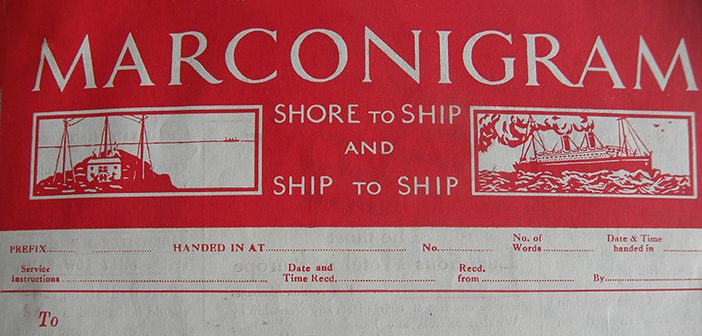
Image result for marconigram lusitaniaI have noticed before how easy it is to become extremely affectionate towards one's wife when separated from her. And at the moment I am very separated from her. The exhilaration of being a bachelor once more! I was feeling so exhilarated, and affectionate, this morning that I sent  my very first marconigram. It cost me 26 shillings - it will never catch on at that rate. I sent Marguerite 26 kisses, which will give her something to think about while I am away. I sent the telegram at noon London time (9 a.m. boat time). No idea when she will get it.

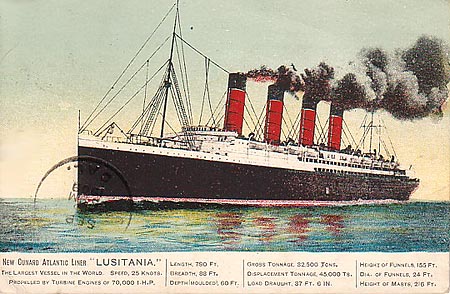
Image result for lusitaniaI had a most busy day yesterday. I was writing most of the morning, and at 2.30 the First Officer took Knoblock and me on a tour of the ship, all the navigating part and also into the engine rooms. This occupied nearly two hours. I t was absolutely astounding. I shall write an article about it. Then we came upon the Captain who invited us into his parlour and we smoked cigars and told stories there for another two hours. later I had a tremendous dinner, but suffered for it in the night. Still, I am all right this morning. There is such a strong breeze that, at the front of the boat, you literally cannot stand up against it. It would blow you down.  yet the boat is very steady. It is not yet certain whether we shall land tomorrow night or Friday morning. I hope it will be Friday as I should like to experience the arrival in New York.


Tuesday, 11 October 2016

All at sea

Wednesday, October 11th., RMS Lusitania, at sea.

Image result for marconigramI sent my very first marconigram yesterday to let Marguerite know all was well with me. I expect it will surprise her greatly. It cost me 26 shillings - incredible!


I had a most busy day yesterday. I was writing for most of the morning and then at 2.30 the First Officer took Knoblock and me all over the navigating parts of the ship and through the engine rooms.This occupied nearly two hours and I can tell you that it was absolutely astounding. I shall describe it in an article. The while we were promenading on the deck the Captain asked us into his parlour and we smoked cigars and told stories for nearly two hours.

Image result for lusitaniaI had a tremendous dinner. Must be the sea air sharpening my appetite, but I felt rather uncomfortable all evening and I woke up this morning at 3 o'clock with a severe headache. However it went off during my next sleep and I am all right today. there is such a strong breeze this morning that at the front of the boat you literally cannot stand up against it.. It would blow you down. yet the boat is very steady and I am writing this as if I were in my study.

It is remarkable to me that man, so small, fragile and weak has contrived an advance in science and industry sufficient to construct a machine like this. Only a hundred years ago men were sailing the seas in wooden ships and relying on the wind for their progress. What will the next hundred bring I wonder?

Monday, 2 December 2013

Atlantic gale

Saturday, December 2nd., Lusitania, at sea.

Following gale, overtaking us. I began to construct a one act play for ship use, and this put me off going to sleep last night, and then I was kept awake by rolling and noises connected therewith. hence, bad night. Read a lot of "Sanine". Insincere voluptuous stuff.

Went out at 10.30. High seas. Whole surface of sea white with long marmoreal lines of foam. Through the mistiness the waves on the horizon looked as high as mountains; or high as a distant range of hills. Curious that distant waves should seem so much higher than those close to. Ship rolling enormously and her prow yawing about. yet forward, sheltered by deck houses from following gale, one had no sensation that the boat was moving forward. Walking backward from bow to stern, the following gale struck one sharply in the face, though one was running away from it at about 30 miles an hour. 

Big squall gradually overtook us. All sunshine clouded out for 15 minutes and snow came down almost horizontally, and much faster than the ship in the same direction. The wind blew spray fiercely off the water in clouds. The screws half-raced from time to time.

While waiting in barber's shop, read Jane Addams on "Old Social Evil and New Remedy". 

Also for "Lusitania" see -
http://earnoldbennett.blogspot.co.uk/2013/10/sailing-to-america.html
http://earnoldbennett.blogspot.co.uk/2012/11/sailing-for-home.html
http://earnoldbennett.blogspot.co.uk/2012/10/all-at-sea.html
http://earnoldbennett.blogspot.co.uk/2013/10/exploring-lucy.html

Additionally for December 2nd., see "Being 'in it' or 'out of it' " -
http://earnoldbennett.blogspot.co.uk/2012/12/being-in-it-or-out-of-it.html

I hate, now, having any evenings quite free, with no society. It is on these evenings, although I amuse myself with writing letters and reading, that I feel 'out of it'. And that phrase expresses the whole thing. 'Out of it.' What it is I don't exactly know.

Thursday, 10 October 2013

Exploring 'Lucy'

Tuesday, October 10th., Lusitania, at sea.

Conversational phrases, etc.
2 Stewards in corridor 8.5 a.m.
1. One coffee with milk in 87. I couldn't take it in because he hadn't gone into his bath. Take it in will you as soon as he has gone into his bath. He hadn't gone into his bath.
2. One coffe with milk in 87?
1. That's it.

http://www.rmslusitania.info/lusitania/

Visiting ship with Chief Officer.
Chart Room. "Holy of holies" Brass and mahogany effect. Dodge for detecting and putting out fires in inaccessible holes. fan to draw out smoke and steam attachment to drown it. All same pipes. 4 or 500 feet of piping at least.
Sounding tubes? Wire draws out water from a tube. Even the wire so drawn in by an electric motor. It can be done at full speed.

Bridge. 75 ft. above the sea. The house was carried away and wheel carried away once by a wave - one wave. One dent, made by glass, left in wood, to commemorate the day.
Subterranean signalling. A bell sounds through it like tapping a pencil on wood. Nantucket bell heard 16 miles off. 

Down below, forward of steerage, capstan gear. The cables will each break only at 265 tons. That is, they could hold in suspension 26 10-ton trucks of coal. The capstan gear is so strong that it will break the cable if it is overwound.
Imagine 265 tons of M.P.'s dropped into the sea.
Well may all this powerful machinery be encaged, just like wild beasts in a menagerie.
7 different steering gears. The last by hand wheel almost direct. Auxiliary engines, etc. We went down two or three stories from lowest passenger deck and saw the tremendous gear actually at work slowly and apparently capriciously moving to and fro at intervals in obedience to sailor on bridge 5 or 600 feet away and 70 foot higher up.

Up and down steel ladders. Climbing over moving chain (like a bike chain) of steering gear, through stray jets of steam, in a forest of greasy machinery, guarded by steel rails, grease on floor: all apparently working alone under electric lights, but here and there a man in brown doing nothing in particular. Dials everywhere showing pressures, etc.
Up a flight to dynamo room. 
Machines revolving 1,200 to the minute.

Then to stokehold. Vast. Terrible. 190 colossal furnaces, opened and fed every 10 minutes, and coal flung in. Mouths of furnaces seemed to me to be very high for coal to be flung into them. This effect was like that of a coal-mine with the addition of hell.
This was the most impressive part of the ship. It stretched away with occasional electric lights into infinite distance. 1,000 tons of coal a day. Finest coal. very hot. An inferno, theatrical. Above, confectioners making petits fours, and the lifts going for 1st class passengers.

Invited into the Captain's room. He showed us his photograph after being invested C.B. by King.
The Englishman's reverence for his old institutions, of all kinds, and his secret sentimentality comes out all over the ship the whole time.

Marvellous after-sunset exactly ahead, as we came out. Sea like slightly uneasy oil.

The trip from England to the US (and vice versa) required no less than 6,000 tons of coal (1,000 tons a day!). The coal required 22 coal trains of 30 trucks each, each truck weighing approximately 10 tons each, to reach the dock. Once there was loaded into the bunkers via hatches on the hull. It was a dirty process that covered nearly everything on deck and in many cases below decks with coal dust that had to be wiped, washed or hosed off before passengers boarded. Her massive steam turbines required 65,000 gallons of water per minute for cooling purposes. The crew of nearly 900 saw to the operations of the ship, from actually navigating the vessel from the bridge, shovelling coal into the furnaces that pressurized the boilers or tending to individual passengers' needs and tasks. The sailing department; seamen, officers and such numbered around 70. There were 390 engineers, more than nearly 400 stewards, 50 cooks and an assortment of others such as band members, telegraph operators, lift attendants, printers, etc. From the Captain himself to the lowest of bell hops, the ship was home. So it was for nearly 8 years. Lusitania enjoyed popularity and prosperity. Comfort was assured by the ship's own luxury and the crew's dedication to the passengers. Safety was always assumed, though perhaps questioned after the 1912 sinking of White Star Line's Titanic in a tragedy that shook the shipping industry at its foundation by exposing the severely lacking safety standards that governed British shipping on the whole.

Dr. Hutchinson introduced himself to me in smoke-room, as being a great admirer. he began to talk about his biological researches and travels and theories, and kept on - very interesting and never referred to my work at all.  

he said that the progress of sanitation in Naples (where up to a few years ago there were no privies at all) was very much hindered by the fact that a company paid the corporation 300,000 frs. a year for the right to remove human excrement. Another company paid 100,000 for right to remove dog excrement. (Same thing in Constantinople, Aleppo, etc.) Dog excrement sent to U.S.A. for preparing of kid gloves, etc. Nothing like it for that.


Additionally for October 10th., see 'H.G.'s boom is over' -
http://earnoldbennett.blogspot.co.uk/2012/10/hgs-boom-is-over.html

Wells came in, and slanged the Webbs as usual, and incidentally said: "My boom is over. I've had my boom. I'm yesterday."

Friday, 30 November 2012

Sailing for home

Thursday, November 30th., Lusitania at sea.

The Dorans, T.B. Wells, Inglish, John Macrae, Davis, and May Preston came to see me off; not to mention several reporters and photographers. The Lusitania left at 9.30 a.m., having been delayed half an hour waiting for the mails. I met the Forbeses on board about 11, and Edgar Selwyn at lunch. Mrs. Selwyn much later. These two had gone to bed at 2.15.

Edgar Selwyn and Margaret Mayo Selwyn
Edgar Selwyn (1875 – 1944) was a prominent figure in American theatre and film in the first half of the 20th Century. He co-founded Goldwyn Pictures in 1916. Born in Cincinnati, Ohio, Selwyn flourished in the Broadway theatre as an actor, playwright, director, and producer from 1899 to 1942. With his brother Archie Selwyn he founded the theatrical production company The Selwyns which produced plays on Broadway from 1919 to 1932. The Selwyns owned several theatres in the United States. Selwyn also worked in Hollywood, producing and directing eight films between 1929 and 1942. In addition, he wrote two screenplays and many more films were adapted from his original plays. He died in Los Angeles, California.

Either they or the Forbeses had received a lot of fruit and flowers, and Forbes had installed a supply of champagne at the foot of the table in ice. I helped to consume everything except the flowers. I had, nevertheless, previously sworn neither to drink nor smoke on board. But having drunk, I thought I might as well buy the best cigar and the oldest brandy on the ship; which I did, and stood liqueurs round. This was after dinner. Perhaps I was coming it a bit strong?

I was overcome by sleepiness both before and after lunch, and also before dinner; the air gave me a headache. I was very gloomy, spent all afternoon alone and had tea alone, and wondered what the hell was the matter with life anyway. I was all right after I had tasted champagne again.


We spent the whole evening in talking "shop", Edgar Selwyn being the quietest. Boat rolled, always. In the middle of the night she rolled so much that she overthrew my red clock. Also fiddles on the tables, last night at dinner. Quite unnecessary, but it is probably a dodge to convince passengers that they are good sailors. No fiddles on at breakfast this morning, when they were necessary and crockery was rattling and crashing about all over the place. 

The Titanic and her sister ship Olympic were an answer to the Cunard Line's speed queens Mauritania and Lusitania - here we see the "Lucy" resolutely knifing her way through an Atlantic swell. In fact, Titanic could never have beaten her rivals' records. A fast ship means a slender hull, and while Cunard's ships were racers, they suffered from a tendency to roll and pitch wildly in rough seas. The wider, more stable and slightly slower White Star Line sisters focused instead on luxurious comfort. But for those seeking the fastest passage across the Atlantic, especially in the calmer summer months, Mauritania and Lusitania were hard to outclass.


The Selwyns and the Forbeses had parting gifts which they displayed, but I also had a parting gift, which I did not display. It was an article for desk use, in silver, heavy and elaborate, engraved with my name, and the card on it bore the following words: "Thank you for all the delightful things you have written and are going to write during the coming year." George Doran will think he can guess the woman it came from at first guess. He couldn't. But he might guess it in three perhaps. And I had five letters from other ladies, chiefly hating "Hilda Lessways", but nevertheless all rustling with flattery.

Tuesday, 9 October 2012

All at sea

Monday, October 9th., Lusitania at sea.


Our third day at sea.
Strange noises through the night. Tappings. Waiting for the dawn to come, forgetting that there could be no dawn. The dawn was the turning on of the electric lights on the corridor.
Lovely Sunday morning. Rippled sea as we left Ireland.
Going out onto starboard deck (on this floor) I am startled to see it crowded. Steerage passengers. This is their playground. I walked round the forward part of the ship, and saw their dining rooms, kitchens and broad staircases leading to the different sections of berths. I had a glimpse of one berth; it seemed all right. All along deck here and there were entrances to paradises forbidden to them.


3rd. class cabin

Third Class passengers were not meant to feel as if they were visiting their country getaway for the weekend. They had no doubt whatsoever that they were aboard a ship. Accomdations were Spartan and designed for heavy use and easy upkeep. Everywhere the Steerage passnger looked, exposed bulkheads and rivets reminded them that they were not there to enjoy themselves. Stark white walls and brightly lit passages further enhanced the utlitarian atmostphere. Third Class cabins were small and deep within the ship. Four metal bunks looked more like hospital beds than anything. A steel wash basin, a single porthole (on outside cabins) and a small closet were the only other features in a Third Class room. Access to the open decks was restricted to First and Second Class passengers. The Second Class Smoking Room featured benaches and a few swiveling chairs. In the large Third Class Dining Hall, one would be fed a simple but no doubt above average meal. Breakfast typically consisted of oatmeal, porridge and millk, steak and onions, corned beef, curried veal or an omelette. Dinner menus featured items like roast beef or pork, fish or steak with a side or vegetables, rice and bread. Available meals varied by day and season.

A certain natural brazenness about some of them - girls, who would not give and take to me in passing.
Today, ragged sky. Black water all round horizon. Nothing in sight. Moon not set. Full moon.
Inspection of ship with Chief Steward. 3rd Class - men watching girls and girls then watching men. "Having their sweet revenge" said the Chief Steward.

2nd. class public room
The second class was like 1st class on a small scale. Less space. Many obviously well-to-do men in smoke-room. Fine view over stern of the ship.
Forbes Robertson, Knoblock, Burton and me in lounge after dinner. Got talking of theft of Mona Lisa, and then each told tales of thefts.
Bit of wind at 11 p.m. Looking through porthole of hall of E Deck. Waves swishing by. Hopeless position of anyone overboard. Suddenly a wave bangs up against porthole with a smash, and you draw your face away startled.


The construction of the RMS Lusitania was begun in September 1904. She was launched on June 7th, 1906 just fourteen months, three weeks, from the laying of her keel. During the whole period of construction her progress was eagerly watched by all interested in shipping, the vessel having aroused - by reason of her size, her magnificent accommodation, her speed, and turbine engine - worldwide attention. On September 7th, 1907, the Lusitania sailed from Liverpool to New York on her maiden voyage; and it is no exaggeration to say that never before had such widespread interest been taken in the first sailing of any liner. Fully 200,00 people witnessed her departure. The cheering of the vast crowds, supplemented by the steam whistles and sirens of all the shipping in the river at the time, as the leviathan moved from the Stage, and slowly disappeared into the darkness, made this epoch-marking event a most memorable one. From the first, the Lusitania became a great favorite with Atlantic travelers, and no wonder, for in addition to her speed, she was so luxuriously appointed that her passenger accommodation was the acme of comfort, and well merited the description of a ‘floating palace’. Her decorative and architectural features compared with those of the world’s finest hotels - lofty domes, fashioned and painted by expert decorators, panels prepared by skilled workers, handsome tapestries, curtains and carpets. The First Class Dining Saloon was a vision in white and gold. The style was Louis Seize, and the predominating colour was vieux rose. The magnificent mahogany side board, with its gilt metal ornaments, was the admiration of all who saw it, while high above towered the wonderful dome with painted panels after Boucher. The Lounge was decorated in late Georgian period, and the fine inlaid mahogany panels, richly modeled dome ceiling and marble mantelpieces constituted a luxurious ensemble. On her second westbound trip she averaged 24 knots, and reduced the passage between Liverpool and New York to well under 5 days, and logged 617 knots for the highest day’s run, incidentally bringing back to the British mercantile service the ‘Blue Riband of the Atlantic’.