Thursday, May 30th., Cadogan Square, London.
Day memorable to me because this evening before dinner I finished Act II of the play the idea for which had forced me to break my oath never to write another play.
To the rest of the British world, however, the day was memorable as being Election Day. I went to an enormous election party in the evening and found dozens of people seriously disturbed at the mere possibility of Labour getting a clear majority. The rancour and asperity of party politics was exposed naked in speech, tone, and gesture. Still the food and the champagne were admirable.
The 1929 United Kingdom general election was held on 30 May 1929, and resulted in a
hung parliament. It was the first of only three elections under
universal suffrage in which a party lost the popular vote (i.e. gained fewer popular votes than some other party) but gained a plurality of seats. In 1929 that party was
Ramsay MacDonald's
Labour, which won the most seats in the Commons for the first time ever but failed to get an overall majority.
The
Liberals led by
David Lloyd George regained some of the ground they had lost in the
1924 election, and held the balance of power. The election was often referred to as the "
Flapper Election" in that it was the first election in which women over the age of 21 were allowed to vote, under the provisions of the
Fifth Reform Act. It was fought against a background of rising unemployment with the memory of the 1926
General Strike still fresh in voters' minds.
Foreign policy also took prominence in the campaign, with
Austen Chamberlain's record as Foreign Secretary contributing to the Conservative defeat, as he was perceived as being "pro-French". By 1929 the Cabinet was being described by many as "old and exhausted".
The Liberals campaigned on a comprehensive programme of public works under the title "We Can Conquer Unemployment". The
Conservatives, under Baldwin, campaigned on the theme of "Safety First".
Some people have reproached me for being too concerned with rare editions, first editions, beautiful editions, the argument being that such matters have no relation to literature itself, and that what counts in a book is the stuff in it, not the presentation of the stuff in it. To my mind the argument is ridiculous. A book is a physical object as well as a medium for the transmission of thought, emotion, and information. And the attributes, including the historical attributes, of the physical object react upon the person to whom the thought, emotion, or information is being transmitted.
Many people read Dickens with joy, still more people assert (without adducing proof) that they read Dickens with joy. But it is an absolute certainty that the first category, if not the second, would be tremendously diminished if Dickens were only published in folio volumes like pulpit bibles - were the price per volume only sixpence, were even the volumes given away.
But even were the argument not ridiculous, it would still be beside the point. The point is that our age is a collecting age. And why should it not be? Only rare, beautiful, historical, odd or scandalous objects are collected. To collect them is a virtue - for which the next generation will thank us.
I am currently re-reading Conrad's "Victory" in a beautiful Folio Society edition. Conrad's prose is marvellous as ever, and the subtlety of his characterisation has a tendency to turn me green with envy, but my reading pleasure is enhanced by holding a beautiful object as well as a work of art. I love the sensation of taking the book from its slip-case; I love the heft of a hard-bound book in my hand; I love to feel and even smell the paper; I love the way a properly bound book stays open at the page you are reading ... I could go on, but if you are a bibliophile you get my point.
 Chores this morning after some letter writing. I had some trouble concentrating as my mind kept turning to the unemployed miners who arrived in London yesterday having walked 180 miles from the Rhondda Valley. Baldwin refused to meet them. Later there was a rally in Trafalgar Square - they marched to the Square carrying lighted lamps, knapsacks and mugs, and supported by brass and fife bands. I wish had had been there to see it. Apparently Arthur Cook, Secretary of the Miners' Federation, told them that "unless the government faces up to the problem of unemployment, a revolutionary situation will be created in this country which no leader will be able to withstand." Strong words for strong men but unlikely to move Baldwin who has probably never seen a mine. I don't suppose anything will come of it. The people in this country are too docile and well fed.
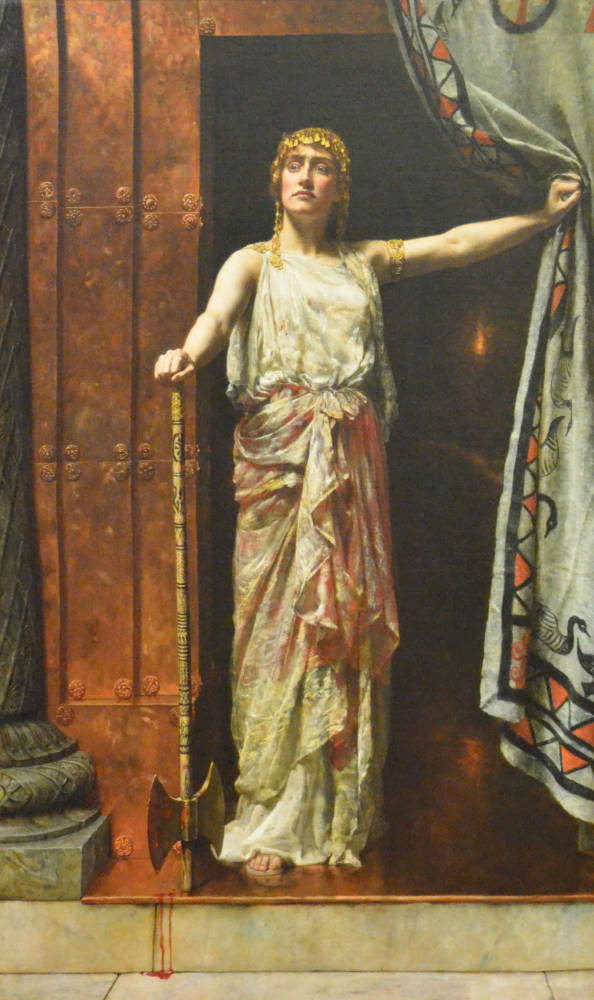 This afternoon I took D. to the Guildhall Art Gallery which had been recommended to me. Mainly Victorian paintings but some good quality works. I was particularly struck by John Collier's "Clytemnestra". In fact I kept going back to look at it again. Highly dramatic. Tells the whole story in one unforgettable image. Collier has made her look proud, immensely strong and slightly deranged all at the same time. Blood dripping off the axe is a nice touch. And behind her is a mysterious light which draws the observer into the murder room in imagination. You feel as if Agamemnon is lying there, just out of your sight. Worth the visit just for that as far as I was concerned. D. was less impressed than me.


