Welcome to our blog!


It's better than a bat in the eye with a burnt stick!


This blog makes liberal use of AB's journals, letters, travel notes, and other sources.


And make sure to visit The Arnold Bennett Society for expert information and comment on all aspects of the life and work of AB.

Showing posts with label Eugene Ullman. Show all posts

Tuesday, 2 February 2021

As usual

Friday, February 2nd., Rue de Calais, Paris.

I went with the two Ullmans to "Fidelio" at the Opera Comique last night. The usual slightly hurried dinner and general excitement in order to get seats. And, the seats being got, the usual exit before the performance to have a cup of coffee in a neighbouring bar. The usual disgraceful physical conditions of the seat - bad air, talkative neighbours, and a very imperfect view of the stage. I believe that a lot of the people who go to the theatre here do so not for the performance but to 'perform' themselves.

I was inclined to change my opinion of the libretto, and to give Beethoven credit for having chosen it not so badly after all. There are situations in it that are genuinely heroic, but which less fine music might have rendered footling. The constant grand beauty of the music is what chiefly affects one in memory after the performance.

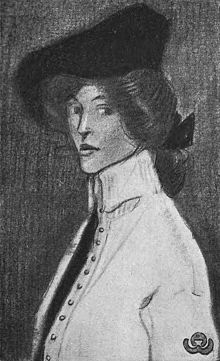
It was a wet and very muddy night. But we walked home because we had need of fresh air after the poison of the theatre. The Ullmans are very agreeable companions. Alice UIlman, formerly Alice Woods is an author and illustrator of some popularity in America and one of the few really intelligent American women I have met here. She is also rather strikingly pretty and was pleasantly attentive to me. I was decidedly envious of Eugene when we parted at their door. As usual!

Friday, 8 March 2019

Elegant women

Monday, March 8th., 37, Clarendon Road, Putney, London.

We left Paris on Saturday at 8.25, traversing hundreds of miles of snow. We are staying briefly with the Kennerleys on our way to Burslem.

Last thing I did in Paris was to visit the Exposition de la Societe des Aquarellistes at George Petit's. I went to pick up some hints about technique. general level very low. Coming out, I met procession of autos depositing elegant women at the door. I doubt if the auto has yet been properly done from the elegant and the purely romantic qualities it has. Then, similar thought to that caused by  the Debussy singer at Ullman's - all those painters having painted for a year to give, ostensibly, momentary pleasure to a few elegant un-understanding persons. Something fine about the notion somewhere. I thought I could work it up for "The Glimpse".

Actresses Postcards ATwo weeks ago, when he wrote to me in Paris, Lee Mathews said he thought he could sell "What the Public Wants" to Lena Ashwell. She is managing the Kingsway as well as appearing herself in the plays. To that end he took me to see Miss Ashwell today and we saw "The Truants", her current production, last evening. It is brightly written, has a splash of melodrama, and makes mild fun of the 'Salome' dance craze. Amusing and rather lightweight I thought for Miss Ashwell who is better suited to playing complex dramatic characters. I hinted this to her and she agreed but confided that the theatre is struggling financially and she needs a popular success. I don't think this will be it.

As at our first meeting I found Miss Ashwell to be in every way extremely attractive. Her voice is pitched low and has a slight vibratory quality which stirs something in me. And her eyes! When conversing with you she looks deeply, and almost without blinking, into your eyes. Hers are large, softly brown, slightly hooded, and entirely captivating. She is in truth a beautiful woman, elegant and understanding. She re-married last year to a medical man, the royal gynaecologist apparently. How much I regret that we did not meet sooner. She seems well-disposed to me, has read my books, and expects "What the Public Wants" to be a great success. What a wife she would have made. I feel quite downcast that her affections lie elsewhere.

Sunday, 29 April 2018

New home

Wednesday, April 29th., Villa des Nefliers, Avon.

The Arnold Bennett Blog: Self awarenessOn Thursday last, the 23rd., we moved into our new house. By Monday morning we were sufficiently straight for me to resume my novel. Tiring but enjoyable to arrange a new home, finding places, establishing systems etc. Not without some loss of temper and disagreement, but nothing significant and I enjoyed the 'making up'. I have a feeling of liberation. Will I write differently out of the city?

Ullman came down yesterday, fresh from the U.S.A. I asked him for his impression: "Is the U.S. a good place to get away from?" He said: "On the whole, yes". Then went on to say that for a visit he thought it would interest me enormously. I think so too. He said that I could form no idea of the amount of drinking that went on there. I disagreed with him on that. No doubt he is exaggerating. I should think that excessive drinking is to be found anywhere except perhaps among the Mohammedans. Probably even there, but more discreetly.

Something I have noticed in myself. A distinct feeling of jealousy on reading yesterday and today accounts of another very successful production of a play by Somerset Maugham - his third now running. Also, in reading an enthusiastic account of a new novelist in the Daily News today, I looked eagerly for any sign to show that he was not after all a really first class artist. It relieved me to find that his principal character was somewhat conventional etc., etc. Curious! I must admit to myself however that I am usually secretly pleased when an acquaintance has some misfortune, and I hate to be told of someone in my social or family circle who has done well. To acknowledge another's achievement with enthusiasm is beyond me.

Tuesday, 14 November 2017

A day in Paris

Monday, November 14th., 4, Rue de Calais, Paris.

Artist Eugene Paul Ullman - FindArtinfoI spent the whole of yesterday en ville. I went to Ullman's Sunday morning reception at his studio, and found some magnificent pictures, and much praise of my books. I particularly enjoyed a watercolour, in muted tones, of a river scene; just the sort of thing I would like to produce myself, but far in advance of my ability. Ullman is an American but lives more or less permanently in Paris. Ten years younger than me but already gaining a significant reputation. He is a very versatile artist - portraits, landscapes, figurative and impressionist. I expect he is not really appreciated in America.

Image result for la scala parisAt 6 o'clock I left. I went to the Cafe D'Orsay, and had a vermouth-cassis, and then I walked all the way by the Seine to Schwob's. He was alone and the chinese servant had been ill and looked sickly. Moreno was away on tour. We were intensely glad to see each other and shook hands with both left and right hands. He was much better and his interest in books had revived. Books were all over the place and he had got a lot of new ones. Ting watched over us while we dined, and Schwob gave me the history of his transactions as to plays with David Belasco. Then he asked if I cared to go out as the carriage was at his disposal. The carriage proved to be a magnificent De Dion cab, and I suppose it belongs to Moreno. We whirled off to La Scala. It was hot and crowded.


Image result for schwob moreno parisSchwob said that he enjoyed music halls and frequented them, and he certainly enjoyed this. Some of the items were very good. He has the habit, which one finds in all sorts of people, of mildly but constantly insisting that a thing is good, as if to convince himself. If I began by saying that a thing was not good, he at once agreed. His taste, though extremely fine, is capricious; it is at the mercy of his feelings.

He whirled me home in about two minutes. I tremendously enjoyed the evening. He was absolutely charming, and his English is so good and sure, and he looked so plaintive and in need of moral support, with his small figure and his pale face, and his loose clothes, and his hat that is always too large for him. Yet I don't know anyone who could be more independent and pugnacious, morally, than Schwob. I have never seen him so, but I know that he would be so if occasion arose.

Wednesday, 19 June 2013

Dark thoughts

Sunday, June 19th., Rue de Calais, Paris.

I was thinking the other day, while reading a very sensual love scene in "Le Lys Rouge", that a novelist never describes the deshabille of the male in such scenes; I can't remember an instance where he even hints at it. This shows how incomplete 'realism' is. I see no reason why the appearance of the male should not be described in a manner to assist the charm of the scene. But tradition is decidedly against the practice.


At first glance, Anatole France's Le Lys Rouge (1894) is a straightforward love story capitalizing on a fin-de-siecle vogue for medieval Italian art. Closer study, however, reveals a mordant satire of contemporaries' aesthetic pronouncements. A regular guest on the salon circuit, France was a privileged witness to contemporary taste and a powerful arbiter of aesthetic trends. Although Le Lys Rouge is a work of fiction, his careful descriptions of fin-de-siecle taste and his sly references to real-life writers, artists, and collectors influenced his readers, while providing twenty-first century scholars with a valuable appreciation of late nineteenth-century French attitudes to art.


I drafted the 7th instalment of "Hugo" yesterday.

The Ullmans and Rickards dined with me; Rickards three quarters of an hour late. Ullman brought out a theory that Wagner, though a great man, was essentially vulgar. He characterised as vulgar all the stage settings on which Wagner set so much store. I would agree as to the "Ring", but not as to the other operas. "Tannhauser" may be, and is, lovely. So is "Tristan". He said that with the same talent Wagner would have been a much finer artist had he been English or French; he was influenced by the fundamental German vulgarity. I could see what Ullman meant, but I thought he was chiefly wrong. However, he argued very well.
See also, 'Parisian Life', April 9th., http://earnoldbennett.blogspot.co.uk/2013/04/parisian-life.html

Later Rickards and I went to the Moulin de la Galette, and saw some good dancing. He leaves this afternoon for London.
See also, 'Parisian Views', October 4th.,  http://earnoldbennett.blogspot.co.uk/2012/10/parisian-views.html

Reading "Le Lys Rouge" tonight. The love scene (Chap. 23) in which Therese tries to rid Decharte of his ideees noires concerning her absolute fidelity to him, is extremely fine in its sensual way. It is just the sort of thing that A. France can do, and it atones for much of the invertebrate quality of the book. If I can accomplish anything as good in "Carlotta" I ought to be satisfied.

I had idees noires myself tonight. There are certainly times when the fact that existence is a choice of evils presents itself too clearly.
Scene from "Cyrano"

I worked from 10 to 6.30 and then dined on the boulevard, and went to see "Cyrano" with Moreno as Roxane. It is a highly elaborate exercise in the obvious, but the verbal and structural adroitness of the whole thing is tremendous. It amused me; I must say that for Rostand. Moreno was coldly distinguished. her diction and her gestures were exquisite. And she had a sore throat and a cough.


See also, 'Parisian Life', September 28th., http://earnoldbennett.blogspot.co.uk/2012/09/parisian-life.html
and 'Parisian evenings', April 15th., http://earnoldbennett.blogspot.co.uk/2013/04/parisian-evenings.html

Monday, 29 April 2013

Self awareness

Wednesday, April 29th., Villa des Nefliers, Avon.


On Thursday last, the 23rd., we moved into our new house, Villa des Nefliers, Avon. By Monday morning we were sufficiently straight for me to resume my novel.


Ullman came down yesterday, fresh from U.S.A. [See also 'Parisian Life' - April 9th. http://earnoldbennett.blogspot.co.uk/2013/04/parisian-life.html ]

I said: "What is your general impression? Is the U.S. a good place to get away from?" He said: "On the whole yes. But for a visit, I am sure it would interest you enormously." He said that I could form no idea of the amount of drinking that went on there. I said I could as I had already heard a great deal about it. He said: "No you can't." He stuck to it, though I tried to treat the statement as an exaggeration, that in the principal clubs everybody got fuddled every night.

Noticed in myself: A distinct feeling of jealousy on reading yesterday and today accounts of another very successful production of a play by Somerset Maugham - the third now running. Also in reading an enthusiastic account of a new novelist in the Daily News today, I looked eagerly for any sign to show that he was not after all a really first class artist. It relieved me to find that his principal character was somewhat conventional, etc., etc. Curious!

Tuesday, 9 April 2013

Parisian life

Sunday, April 9th., Rue de Calais, Paris.

Cornillier called yesterday morning, and I was telling him about a good early picture by Tissot that Ullman had bought for 200 francs.

Pierre-Émile Cornillier (1862-1933) was a French painter and writer . He married Anna Lyon, a U.S. citizen March 20, 1901 in Paris. His workshop was at 21 Rue Guénégaud in the sixth arrondissement. He exhibited for the first time at the show in 1885 and was included in exhibitions of the National Society of Fine Arts until the beginning of the First World War .

He said that a long time ago Tissot had a mistress, with whom he had continued relations for a considerable period. He decided to break the liaison, and he wrote one letter to his mistress, giving her the gentlest possible hint that the affair must ultimately come to an end, and another letter to an intimate friend, a man, saying brutally that he was sick of the thing and wanted to marry. he mixed the letters up, and the mistress received the wrong one. She committed suicide. Tissot was deeply affected, regarded himself as her murderer, and became devot. This was really the origin of his journeys to Palestine, and the ruin of his art.

Jacques-Joseph Tissot was born in 1836, in Nantes in a seaport on the French coast. In 1856 Tissot went to Paris to train as a painter. Here, at the Ecole des Beaux Arts the young Tissot met the young James McNiell Whistler (1834-1903), one of the most celebrated and unusual figures in 19th century art. At about this time Tissot also met, and became a friend of Degas (1834-1917) the Impressionist painter. In 1873, the painter bought the house in St John's Wood where he was to live for the rest of his time in London. In the mid 1870s Tissot met Kathleen Newton (1854-1882), an Irish divorcee with a distinctly colourful past who became his model, muse, mistress, and the great love of his life. In 1882, the desperately ill Kathleen cheated consumption by committing suicide, and Tissot was devastated by his loss, and never really recovered from it.

In the evening I went with Ullman to Antoine, and saw "Les Avaries", which is an extremely good sermon, and an extremely bad play; and "La Parisienne". I was more enthusiastic than ever about the latter. I can recall no portrait of a woman which is at once so true and so brilliant. But what a storm it would raise in England! Henri Becque, one of the greatest dramatists of the nineteenth century, and certainly the greatest realistic French dramatist, died at the close of the century in all the odour of obliquity. His work is now the chief literary topic in Paris; it has indeed rivalled the Portuguese revolution and the French railway strike as a subject of conversation among people who talk like sheep run. This dizzy popularity has been due to an accident, but it is, nevertheless, a triumph for Becque, who until recently had won the esteem only of the handful of people who think for themselves. The most fantastic and the most exotic foreign plays have been performed in England, but I doubt if the London curtain has ever yet risen on a play of Becque's. Once in Soho, a historic and highly ceremonious repast took place. I entertained a personage to afternoon tea in a restaurant where afternoon tea had never been served before. This personage was the President of the Incorporated Stage Society. He asked me if I knew anything about a French play called "La Parisienne." I replied that I had seen it oftener than any other modern play, and that it was the greatest modern play of my acquaintance. He then inquired whether I would translate it for the Stage Society. I said I should be delighted to translate it for the Stage Society. He expressed joy and said the Committee would sit on the project. I never heard any more.
See also, Being 'in it' or 'out of it', December 2nd. <http://earnoldbennett.blogspot.co.uk/2012/12/being-in-it-or-out-of-it.html>

"La Parisienne," which had its first performance in 1885, was for other reasons a bitter pill to the public. Nobody questioned its wit. It was admitted that the diabolically clever dialogue of the first scene, leading up to the thunderbolt discovery of the audience thatLafont is not Clotilde's husband, but her lover, was alone worth the price of admission. But the critics, most of them, thought that Becque had slandered the Parisian woman. Someone said that the title of the play should be changed from "La Parisienne" to "Une Parisienne"; but what the temper of the time could not forgive was the ruthlessness with which Henry Becque tore the veil of romance from illicit love--from adultery, if you please--and put it on the prosaic basis of every-day marriage. That was too much. However, as Mr. James Huneker remarks in his delightful essay on Becque, the conventional naughty triangle of the French theatre, after the presentation of "La Parisienne," was done forever.

I met the Ullmans last year and have become very friendly with them. I meet a lot of Americans at their home, including women who are pretty with an American prettiness; but none of them could be called really intelligent except Mrs. Ullman, formerly Alice Woods an author of some popularity in America. Occasionally I visit Ullman's studio (he has Sunday morning receptions) and there have found some magnificent pictures, and much praise of my books.

Ullman by William Merritt Chase
Eugene Paul Ullman, American painter, born in New York on March 27, 1877; died in Paris, France, on April 26, 1953. His portrait of the Arnold Bennetts at home, with the famous writer in the background playing the piano while his wife reads a book in the foreground, was reproduced in the fourth volume of the novelist’s letters. Bennett mentions in his Journals the news of Eugene’s marriage to Alice Woods, daughter of Judge William Allen Woods of the Seventh District Court, novelist, short-story writer, and a student of Chase’s. It was through her literary connections that he got to know the Bennetts and Margaret Cravens, who in 1911 commissioned him to do Ezra Pound’s portrait.

I enjoyed myself at the theatre and as I walked home, I thought how fine Paris was, and that in old age, or even earlier, if I quitted it, I should look back on these days and perceive that I had been happy.