Sunday, November 8th., 6 Victoria Grove, London.
Dr. Farrar said that the difficulties of diagnosis were much greater than most people imagined. As an instance he stated that in certain cases it was impossible for a doctor to say whether a patient was suffering from consumption or typhoid fever, widely and essentially different though these two diseases were. He told me of the case of a girl he had been called to attend in a 'house of business'. She had a persistently high temperature and eventually was admitted to St. George's Hospital. At length, after a fortnight, just as they were about to put her on an ordinary diet, she was taken with diarrhoea, haemorrhage of the bowels, and other unmistakable symptoms of typhoid fever. He didn't say whether others at her 'workplace' had been affected.
Farrar has become a friend, as well as being my medical advisor. I owe him a significant debt of gratitude. When I first saw him in Putney I had no real career in prospect, but envied those around me who were engrossed in their careers as artists, musicians and journalists. Farrar, after giving me a physical overhaul, administered a mental tonic that had the summary effect of stimulating my self-esteem. He said, sitting back with his stethoscope round his neck and his fingers steepled: "You know, you're one of the most highly strung men I've ever met." I realised that my temperament was that of an artist, in tune with those around me, fine-grained, sensitive, and gifted. It made me take stock of myself and, as it were, re-launch myself after a false start.
Showing posts with label Putney. Show all posts
Showing posts with label Putney. Show all posts
Wednesday, 8 November 2017

Wednesday, 9 April 2014
Done in the eye
Friday, April 9th., Clarendon Road, Putney.
Wednesday. Dinner at Ford Madox Hueffer's. John Galsworthy and wife there. Slight gene on my part on first encounter with Galsworthy, seeing my recent articles on him. However we did well together and he asked me to dinner. Hueffer said that Henry James dictated so slowly that he insisted on his amanuensis having a novel open before her to read while he dictated. He said that Conrad was still as late as ever with his copy.
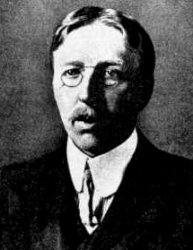
I wonder at myself accepting Hueffer's invitation. Earlier this year he played a dirty trick on me by agreeing with Pinker to buy a short story of mine at a fraction of its worth. He told Pinker that I had originally agreed to do a serial and the short story was by way of some compensation for reneging on this agreement. A pack of lies presented as half-truths. I wrote to him to express my feelings and soon afterwards he invited me to dinner. I replied in sorrow that I could not come to dinner, as I considered that he had done me in the eye over the price of the short story. He wrote to ask me by how much I considered that he had done me in the eye. I answered by at least ten pounds. He sent me a cheque for ten pounds. I attended his dinner. Such is the way the world works.

All these days magnificent weather. East wind having gradually died down. Putney Bridge and High Street at 11 a.m. Talk about road to Delhi. "I met a hundred men on the road to Portsmouth and they were all my brothers" (Indian proverb).
Additionally for April 9th., see 'Parisian life'
Cornillier called yesterday morning, and I was telling him about a good early picture by Tissot that Ullman had bought for 200 francs. He said that a long time ago Tissot had a mistress, with whom he had continued relations for a considerable period. He decided to break the liaison, and he wrote one letter to his mistress, giving her the gentlest possible hint that the affair must ultimately come to an end, and another letter to an intimate friend, a man, saying brutally that he was sick of the thing and wanted to marry. he mixed the letters up, and the mistress received the wrong one. She committed suicide. Tissot was deeply affected, regarded himself as her murderer, and became devot. This was really the origin of his journeys to Palestine, and the ruin of his art.
Wednesday. Dinner at Ford Madox Hueffer's. John Galsworthy and wife there. Slight gene on my part on first encounter with Galsworthy, seeing my recent articles on him. However we did well together and he asked me to dinner. Hueffer said that Henry James dictated so slowly that he insisted on his amanuensis having a novel open before her to read while he dictated. He said that Conrad was still as late as ever with his copy.
The writer Ford Madox Hueffer, now known as Ford Madox Ford, was a prolific novelist, poet, critic, editor, and reminiscer. He is one of the most intriguing, versatile, and often still misunderstood of the great Modernist writers. He was brought up in London, the grandson of Ford Madox Brown, the painter closely associated with the Pre-Raphaelites. At the turn of the century he lived on the Romney Marsh, befriending Henry James and Stephen Crane, and beginning a ten-year collaboration with Joseph Conrad. In the years before the First World War he moved to London, where he founded the English Review, bringing together many of the best established writers of the day – James, Thomas Hardy, Conrad, H. G. Wells, and Arnold Bennett – with his new discoveries, many of whom would help redefine modern literature, such as Ezra Pound, Wyndham Lewis, and D. H. Lawrence. Ford’s best-known and most highly-regarded novel was The Good Soldier (1915). During the war he wrote propaganda; but in 1915 enlisted, serving in France in 1916-17 during the Battle of the Somme and at the Ypres Salient. He was invalided back to Britain in 1917, remaining in the army and giving lectures. After a spell recuperating in the Sussex countryside after the war, Ford lived mostly in France during the 1920s, first in Provence, then in Paris. He published his other major fictional work, the series of four novels known as Parade’s End, between 1924 and 1928. These were particularly well-received in America, where Ford spent much of his time from the later 1920s to his death in 1939.
I wonder at myself accepting Hueffer's invitation. Earlier this year he played a dirty trick on me by agreeing with Pinker to buy a short story of mine at a fraction of its worth. He told Pinker that I had originally agreed to do a serial and the short story was by way of some compensation for reneging on this agreement. A pack of lies presented as half-truths. I wrote to him to express my feelings and soon afterwards he invited me to dinner. I replied in sorrow that I could not come to dinner, as I considered that he had done me in the eye over the price of the short story. He wrote to ask me by how much I considered that he had done me in the eye. I answered by at least ten pounds. He sent me a cheque for ten pounds. I attended his dinner. Such is the way the world works.
All these days magnificent weather. East wind having gradually died down. Putney Bridge and High Street at 11 a.m. Talk about road to Delhi. "I met a hundred men on the road to Portsmouth and they were all my brothers" (Indian proverb).
Additionally for April 9th., see 'Parisian life'
Cornillier called yesterday morning, and I was telling him about a good early picture by Tissot that Ullman had bought for 200 francs. He said that a long time ago Tissot had a mistress, with whom he had continued relations for a considerable period. He decided to break the liaison, and he wrote one letter to his mistress, giving her the gentlest possible hint that the affair must ultimately come to an end, and another letter to an intimate friend, a man, saying brutally that he was sick of the thing and wanted to marry. he mixed the letters up, and the mistress received the wrong one. She committed suicide. Tissot was deeply affected, regarded himself as her murderer, and became devot. This was really the origin of his journeys to Palestine, and the ruin of his art.
Wednesday, 9 January 2013
A picturesque survival
Monday, January 9th., London.
 The "beach" (for it is not a wharf) on the Surrey side of the Thames at Putney Bridge presents one of the most genuinely picturesque sights in London. Moored side by side in rows are a number of barges with their immense brown main-sails furled on the masts. Their rigging, seen as I see it against the panorama of a sunset sky, makes a forest of cordage, above which the little coloured pennants flutter. At all states of the tide the barges are being busily unloaded of their cargoes of yellow bricks and road metal. Shovelfuls of stones and little cubes of brick pass ceaselessly from the enormous holds into the, by comparison, tiny carts, and as each cart is filled a tip-horse attaches itself to it, and with cracking of whips the animals dash up the steep incline to the street.

This seems to go on all day and every day. At high tides the water is over the hubs of the wheels and washing against the chests of the motionless horses ... It is a scene of rapid and healthy activity, and the blue smoke from the cabins of the sailing barges suggests other activities than those seen from the bridge.
In time no doubt all this building and road material will reach Putney by railway or by steamer; at any rate a wharf will be built and served by steam crane; and then this singular survival of an old activity will pass away in its turn, and we shall tell young people that we remember it.

This seems to go on all day and every day. At high tides the water is over the hubs of the wheels and washing against the chests of the motionless horses ... It is a scene of rapid and healthy activity, and the blue smoke from the cabins of the sailing barges suggests other activities than those seen from the bridge.
In time no doubt all this building and road material will reach Putney by railway or by steamer; at any rate a wharf will be built and served by steam crane; and then this singular survival of an old activity will pass away in its turn, and we shall tell young people that we remember it.
Subscribe to:
Posts (Atom)