 On Friday I went to Nottingham under charge of Captain Lloyd, R.N., to inspect a National Projectile Factory. I have written an article on this for the Munitions Ministry propaganda. The press-publicity of the Ministry of Munitions is now in the hands of Sir Hedley le Bas, who did all the recruiting advertising. He was the man behind the famous "Your country needs you" poster. I know him pretty well and when he demands the sacred pen of the novelist it is impossible to refuse. This factory produces 6 inch and 9.2 inch shells. It is turning out 6,000 six inch shells and 2000 9.2 inch shells every week. Just imagine that! And most of the workers here are women. I can't get over the surreal quality of the whole business. All this effort, ingenuity and sheer hard work to make things which are designed to destroy themselves on first use (and incidentally fragile humans who are unfortunate enough to be in the vicinity). What has the world come to?
On Sunday, in dreadful east wind we went to Peldon to see what remains of the Zep. It was worth seeing.
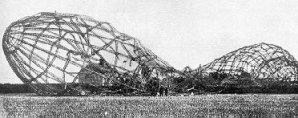
During the afternoon of September 23rd 1916, one of the ‘next generation’ super-Zeppelins, L33, took to the air for its first operational mission: the bombing of downtown London. The L33 was truly a remarkable piece of engineering. She was 649’ long, with a 78 feet diameter and with a total gas capacity of 1,949,000 cubic feet. Six powerful Maybach 240hp Hslu engines gave the lumbering giant a top speed of 59 mph at a maximum operational ceiling of 13,500 feet. Beside its sheer size, what separated the L33 from its predecessor was its bomb load capacity. An impressive five tons of ordinance could be carried.
 Taking part in the London raid was L33, controlled by Alois Bocker. At approximately ten o’clock GMT, L33 flew over Britain’s coast. The huge dirigible was spotted by some local boys near Thames Estuary. From the Estuary, it moved on towards the north east in order to avoid the heavy saturated British defences in the east. At 11:48 pm, Bocker ordered L33’s bombs to be dropped. Six high explosive bombs landed on Hornchurch. Twenty minutes later, the L33 was seen passing West Ham by a couple of street policemen. A little after 12:05 in the morning, London’s powerful searchlights were turned on. The spotters must have seen the sight of the German slow moving dirigible, because an intense ground attack commenced short after. Bocker’s airship was cruising at 12,000 feet following the Ham’s banks when fire erupted. Despite it all, he and his crew kept up L33’s attack all the way up to Bromley-by-Bow, where the gas giant dropped its main ordinance. One 100kg bomb and five small, incendiary bomblets landed on St. Leonard’s and Empress Streets. Four urban houses were damaged and six people were killed on this early stage of the raid. L33 went on to deliver several more bombs in and around Bow. But by this time, the airship was shadowed by British defences. Low trajectory shells began to find its mark. Several fragments of high detonation shells exploded only a few feet away from the ship’s skin puncturing one gas cell.
  Now the big air platform was in trouble. It began losing altitude fast. At 12:20 am, L33 was seen crossing Buckhurts Hill, leaking gas. Besieged by heavy ground fire, and declining altitude, Bocker decided to dump water from the ship’s ballast tanks, which caused the L33 to regain some of the height it had lost but the damage was done. Near Kelvedon Common, a new and more ominous threat arrived: a British pursuit airplane. Second Lieutenant Alfred de Bathe Brandon was ready for the opportunity to engage the German ship. Brandon met L33 head on, emptying his Lewis gun, fifty explosive incendiary bullets, into the airship’s stern section. He swung around and hit the stern again, but his gun jammed forcing him to call off the engagement. L33 escaped, at least for the moment. It was now 12:45 and the dirigible was passing by Chelmsford, still losing precious high. In an attempt to stem the descent, all non-essential materials aboard were jettisoned. Twenty five minutes after, at 1:10, Bocker’s ship passed over the Essex coastal area near Mersea Island. Its destination was the security of the Belgium skies. Unfortunately for Bocker and his crew, L33 was doomed. The Zeppelin was almost out of gas, losing altitude fast and its structure was compromised. It would go down and the only question for Bocker was where. Two and a half miles inland, at 1:20am, L33 went down on a deserted field near Peldon and Little Wigboroug church. The crew managed to escape before the gas giant was engulfed in a fire storm. Soon after the fire died down, and with the metal frame still standing, Bocker ordered his men to climb back into what was left of the super-Zeppelin to destroy any classified material. Despite their best efforts, the British still were able to gather many essential documents and systems out of the wreck. As for the dirigible’s debris, they were studied by engineers for days. After authorities were satisfied that every drop of information was collected, the ship’s frame was burned to the ground.
http://www.century-of-flight.freeola.com/Aviation%20history/airplane%20at%20war/upload2/bombing%20by%20Zeppelin%20airships.htm


