Welcome to our blog!


It's better than a bat in the eye with a burnt stick!


This blog makes liberal use of AB's journals, letters, travel notes, and other sources.


And make sure to visit The Arnold Bennett Society for expert information and comment on all aspects of the life and work of AB.

Showing posts with label Churchill. Show all posts

Sunday, 2 December 2018

To the Other Club

Thursday, December 2nd., Cadogan Square, London.

As I had not got my ideas clear for the next chapter of the novel, I went out for a walk after finishing correspondence and oddments, and walked to the XXI Gallery in Durham House Street, Strand. I found my idea all right. The gallery is very dark, appropriately in the circumstances as it has an exhibition of Cosmo Clark's pictures of the Black Country. I wasn't awfully pleased with them, but I bought one because I had known Cosmo as a baby and was an old friend of his father's.

10 best London 1920's images on Pinterest | Old london ...I walked all the way to the Savoy Hotel for the dinner of the Other Club. Birkenhead came in, and we were very affable to one another, and everybody laughed about the just-finished scrap between us in the Daily Mail. Afterwards he was most friendly and asked me to lunch with him alone. Reading was in the chair and the dinner was the most agreeable that I remember of this Club. I sat next to Charles Masterman and opposite Alf Mason, and we had a great time. Afterwards I went and sat next to Jim Garvin. He talked exceedingly well, and is full of knowledge and ideas. Churchill and Jack Seely came in very late, long after dinner. Churchill said to me: "Receive the congratulations of Tom Hogarth" (over my row with Birkenhead). There was a great deal of "Raingo" throughout the evening.

Friday, 24 November 2017

Getting about

Thursday, November 24th., Cadogan Square, London.

Image result for welsh miners 1927 cookChores this morning after some letter writing. I had some trouble concentrating as my mind kept turning to the unemployed miners who arrived in London yesterday having walked 180 miles from the Rhondda Valley. Baldwin refused to meet them. Later there was a rally in Trafalgar Square - they marched to the Square carrying lighted lamps, knapsacks and mugs, and supported by brass and fife bands. I wish had had been there to see it. Apparently Arthur Cook, Secretary of the Miners' Federation, told them that "unless the government faces up to the problem of unemployment, a revolutionary situation will be created in this country which no leader will be able to withstand." Strong words for strong men but unlikely to move Baldwin who has probably never seen a mine. I don't suppose anything will come of it. The people in this country are too docile and well fed.


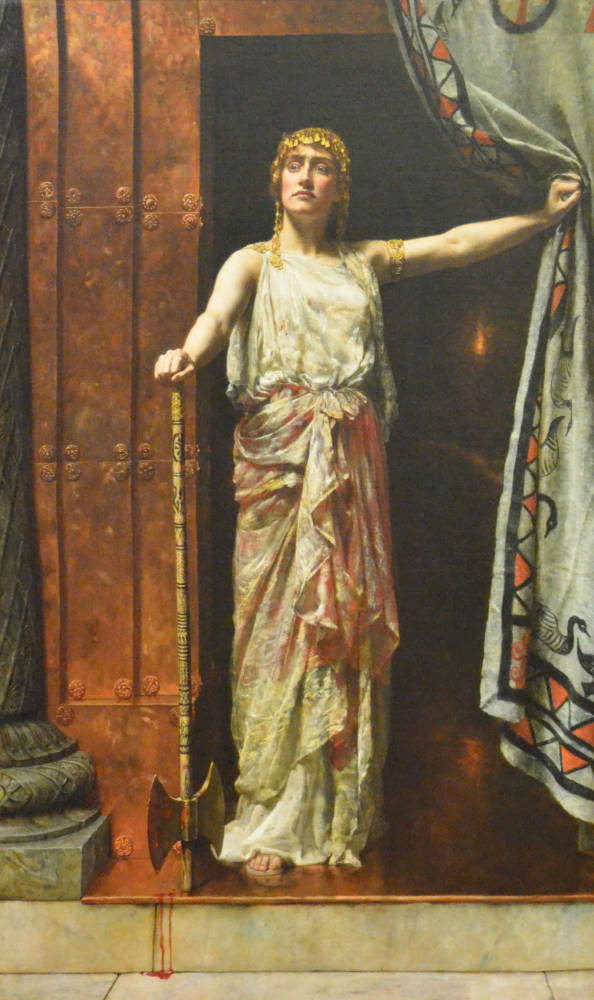
Image result for collier clytemnestraThis afternoon I took D. to the Guildhall Art Gallery which had been recommended to me. Mainly Victorian paintings but some good quality works. I was particularly struck by John Collier's "Clytemnestra". In fact I kept going back to look at it again. Highly dramatic. Tells the whole story in one unforgettable image. Collier has made her look proud, immensely strong and slightly deranged all at the same time. Blood dripping off the axe is a nice touch. And behind her is a mysterious light which draws the observer into the murder room in imagination. You feel as if Agamemnon is lying there, just out of your sight. Worth the visit just for that as far as I was concerned. D. was less impressed than me.


Image result for lord birkenhead
Lord Birkenhead
Went to the Savoy this evening for "The Other Club" dinner in the Pinafore Room. 15 minutes late which is regarded as rather bad form. Alfred Mason in the chair. I sat near to Lutyens, Jos Wedgwood, Hamar Greenwood, Birkenhead, William Berry and Anthony Hope. I had some sparring with Birkenhead, rather loud and abusive, but good natured. However, I could be just as abusive as he could. It was Birkenhead (F.E. Smith as he was then) who founded the club with Churchill. They put it about that it was because the old clubs would not accept them. Too brash. I don't believe it myself - they are both arch self-publicists. Supposed to be a limit on the number of politician members, but it seems to have been forgotten. I should have asked Birkenhead if he had spoken at the rally. He would have had apoplexy.

Thursday, 29 May 2014

War talk

Saturday, May 29th., Comarques, Thorpe-le-Soken.

On Thursday I sent off first copy of first half of "The Lion's Share".

London yesterday for the day. New English Art Club. Very interesting watercolours of Steer, etc.

Painswick Beacon, Wilson Steer, 1915
It is in relation to the Royal Academy that much of the development of the New English has been seen. The origin of the Club was in the studios of a group of young London artists in 1885. These painters had studied and worked in Paris, and felt a dissatisfaction with the exhibition potential of the very academic R.A. which was under the presidency of Sir Frederick, later Lord Leighton It was decided to mount a rival show, so in April 1886 the first exhibition of the New English Art Club was organised at which about fifty artists were represented, including Fred Brown, George Clausen, Stanhope Forbes, J.S. Sargent and Wilson Steer. Thus the scene was set: the stolid academic approach of the R.A. as opposed to the dynamic and vibrant observation of the New English - a caricature of course, as are all such comparisons. However, it is remarkable that the artistic descendants of the Impressionists continued to be associated with the New English whilst the R.A. moved by fits and starts towards a more conceptual approach and towards public gallery orientated work. During the late 19th and early 20th century the New English grew greatly in influence, and the days of Sickert, Augustus John, Tonks, Steer and William Rothenstein were a golden period indeed. In the 1920's Stanley Spencer, Paul Nash, Duncan Grant and Mark Gertler were all members - indeed almost every member of the Camden Town Group started with the New English, and it formed an essential part of their development.

Lunch with Mair at Garrick Club. Mair said that Princess Irene blew up with 300 mines on board. 

HMS Princess Irene
At about 11.14 on the morning of 27th May 1915, Sheerness witnessed the destruction of the minelayer HMS Princess Irene which was on No.28 buoy about 3 miles WSW from the town centre. The ship had been built in Scotland in the previous year to the order of the Canadian Pacific Railway Company but was requisitioned and converted for Naval use before she could sail to the Pacific. The Princess Irene had a complement of 225 officers and men, three of whom were ashore that morning as the mines were being primed on the ship's two mine decks. Also on board were a party of 80 or so Petty Officers from Chatham in addition to 76 Sheerness Dockyard workers who were completing tasks prior to the ship's planned departure to lay her mines on 29th May. Without warning, the ship was blown to pieces and her remains, and the remains of those on board, were scattered over a wide area of the surrounding river and countryside. One of the Chatham Dockyard workers, David Wills, amazingly survived the explosion but few bodies were found. Those that were located were buried in Woodlands Cemetery in Gillingham. A memorial to those lost in both this and the Bulwark disaster is situated opposite Sheerness Railway Station. The cause of the disaster was thought to have been due to a faulty primer (pistol)although evidence at the Official Enquiry showed that the work of priming the lethal mines was being carried out a) in a hurry and b) by untrained personnel.

He said that whereas Fisher went to bed at 10 and rose at 5, Churchill would come to the Admiralty after dinner. Churchill sent in a telegram to be approved by Fisher; Fisher declined to approve it. On the intermediary suggesting that instead of sending a blank refusal he should draft a new telegram, he did so.

Mair said that Sir John Simon was going to be much more strict with the censorship, and that it was intended to prosecute The Times. He also said that Fisher on being appointed ordered 300 craft of various sorts. One firm alone made 24 light cruisers. There are special craft for going up the Danube, and special monitors for running over mine fields to attack Cuxhaven.

Churchill and Fisher
Admiral of the Fleet John Arbuthnot "Jacky" Fisher, 1st Baron Fisher, (1841 – 1920) was a British admiral known for his efforts at naval reform. He had a huge influence on the Royal Navy in a career spanning more than 60 years, starting in a navy of wooden sailing ships armed with muzzle-loading cannon and ending in one of steel-hulled battlecruisers, submarines and the first aircraft carriers. The argumentative, energetic, reform-minded Fisher is often considered the second most important figure in British naval history, after Lord Nelson. Fisher is primarily celebrated as an innovator, strategist and developer of the navy rather than a seagoing admiral involved in major battles, although in his career he experienced all these things. When appointed First Sea Lord in 1904 he removed 150 ships then on active service which were no longer useful and set about constructing modern replacements, creating a modern fleet prepared to meet Germany during World War I. He first officially retired from the Admiralty in 1911 on his 70th birthday, but became First Sea Lord again in November 1914. He resigned seven months later in frustration over Churchill's Gallipoli campaign, and then served as chairman of the Government's Board of Invention and Research until the end of the war.

Additionally for May 29th., see 'Parisian culture'

He took me yesterday afternoon to make the acquaintance of the Godebskis at Valvin. Husband, wife, two small kids. Poles. Among the most charming people I have ever met. Purely artistic. Godebski once owned and edited a little review. Looks like a Jew but is not one. I saw on a table a copy of Mallarme's "Divagations", with the envoifrom the author "A son vieil ami, Godebski". Not interested in anything but artistic manifestations. I said I had gas and they hadn't. Godebski said he didn't like gas lamps. I said: "For cooking." "Yes", he said, carelessly, "but with alcohol and oil they can manage." Didn't care a damn about inconveniences. A whole crowd of artistic youth there; various French accents. A picturesque, inconvenient house, full of good and bad furniture in various styles. A large attic with rafters formed the salon; a good grand piano in it.

Sunday, 9 March 2014

Authenticity

Wednesday, March 9th., Cadogan Square, London.

This morning before noon I finished reading what I had done of "Accident" and I decidedly liked it. It seemed to me to be sound and interesting; of course old-fashioned - at least I suppose so.

Then I walked up to the Reform, and got there early. I lunched with Page, Gardiner, Roch and two others. Discussion of Churchill's book. Everyone praised it as a tour de force, but said it was by no means always honest, and certainly wasn't history, inasmuch as it was obviously written to prove that Churchill had been right throughout the war. Personally, I think it is a bit better than that. I regard it as a remarkable achievement. 

As First Lord of the Admiralty and Minister for War and Air, Churchill stood resolute at the centre of international affairs. In this classic account, he dramatically details how the tides of despair and triumph flowed and ebbed as the political and military leaders of the time navigated the dangerous currents of world conflict. Churchill vividly recounts the major campaigns that shaped the war: the furious attacks of the Marne, the naval manoeuvres off Jutland, Verdun's "soul-stirring frenzy," and the surprising victory of Chemins des Dames. Here, too, he re-creates the dawn of modern warfare: the buzz of airplanes overhead, trench combat, artillery thunder, and the threat of chemical warfare. In Churchill's inimitable voice we hear how "the war to end all wars" instead gave birth to every war that would follow. Written with unprecedented flair and knowledge of the events, The World Crisis remains the single greatest history of World War I, essential reading for anyone who wishes to understand the twentieth century.

I came home by bus and slept. I felt gloomy. I hadn't really begun to get my ideas in order for proceeding with my novel. Then I read the newest fiction. Priestley's "Adam in Moonshine" and Romer Wilson's "latter Day Symphony", and I at once wrote paragraphs about them to go into a future Standard article. Poor and pretentious stuff, I thought. Nothing original in them. But Elizabeth Madox Roberts's "The Time of Man" (American - sent to me by Doran) seems to me to be pretty good authentic fiction. A very different affair from the other two.

Friday, 5 April 2013

A parliamentary occasion

Friday, April 5th., Yacht Club, London.

Yesterday I was at the House of Commons.
Lloyd George's introduction of Man Power Bill, for conscripting Ireland and raising military age etc. See also 'War Nerves' - March 27th. <http://earnoldbennett.blogspot.co.uk/2013/03/war-nerves.html>


From early 1918, the British Army were dangerously short of troops for the Western Front. In addressing this grave military situation, Prime Minister David Lloyd George and his coalition Government decided to extend conscription to Ireland and to additional older men and workers in Britain, conscription in Great Britain having started in January 1916. The goal was to reach into an untapped reservoir of manpower through a new Military Service Bill. The intent was to connect the conscription legislation to a new Home Rule Bill. This had the effect of alienating both nationalists and unionists in Ireland. Despite opposition from the entire Irish Parliamentary Party, conscription for Ireland was voted through at Westminster. Though large numbers of Irishmen had willingly joined Irish regiments and divisions of the New British Army at the outbreak of war in 1914, the likelihood of enforced conscription created a backlash. The linking of conscription and Home Rule outraged the Irish nationalist parties at Westminster, who walked out in protest and returned to Ireland to organise opposition. Although the crisis was unique in Ireland at the time, it followed similar campaigns in Australia (1916–17) and Canada (1917)

Policeman looks at card outside. Then you go up in a lift. Through an outer room with one or two journalists, hat pegs, etc. Then an inner room, with two Morse instruments tapping, and then into Gallery, at entrance of which your ticket is looked at again by an official (very friendly with all reporters, and doing their little errands etc.) in evening dress with large insignia on his breast.
Two rows of seats with narrow desk all round. A few standing at either corner, including Spender, (see also 'Writing for Victory - Sept. 3rd. http://earnoldbennett.blogspot.co.uk/2012/09/writing-for-victory.html and 'Writers for Peace - Feb. 11th. http://earnoldbennett.blogspot.co.uk/2013/02/monday-february-11th.html ) Gardiner and me. Reporters passing in and out all the time, crushing past; a horrible lack of space. No light in House of Commons except through glass roof. No repose in Press Gallery. Sharp corner of elaborate wood carving against which you knock your head if sit or lean in corners. Glimpse of Ladies' Gallery above, with glimpse of a smart woman, past first youth, with complexion soigne but going.

Lloyd George and Churchill

Looking from left, I could just see Ll. G., Churchill, Bonar Law, Cecil, Balfour etc., on right. House full. 12 or so standing between cross benches. (Gallery opposite full. Side galleries half full.) Two M.P.s wearing hats. As the M.P.s left they bowed awkwardly to Speaker in getting up if in front rows or on reaching central space if not; and on coming in they bowed either on entering, or on reaching open space. Speaker under a canopy.


Cheap effects of Ll. G. looking round as if challenging; trick of dropping his voice for last, rather important word of sentence. Unpleasant Noncomformist voice. He did not know his case, and having made a muddle deliberately left the muddle. Truisms about values and will-to-win cheered. Proposal to conscript Ireland loudly cheered a long time by Tories. No applause as he sat down.

Herbert Asquith


The whole thing a vast make-believe, with an audience of which a large part was obviously quite unintelligent and content with the usual hollow rot. Ll. G.'s oratorical effects very poor - like a Lyceum melodrama. Asquith with long hair very dignified, at home, persuasive.

Sunday, 11 November 2012

Remembrance

Sunday, November 11th., London.

I walked out and 'saw' the Two Minute Silence from inside the lobby of the Court Theatre. When I saw old gents standing two minutes  in that perishing wind, hatless, I was glad I'd come inside.


The idea for a Remembrance Day silence was first suggested by Australian journalist Edward George Honey in a letter to The Times in May 1919. He was thinking of a five-minute silence but that was thought too long. One minute was deemed too short. On 7th November 1919, King George V issued a proclamation asking that: "at the hour when the Armistice comes into force, the 11th. hour of the 11th. day of the 11th. month, there may be for the brief space of two minutes a complete suspension of all our normal activities... so that in perfect stillness, the thoughts of everyone may be concentrated on reverent remembrance of the glorious dead."

I read the "Memoirs of Max of Baden", and learned something about Germany in the war.

Then to Stornoway House to dine with Beaverbrook. Dean Inge and wife, Churchill and McKenna were the other guests. The gloomy dean was not at all gloomy. 


William Ralph Inge was known to the public as ‘The Gloomy Dean’ for the sharp cultural criticism of his columns in the Evening Standard. He was a passionate Christian Platonist known in the academy for his work on mysticism, Plotinus and a synthesis of Christianity and Platonism. Inge wrote over thirty-five books in the areas of mysticism, Christianity, Platonism, ethics and contemporary issues. A number of his books were collections of his essays, including two series of Outspoken Essays, a title that betrays much about its author. For Inge was a controversialist, even a contrarian. In theology he was a liberal, in politics something of a reactionary. A supporter of animal rights and the arts (serving as trustee of the National Portrait Gallery from 1926 to 1951), he was a constant critic of the state of modern civilization, particularly in its democratic form. It was this criticism in the form of regular columns in the Evening Standard (1921–1946) that earned him his reputation as ‘The Gloomy Dean’.


 We all went to the Armistice Festival organised by the Express at the Albert Hall; we had the box next to the King, Queen, and Co. This affair was very impressive indeed.


Thousands of former soldiers and 1,000 widows and other women in deep mourning attended the Remembrance Festival at the Albert Hall. There was an ovation when a fanfare of State trumpets announced the arrival of the King and Queen, who were accompanied by the Duke and Duchess of York. A trench ran down the centre of the hall, and the stage was fashioned to represent a dugout, giving point to the community singing of such wartime favourites as "Tipperary," "Keep the Home Fires Burning," and the old-time catchwords which were shouted across the hall, such as "Are we downhearted?" and the thunderous answer "No!" These were lighter episodes, but deeper emotions were stirred when the lights were dimmed and such memorial music as Chopin's "Funeral March" was played by the massed Guards' bands, and the hymns "O God Our Help in Ages Past" and"Abide With Me" were sung. The festival ended with the sounding of the Last Post and the Reveille. Earl Jellicoe made an impressive appeal to the vast assembly to renew the pledges to keep the spirit of comradeship which won the war for the Allies, while working unceasingly for peace, so that such horrors would never be repeated.


In argument on finance, McKenna knocked Churchill to bits. The financial debate between the Chancellor and the ex-Chancellor was very diverting. I left at midnight.
I enjoyed this evening. It woke me up.