Monday, February 12th., Hotel Savoy, Cortina d'Ampezzo, Italy.
Woke to a clear blue sky and a hard frost. Perfect day for a good walk and I seized the opportunity. Out just after 9 o'clock. Invigorating chill in the air. I noticed the satisfying crunch of the frost-frozen mud as I put my weight into each step. And no adhesion to the sole of the boot. In fact my boots were cleaner when I got back than when I set off. A good long walk is just the thing for someone of a thoughtful disposition. I suppose some would say that it was a waste of valuable working time, and I might myself in my younger days. But not now. There is nothing like a solitary walk in the countryside for getting ideas. And one really good idea is worth any amount of time labouring with second class ideas at the desk.
I wish I had more knowledge about nature and the countryside. Of course it's not important to be able to name birds and animals, the thing is to enjoy them 'in the moment' as it were. But there is a stubborn part of me that wants to know what they are. My knowledge is abysmal! It occurred to me today that I don't even know what the difference is between moss and lichen. Why does one grow where it does and not the other? And birds ... I saw a bird of prey swooping and diving over a field, obviously hunting. I don't think it was a kestrel but what was it? A bit depressed by my ignorance, but content overall. Especially as I had a grand sleep this afternoon.
I want to write one more article for the Evening Standard before we leave here; but I don't seem to be able to get any leading idea for it, except that of slating one or two of my young friends, such as William Gerhardi. I did get the first inkling of an idea this morning, something about the 'reforming' inclinations of our imaginative writers, like Wells and Huxley, but it needs development.
I read a lot more of Castellane's "Memoirs". There are still very good things in it, though some pages are tedious and even absurd. And all the criticisms of his wife are a mistake. After all he lived with her for twelve years and had two children by her. When you have done that you ought to leave a woman alone.
Showing posts with label Aldous Huxley. Show all posts
Showing posts with label Aldous Huxley. Show all posts
Monday, 12 February 2018

Tuesday, 6 February 2018
Snow jumps
Sunday, February 6th., Hotel Savoy, Cortina d'Ampezzo. Italy.
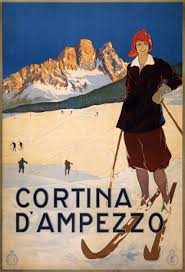
Didn't get out unitl 11.30 and we had lunch at noon in order to go to the International Ski-jumping competition, two miles off. We took the Huxleys. Frost, overcast. We drove there in a small sleigh, but had to walk at the end up hill about half a mile to get to our tribune, upon which we got excellent seats. The tribunes are built on poles down the 45 degree snow slopes of the jump. It looks terrifying.
The Scandinavians were the best and the Italians the worst, but there were exceptions. Apparently the jump dates from 1923 and was named after the hotel owner and financial supporter of its construction. In 1926 the jump was enlarged and jumps over 50 metres are now possible. We saw some today. The first jump gives you a great thrill but you soon get used to it, when you perceive that the chances of a serious accident are trifling. Mind you, you wouldn't get me doing it for any money. The swiftest of them you can hear hurtling through the air. I tried to watch the faces of the competitors as they flew past us and above me. On the whole they seemed fairly calm and set. Might just be rigid with terror!
I read an article in the Times Literary Supplement on "Re-reading Walter Pater", and found in it no reason why I should re-read Walter Pater. Huxley agrees with me.
For some reason I was struck whilst we were out there in the cold and snow by a new thought about sensory perception; in fact it came to me first when we were in the sleigh and I was looking about. All we really see are shapes and colours more or less in a blur until our eyes focus on something and we then identify it to ourselves. But we have seen it in an immediate sense before we 'know' what it is. So our bodies as it were are on a general look-out but our minds only get involved when something causes our eyes to focus. It's not a conscious process. Really our minds are more or less constructing the world out of a mass of sensory perceptions. I was talking to the Huxleys and Dorothy about this in a general way, though I don't think I conveyed my meaning very well. In fact I'm not too sure what my meaning is. And I made the suggestion that what the abstract painters are trying to do is to get back to the fundamentals of perception, shapes and colours. Aldous seemed interested but the women found it all a bit airy-fairy. In my experience women prefer tangible concepts.
Saturday, 27 January 2018
Winter sport
Thursday, January 27th.,, Hotel Savoy, Cortina d'Ampezzo, Belluno, Italy.
I began to have vague ideas about work today, partly due no doubt to Aldous Huxley's remark that he always began to pine away after only a few days of complete holiday from work. The Huxleys have a place nearby, and are excellent companions. Of course I have had lengthy periods of doing no work in the past but my expenses are considerable and I must work to earn. Nearly sixty now and should be able to relax a bit but, having acquired a new 'wife' and child, and still supporting the old one, I see little prospect of respite. Can't complain. As I often remark, "the best is good enough for me", so I must earn to maintain the style of life to which I have become accustomed. Sometimes (in fact quite often) I think back though to simpler times and wonder if it is all worth the effort. In a way we become prisoners of our own narrative!
At 3 p.m. today we set off to see the finsh of the bob-sleigh match. Nothing much to see at the end of the 'Pista da Bob' except the ducal party standing and sitting on a rough platform of boards. This is the Duke of Genoa with his two sons, Dukes of Padua and Pistoia, who arrived yesterday, with certain ladies. Not sure if the latter are some species of duchess. Suspect not. They have a table in the corner of the restaurant, and are waited on by the Head Waiter. Later they came into the ballroom, the national anthem or something veing played at their entrance therein. The young dukes danced a bit, one of them with a hotel visitor. She seemed charmed. They seemed bored. The Duke of Genoa is very old, with a hatchet sharp face, and he seems to chew all his food, at great length, with his front teeth. Gives the appearance of a rat eating a piece of wood. But apparently a decent fellow. I don't quite know how all the old aristocratic forms fit into the Mussolini regime.
Anyway at intervals a 'bob' swept round the corner and drew up past the winning post, where men sat at a table in the sharp frost writing down times and numbers in a book. The skiing practice of village boys on a neighbouring slope was much more amusing. Fortunately this spot was close to the Huxley's cottage. We were bidden ther for tea, and arrived before 4, and played make-believes with the two kids and Matthew's mother.
Sunday, 23 September 2012
Visit from Huxley
Tuesday, September 23rd., London.
Aldous Huxley came yesterday afternoon to do what he had called on the telephone 'pay his homage'. He looked older and more distinguished. His clothes seemed to be Italian and in material if not in fit very nice. Altogether he looked better and talked more easily. We agreed on nearly all literary questions except the value of his "Antic Hay". He likes that book, thinks it has a point to it.

He seems to agree with my few criticisms of "Uncle Spencer". He said his wife had driven him in a Citroen from Florence to Ostend, over the Alps etc. Said she was mad about driving and a bit inclined to be a speed-merchant. He told me some funny tales about Fascism. One friend of Mussolini's made 40 million lire in two years. He had four very big motor cars of the .......... Company. It was found out that in exchange for these cars he had let the company off taxation for two years - had promised to do so and had done so. The consideration for this great act seems rather trifling to me. Also he insisted on an edict enforcing the little red glass reflectors on the backs of bicycles. The Cabinet was not in favour of it, but he got it through, apparently behind their backs. I told Aldous there was bound to be a big rumpus in Italy soon. He thought there was too, but he couldn't see quite what was to be done against 400,000 well-armed Fascists, the only power in the country.

I asked Aldous to come early and he came early. After one and a half hours I had to tell him I had to go out. So he left. very agreeable meeting, this was.
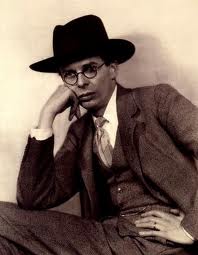
Aldous Huxley came yesterday afternoon to do what he had called on the telephone 'pay his homage'. He looked older and more distinguished. His clothes seemed to be Italian and in material if not in fit very nice. Altogether he looked better and talked more easily. We agreed on nearly all literary questions except the value of his "Antic Hay". He likes that book, thinks it has a point to it.

Most people know Aldous Huxley only from having read his Brave New World (1931). It's a good novel, but it's not really a fair representation of what Huxley the novelist was all about. Huxley began his career as a satirist, and Antic Hay is a dark and vicious look at the poseurs and pseuds inhabiting London's bohemian world just after WW I. It follows a half-dozen or so characters who form a kind of sampler pack of bohemians; there's Mercaptan the effete, womanizing writer of irrelevant scholarly articles; Lypiatt the blustering, self-important artist; Coleman the bombastic hedonist; and Theodore Gumbril, the main character, a dissatisfied intellectual who quits his teaching job to pursue a fatuous scheme to invent and sell trousers containing an inflatable seat for added comfort. The women in the group include Myra, a dark muse to two of the male characters, and Rosie, a bored housewife. The plot is a kind of dance in which various characters pair off for an hour, an evening or a day to expound their beliefs, strike intellectual poses or seduce each other. More often than not they come across as monstrously affected, self-absorbed and pretentious. Although Huxley's intention is satirical (characters are given ludicrous names like Bruin Opps), the novel has a dark edge that makes it more than just a benign jab at some ridiculous personalities. Myra appears to be a casually cruel, cold-hearted beauty, but Huxley shows that she's been terribly damaged, like so many others, by the death of a loved one in the war. Similarly, Lypiatt initially comes across as a buffoon, but at the end of the novel he comes to a devastating realization that his artistic life has been a failure and a farce. The last we see of him he's probably on the verge of blowing his brains out. Something that all the characters share is a realization that the world has changed profoundly and that there are no certainties or truths to anchor themselves to anymore. The nineteenth century ended with WW I, and the years following the war saw a sea change in the arts, fashion, politics and music. Huxley's characters are lost in this new world and their eccentric behaviour can be seen as a way of dealing with the stress of these changes. Huxley's writing also reflects the changes going on at the time. On the one hand he flaunts his classical education with references and quotes from Greek and Latin, but on the other hand he abandons a traditional plot structure in favour of something more freewheeling and unpredicatable. Antic Hay is a mostly amusing novel, although at times Huxley's erudite style can be grating, and the changes in tone from comic to serious to philosophical aren't always managed well. The strength of the novel lies in Huxley's ability to tease out the fear and uncertainty at the heart of his main characters. The spirit of the novel is captured best in this passage:
"And besides, when the future and the past are abolished, when it is only the present instant, whether enchanted or unenchanted, that counts, when there are no causes or motives, no future consequences to be considered, how can there be responsibility, even for those who are not clowns?"
He seems to agree with my few criticisms of "Uncle Spencer". He said his wife had driven him in a Citroen from Florence to Ostend, over the Alps etc. Said she was mad about driving and a bit inclined to be a speed-merchant. He told me some funny tales about Fascism. One friend of Mussolini's made 40 million lire in two years. He had four very big motor cars of the .......... Company. It was found out that in exchange for these cars he had let the company off taxation for two years - had promised to do so and had done so. The consideration for this great act seems rather trifling to me. Also he insisted on an edict enforcing the little red glass reflectors on the backs of bicycles. The Cabinet was not in favour of it, but he got it through, apparently behind their backs. I told Aldous there was bound to be a big rumpus in Italy soon. He thought there was too, but he couldn't see quite what was to be done against 400,000 well-armed Fascists, the only power in the country.
Benito Mussolini in 1919 described fascism as a syncretic movement that would strike "against the backwardness of the right and the destructiveness of the left". Later the Italian Fascists described fascism as a right-wing ideology in the political program The Doctrine of Fascism, stating: "We are free to believe that this is the century of authority, a century tending to the 'right,' a fascist century."
However Mussolini clarified that fascism's position on the political spectrum was not a serious issue to
fascists and stated that:

"Fascism, sitting on the right, could also have sat on the mountain of the centre ... These words in any case do not have a fixed and unchanged meaning: they do have a variable subject to location, time and spirit. We don't give a damn about these empty terminologies and we despise those who are terrorized by these words."
I asked Aldous to come early and he came early. After one and a half hours I had to tell him I had to go out. So he left. very agreeable meeting, this was.
Aldous Leonard Huxley (26 July 1894 – 22 November 1963) was an English writer and one of the most prominent members of the famous Huxley family. Best known for his novels including Brave New World and a wide-ranging output of essays, Huxley also edited the magazine Oxford Poetry, and published short stories, poetry, travel writing, film stories and scripts. Huxley spent the later part of his life in the United States, living in Los Angeles from 1937 until his death.
Subscribe to:
Posts (Atom)