Welcome to our blog!


It's better than a bat in the eye with a burnt stick!


This blog makes liberal use of AB's journals, letters, travel notes, and other sources.


And make sure to visit The Arnold Bennett Society for expert information and comment on all aspects of the life and work of AB.

Showing posts with label Balzac. Show all posts

Thursday, 7 November 2019

Orlando

Thursday, November 7th., Chiltern Court, London.

Well, I have read Virginia Woolf's "Orlando" and hope thereby to keep my end up more successfully in middle-brow circles.

Woolf in the World: A Pen and a Press of Her Own: Case 11a ...It is a very odd volume. The novel, which is a play of fancy, a wild fantasia, a romance, a high brow lark, is illustrated with ordinary realistic photographs, including several of Vita Sackville-West, to whom the book is dedicated. The portraits of Miss V. S-W are labelled "Orlando". I draw no particular conclusion from this, though certain rumours have been brought to my attention. Who knows why Mrs. Woolf has decided to indulge herself in this way and whether she has some objective in view vis-a-vis her relationship with Miss S-W.

Portadaorlando.jpgOrlando at the end of the book has attained an age of some four centuries, which reminds one of the Wandering Jew and the Flying Dutchman. Halfway through the story he changes into a woman - and 'stays-put'. Which reminds one of "Seraphita", the dullest book that Balzac ever wrote. I surmise that Orlando is intended to be the incarnation of something or other - say the mustang spirit of the joy of life, but this is not quite clear to me; in fact it is as clear as mud. The first chapter is goodish. It contains vivacious descriptions of spectacular matters such as a big frost, royal courts, and the love-making of Orlando and a muscovite girl in furs and in the open air amid the fiercest frost since the Ice Age. Mrs. Woolf almost convinces us of the possibility of this surely very difficult dalliance. The second chapter shows a startling decline and fall-off, and succeeding chapters are still more tedious in their romp of fancy. Mrs. Woolf does not seem to understand that fancy must have something to play on. I shall no doubt be told that I have missed the magic of the work. The magic is indeed precisely what I have missed.

The theme is a great one. But it is a theme for Victor Hugo, not Virginia Woolf who, while sometimes excelling in fancy and in delicate realistic observation, has never yet shown the mighty imaginative power which the theme clearly demands. Her best novel "To the Lighthouse" raised my hopes of her. "Orlando" has dashed them, and they lie in irridescent fragments at my feet.

Saturday, 7 April 2018

Other ways

Monday, April 7th., Comarques, Thrope-le-Soken.

Last week being in need of an inspirational bucking up, I dropped "War and Peace" and read Balzac's "Cure de Tours" and "Pierrette". Latter better than Saintsbury says it is. Balzac was an ignorant and crude man, often childish in his philosophising. But if he had been properly educated and influenced he would have been a great social philosopher. His apercus are often astounding. And his vitality is terrific. He is full of inspiring and agreeable ornament.

Nothing of the kind in Tolstoy. All a flat recital. Often dull, unless you give yourself to it. But if you do, he is never dull. Some of Tolstoy's long descriptions (such as of the wolf-hunt on Count Izla's estate) are extremely beautiful. Natasha is the most beautiful character - anyway up to page 700 or so, where I am now.

I think of the contrast between life on an estate in Russia and my estate here in Thorpe. It's not just the scale, but the whole aspect of things, physically and socially. Tolstoy makes Russia seem untamed and exciting - not words one would use in describing Essex! And the women! How it must be to be loved and desired by a Russian woman. Makes my blood flow faster just thinking about it. I thought I was doing something exotic by marrying a Frenchwoman, but to think if she had been Russian. No prospect of peace and tranquility of course, but the passion!

Wednesday, 24 January 2018

Idleness and dawdling

Wednesday, January 24th., Cadogan Sqaure, London.

Image result for "James Douglas" editor expressI find that I am not yet out of the wood of my recent article on Balzac wherein I asserted that work did not kill people. Mr James Douglas, editor of the Sunday Express, has emerged on a weekday with a most scandalous article about this. In calling the article scandalous I refer to its anti-work attitude, not to its personalities which are merely the product of Douglas's characteristic undisciplined didacticism, are innocuous and even touching. I have crossed swords with Douglas before. He it was who called for an immediate ban on "The Well of Loneliness" stating that "I would rather give a healthy boy or a healthy girl a phial of prussic acid than this novel. Poison kills the body but moral poison kills the soul." This was an act of stunt journalism, typical of the Sunday Express, which appalled many notable figures in the literary world, myself includud.

Douglas says that people are killed by work. He talks of 'work addicts' who work 'right around the clock', their arteries hardened, their blood pressure high, their heart muscles enfeebled. I have not met one. Nor had I lunatics in mind when I made my assertion. Douglas claims that Dickens died of work. He did not. Dickens, of a very histrionic temperament, had a passion for exhibiting himself, which passion, together with his passion for money, led him to give incessant readings. He continued to give readings even when his health was such that he had to be followed about by a doctor. It was addiction to readings and a scramble for money that killed him. Dickens could have done his work easily enough if he had kept his energy for his work. He didn't. Trollope worked harder than Dickens, and work did not kill Trollope.

If authors die too soon, the reason is that they have not learnt how to live. Few authors know how to treat their bodies sensibly. Witness the number of them who wake uip exhausted and cannot even begin to work until the afternoon: sure proof of an idiotic way of life. Balzac for example. For myself I have not worked in the evening for over a quarter of a century. Nor would I. Some will say that they await inspiration and must work when it is upon them. I say they are self-excusers and fundamentally disorganised.

Douglas's article is scandalous because it is an apology for idleness and dawdling, the sins of an age which exults in cocktails and bed at 2 a.m., after a wanton waste of four to six hours of eternity; an age whose great schools and universities frown on work. Mr Julian Hall in a recently published book endorses H G Wells' phrase about 'the waste of seriousness' at our ancient universities. Hall says that youth is sceptical and that "the sceptic has no sense of certain activities having more claim on him than others." A rather profound remark! There is a difference between work and play, and the latter is relatively unimportant, though not,it seems, to Mr James Douglas.

About the word 'motivate'. I used it last week and have been vituperated for using it by classical scholars, authors, journalists and members of the learned professions. They throw doubt on its authenticity and condemn it as ugly. It is not uglier than irritate, descrate, palpitate, procrastinate, or ipecacuanha. As for authenticity, I contend that it is a good English word, that has been in constant use for sixty years at least, that there is no alternative verb, and that I propose to go on using it. I will not guarantee not to use it next week.

Wednesday, 10 January 2018

Death by coffee?

Wednesday, January 10th., Cadogan Square, London

Balzac is one of the most romantic figures in the history of fiction. To me possibly the most romantic of all. I should say that no novelist was ever so dominated by the demon of creative work as Balzac. It is generally believed that he died, at age 50, of work. But I doubt if work ever killed anybody. Balzac's death was due rather to his insane methods of work, and to excessive coffee. When other people went to bed, Balzac went to work. He worked all night and drank coffee all night. Apparently he once wrote 80 pages of a novel in a night. If he had known how to organise his energies he might just have well have written those pages in the daylight. At another period, when ill, defying his doctor, he worked 18 hours at a stretch.

Image result for balzacBalzac however was incapable of organising his energy. In practical matters he was a perfect fool. His absurd business schemes were deservedly disastrous. He made quite a lot of money but was usually hard up. Seemingly, his dentist sent him to prison for an unpaid bill! He was always talking about francs; and his novels are full of francs; so are his letters. He wasted half a fortune on proof corrections, simply because he was always in a hurry.

He must have been a very restless worker; probably an effect of the coffee. He once exclaimed: "This year I have killed two armchairs under me." Which means that he either couldn't sit still or the armchairs were acutely gimcrack. One thing is to Balzac's credit in the enterprise of daily existence - he never made his wife unhappy. Because he never lived with a wife. Had he done so he would undoubtedly have made her unhappy, but she would certainly have cured him of working excessively. This consequential result I can attest to from personal experience.

Balzac entirely changed the status of the novel. Nobody before him had ever written novels with the scope of his. And for 80 years afterwards nobody enlarged the scope further. And very few novelists have proved able to draw characters as completely, or as powerfully, as Balzac. Balzac created new characters as easily as Dickens, and far more completely. It appears that for him his characters achieved an independent existence - on his death bed he is alleged to have called out for the character Bianchon, a doctor, to be called to save him!

In recent years I have re-read much Balzac, and regret to say that some of it dates. But the best of his novels do not date. For instance "Cousin Bette", which I always held, and still hold, to be the finest of the lot. Never was achieved a better, more heroical, more ruthless, more touching portrait of a libertine than the portrait of Hulot in this masterpiece.


Sunday, 12 November 2017

Currents of imagination

Friday, November 12th., Villa des Nefliers.

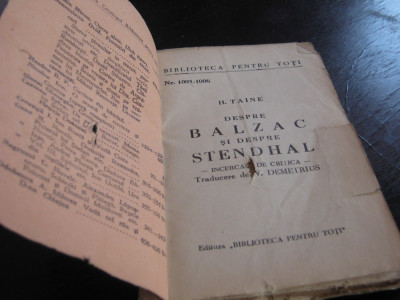
Image result for Taine BalzacTaine's long essay (over 100 pp.) on Balzac, is really very good reading, especially when he comes to describe the big characters, such as Joseph Bridau, Grandet, and the Baron Hulot. Lying awake last night, after a fearful crash caused by the faience suspension falling out of the ceiling in the hall, I had the desire to do likewise for one or two English novelists. It is Taine's method that appeals to me, and the intoxicating effectf a vast number of short sentences or clauses hurled down one after the other. Funny how ideas come to one in the night and make one feel excited, and a whole edifice of imagination is built up. Then, back to sleep, and in the cold light of morning the realisation that it was all so much poppycock. What profit would there be for me, a professional writer in literary biographies? Who would buy them? I can imagine writing a newspaper column about books and writers, but nothing more 'academic' - too busy making a living.


Night thoughts are strange phenomena though and I probably have more than most as I rarely sleep through a night. A few days ago I went to bed very tired having walked 9 or 10 miles during the day and slept from 11 pm to 6 am. I was amazed. That must be the longest continual period of sleep I have experienced for years. Sometimes, after waking, I rise, do what is necessary, and then go more or less straight back to sleep. But more often I am awake for a while, or rather in that sort of intermediate stage between wakefulness and sleep. That is when the odd night thoughts occur. Often worrying about something, or rehearsing an impending meeting, or turning over a problem. Occasionally erotic, but not often. I have learned from experience not to fight it. If I try to make myself sleep I invariably fail. Best just to drift away on the currents of imagination.

Monday, 7 April 2014

Social philosophy

Monday, April 7th., Comarques, Thorpe-le-Soken.

Last week, being in need of inspirational bucking-up, I dropped "War and Peace" and read Balzac's "Cure de Tours" and "Pierrette". Latter better than Saintsbury says it is. Balzac was an ignorant and crude man, often childish in his philosophising. But if he had been properly educated and influenced he would have been a great social philosopher. His apercus are often astounding. And his vitality is terrific. he is full of inspiring and agreeable ornament. Nothing of the kind in Tolstoy. All a flat recital. Often dull, unless you give yourself to it. But if you do he is never dull. Some of Tolstoy's long descriptions (such as of the wolf-hunt on Count Ilza's estate) are extremely beautiful. Natasha is the most beautiful character - anyway up to page 700 or so, where I now am.

Will I be thought of as any sort of social philosopher in the future? I should certainly think that my Five Towns books will be useful as social history, but have my characters any universal significance? I would like to think so. And when I think for example about the marriage of Edwin and Hilda, as described in "These Twain", it seems to me, and others have told me, that I have captured something important, if not profound. Also death has featured in several of my books and I think I have shown something of the variety of human response to that most troubling of experiences.

Additionally for April 7th., see 'Identity and disguise'

Since the war I have naturally become a target for satire, and I know it. It is partly the price of fame and partly because I have deliberately courted publicity and made myself into a 'character'. I have become a popular cartoon subject, turning up in various guises - at first nights, in the barber's and in the cartoon above. All publicity is essentially good publicity and I have given the press and cartoonists things to seize on - very fine lace shirts, the quiff of my hair, and my fob. I consider these to be both an identity and a disguise.

Friday, 24 January 2014

Writing well.

Tuesday, January 24th., Fulham Park Gardens, London.

Last night I finished my sensational novel, "The Curse of Love", 50,000 words in exactly three months, with all my other work. The writing of it has enormously increased my facility, and I believe that now I could do a similar novel in a month. It is, of the kind, good stuff, well written and well contrived, and some of the later chapters are really imagined and, in a way, lyrical. I found the business, after I had got fairly into it, easy enough, and I rather enjoyed it. I could comfortably write 2,500 words in half a day. It has only been written once, and on revision I have scarcely touched the original draft. Now I want to do two short sensational stories - and then to my big novel.

I have been reading Balzac's "Old Goriot" in translation (Ellen Marriage). I find the amoral Vautrin to be the most interesting character, much more interesting than Rastignac. I think that I could create a similar sort of 'villain' in one of my novels at some time in the future. The Paris that Balzac writes about is less than 100 years in the past, and is convincingly portrayed, yet it seems impossibly archaic. This reflects the rate of social progress experienced in this century now drawing to a close. It is similar in that sense to Hardy's depictions of a rural world that was already a memory when he wrote about it.

Additionally for January 24th., see 'Layers' -
http://earnoldbennett.blogspot.co.uk/2013/01/layers.html

In becoming acquainted with people you uncover layer after layer. Using the word in my sense, one person may be the most distinguished of a crowd on the first layer, another on the second, and so on. Until after uncovering several layers, you may ultimately come to a person who, down below, is the most distinguished of all - on that layer. The final result may be quite unexpected. I suppose that the inmost layer is the most important, but each has its importance.
I think that I am a very layered person, and am likely to become more so as I get older. I don't think anyone has penetrated far below my surface and, if I am honest, I have no wish that they should.

Saturday, 23 March 2013

Enchanted

Wednesday, March 23rd., Rue de Calais, Paris.

On Friday night last "Le Dedale", play in 5 acts by Paul Hervieu. I thought this one of the greatest modern plays I have ever seen, especially as to the three middle acts. Constant spiritual action of the piece, and constant drama, conflict of emotions etc. rising at times to great heights. The famous catastrophe of the precipice in the fifth act did not convince me; nor was I convinced of the necessity for any such fatal tragedy at all. On the other hand the catastrophe may have seemed ineffective because I demanded a stage effect which the stage-manager could not realise, or had failed to realise: the sense of a dizzy height etc. ... When one has been extremely pleased with a work one always tries to reason away what one fears may be faults.

Paul Hervieu (1857-1915) was born at Neuilly, near Paris. His first play, Point de Lendemain, a short adaptation of a story, was produced in 1890, and five years later The Nippers appeared, firmly establishing Hervieu's reputation. The plays of Hervieu are perhaps the nearest approach to true tragedy [of their day]; they are also what the French call "thesis plays." With his faultless logic, clear and direct methods of writing, and admirable sincerity, he comments on and criticizes those phases of life that seem to need correcting -- the law, chiefly, and its relation to man and woman in the married state. The Labyrinth (Le Dédale) proves the thesis that the child is the everlasting bond between man and wife. The best plays of Hervieu -- The Labyrinth, The Nippers, and The Passing of the Torch -- rightfully place their author as a master-psychologist of the French stage of his day. Hervieu died in Paris.

On Saturday morning I went down to Les Sablons to stay with the Davrays. We went for a walk in the forest of Fontainebleau in the afternoon. I noticed on entering this vast forest, intersected with glorious roads, a characteristically French sign-board: "General instructions for reading the signposts in the forest." The system of signposts seemed to me to be absolutely complete. I found the forest quite up to my expectation, but bigger.

Nemours - the castle and the church bordering the Loing River
On Sunday Dr. Vallee took us to Nemours, a delicious old town with a castle, ramparts, moats, and the Loing; full of wonderful views. Mme. and I went to buy cakes and we all had tea on the pavement in front of an inn; while the landlady and another woman sat and sewed nearby. Seeking the garcon to pay the bill I got into a vast kitchen full of all kinds of curious domestics and copper pans. Passing along the street we saw a tailor, old, in black, white hair, and a strangely shaped head, standing at the door of his shop. Davray and I both exclaimed at once: "Balzacian". "Ursule Mironet" is laid in Nemours, and the extraordinary veracity of Balzac's descriptions strikes one everywhere. His descriptions were not exaggerated. 

Ursule Mirouët, an often overlooked novel, belongs to Honoré de Balzac’s great series of 94 novels and short stories La Comédie humaine. First published in 1841, it forms part of his Scènes de la vie de province. The action of the novel takes place in Nemours, though with flashbacks to Paris. It is set in the years 1829-1837. The dominant tone of Ursule Mirouët is projected at the very outset of the work, when Balzac compares its Nemours setting to the beauty and simplicity of a seventeenth-century Dutch landscape painting. Ursule Mirouët has that “noble simplicity, and … tranquil greatness” which, in Winckelmann’s words, were the defining characteristics of Classicism.
"Who knows Nemours," wrote Balzac, "knows that nature there is as beautiful as art,"

I was enchanted with Nemours. 

We came back to Les Sablons on the great Paris-Antibes road, passing from that to the great Paris-Marseilles road, stupendous highways both, straight, interminable, with double rows of trees on either side.

At night music, and that freedom of speech which is one of the joys of France.


On Monday Dr. Vallee took Mme. and I to Fontainebleau. The Napoleonic suites of rooms and all the others impressed me much. Napoleon's bedroom with the cradle of the Roi de Rome and its gold guardian angel (much like the angel on top of Burslem Town Hall) remains in my mind.


The Palace of Fontainebleau, is one of the largest French royal châteaux. The palace as it is today is the work of many French monarchs, building on an early 16th century structure of Francis I. The building is arranged around a series of courtyards. The commune of Fontainebleau has grown up around the remainder of the Forest of Fontainebleau, a former royal hunting park. Within a decade of the Revolution, Emperor Napoleon Bonaparte began to transform the Château de Fontainebleau into a symbol of his grandeur. With modifications of the château's structure, including the cobblestone entrance wide enough for his carriage, Napoleon helped make the château the place that visitors see today.