Wednesday, March 16th., Rue de Calais, Paris.
I meant to go and see "L'Etrangere" at the Francais on Monday night but was too unwell - a mysterious lassitude. So I bought "La Petite Roque" od de Maupassant instead, and came home. yesterday I bought Taine's "Graindorge". This book brought to a head the ideas I have had for writing 'impressions' of Paris. I find I must write something. I can't lie quite fallow. Moreover I have now been in Paris exactly a year, and my ideas are becoming defined.
So this morning I started a book of impressions with an account of, and reflections upon, the opening of the Concerts-Berlioz which I went to last night. It is probable that this book, if I continue with it, will reduce my journal to a naked record. I am worried with an idea for placing the impressions serially in various newspapers. Many things seem to worry me in a general way at the moment. Not enough to lose sleep, but a sort of background 'noise' to my daily activity. I am inclined to think that I am working too little, and spending too much time alone. I will need to make a concerted effort to get on with things.
Showing posts with label Taine. Show all posts
Showing posts with label Taine. Show all posts
Saturday, 16 March 2019

Monday, 25 February 2019
Pleased for Punch
Thursday, February 25th., Rue de Calais, Paris.
I worked nearly all day yesterday, till 11 p.m. This singular industry is becoming monotonous.
 Reading "Notes sur Angleterre" last night - a wonderful book - I was amused by Taine's noting young Englishmen sleeping with open windows in winter as a sign of primitivism, a sort of healthy reversion to original type. I think myself it is more talked of than done, though it may feature in public schools where masochism is part of the curriculum. I went to a school which aped public schools in many ways - fagging, prefects, latin school song, that sort of thing - but shied away from those so-called 'character forming' aspects of public school life. Taine's remarks on Punch are extremely clever and ingenious, in the way of finding the very roots of our national character in that periodical. Punch will always be able to say that Taine gave three pages to praising it.
I worked nearly all day yesterday, till 11 p.m. This singular industry is becoming monotonous.
Sunday, 12 November 2017
Currents of imagination
Friday, November 12th., Villa des Nefliers.
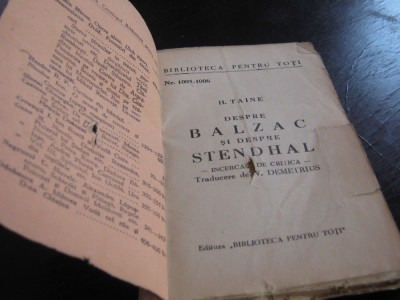 Taine's long essay (over 100 pp.) on Balzac, is really very good reading, especially when he comes to describe the big characters, such as Joseph Bridau, Grandet, and the Baron Hulot. Lying awake last night, after a fearful crash caused by the faience suspension falling out of the ceiling in the hall, I had the desire to do likewise for one or two English novelists. It is Taine's method that appeals to me, and the intoxicating effectf a vast number of short sentences or clauses hurled down one after the other. Funny how ideas come to one in the night and make one feel excited, and a whole edifice of imagination is built up. Then, back to sleep, and in the cold light of morning the realisation that it was all so much poppycock. What profit would there be for me, a professional writer in literary biographies? Who would buy them? I can imagine writing a newspaper column about books and writers, but nothing more 'academic' - too busy making a living.
Night thoughts are strange phenomena though and I probably have more than most as I rarely sleep through a night. A few days ago I went to bed very tired having walked 9 or 10 miles during the day and slept from 11 pm to 6 am. I was amazed. That must be the longest continual period of sleep I have experienced for years. Sometimes, after waking, I rise, do what is necessary, and then go more or less straight back to sleep. But more often I am awake for a while, or rather in that sort of intermediate stage between wakefulness and sleep. That is when the odd night thoughts occur. Often worrying about something, or rehearsing an impending meeting, or turning over a problem. Occasionally erotic, but not often. I have learned from experience not to fight it. If I try to make myself sleep I invariably fail. Best just to drift away on the currents of imagination.
Taine's long essay (over 100 pp.) on Balzac, is really very good reading, especially when he comes to describe the big characters, such as Joseph Bridau, Grandet, and the Baron Hulot. Lying awake last night, after a fearful crash caused by the faience suspension falling out of the ceiling in the hall, I had the desire to do likewise for one or two English novelists. It is Taine's method that appeals to me, and the intoxicating effectf a vast number of short sentences or clauses hurled down one after the other. Funny how ideas come to one in the night and make one feel excited, and a whole edifice of imagination is built up. Then, back to sleep, and in the cold light of morning the realisation that it was all so much poppycock. What profit would there be for me, a professional writer in literary biographies? Who would buy them? I can imagine writing a newspaper column about books and writers, but nothing more 'academic' - too busy making a living.Night thoughts are strange phenomena though and I probably have more than most as I rarely sleep through a night. A few days ago I went to bed very tired having walked 9 or 10 miles during the day and slept from 11 pm to 6 am. I was amazed. That must be the longest continual period of sleep I have experienced for years. Sometimes, after waking, I rise, do what is necessary, and then go more or less straight back to sleep. But more often I am awake for a while, or rather in that sort of intermediate stage between wakefulness and sleep. That is when the odd night thoughts occur. Often worrying about something, or rehearsing an impending meeting, or turning over a problem. Occasionally erotic, but not often. I have learned from experience not to fight it. If I try to make myself sleep I invariably fail. Best just to drift away on the currents of imagination.
Friday, 14 September 2012
Self-discipline
Saturday, September 14th.,
Yesterday I could not write and had leisure to think about myself. I saw that even now my life was not fully planned out; that I was not giving even an hour a day to scientific reading, to genuine systematic education; and that the central inspiration for my novel was not fine enough.
I began to rectify this, resuming my Spencer. I bought Taine's "Voyage en Italie", and was once again fired to make fuller notes of the impressions of the moment, of choses vues. Several good books by him consist of nothing else.

I must surely by this time be a trained philosophic observer - fairly exact and controlled by scientific principles. At the time one can scarcely judge what may be valuable later on. At the present moment I wish for instance, that some school mistress had written down simply her impression of her years of training; I want them for my novel. The whole of life ought to be covered thus by "impressionists", and a vast mass of new material of facts and sensations collected for use by historians, sociologists and novelists. I really must try to do my share of it more completely than I do.
So, today I worked from 6 to 7.45. Then, after breakfast, I read Epictetus and Spencer, did my Italian and my piano. After lunch I read Conrad's new book "The Secret Agent", then went out and collected ideas for my novel.

After tea I wrote letters and took a stroll with my wife. After dinner more piano; and French poetry; then this journal. In short a damned virtuous, high-minded day
Yesterday I could not write and had leisure to think about myself. I saw that even now my life was not fully planned out; that I was not giving even an hour a day to scientific reading, to genuine systematic education; and that the central inspiration for my novel was not fine enough.
I began to rectify this, resuming my Spencer. I bought Taine's "Voyage en Italie", and was once again fired to make fuller notes of the impressions of the moment, of choses vues. Several good books by him consist of nothing else.

Hippolyte Adolphe Taine (21 April 1828 – 5 March 1893) was a French critic and historian. He was the chief theoretical influence of French naturalism, a major proponent of sociological positivism, and one of the first practitioners of historicist criticism. Literary historicism as a critical movement has been said to originate with him. Taine is particularly remembered for his three-pronged approach to the contextual study of a work of art, based on the aspects of what he called "race, milieu, and moment". Taine had a profound effect on French literature; the 1911 Encyclopædia Britannica asserted that "the tone which pervades the works of Zola, Bourget and Maupassant can be immediately attributed to the influence we call Taine's."
I must surely by this time be a trained philosophic observer - fairly exact and controlled by scientific principles. At the time one can scarcely judge what may be valuable later on. At the present moment I wish for instance, that some school mistress had written down simply her impression of her years of training; I want them for my novel. The whole of life ought to be covered thus by "impressionists", and a vast mass of new material of facts and sensations collected for use by historians, sociologists and novelists. I really must try to do my share of it more completely than I do.
So, today I worked from 6 to 7.45. Then, after breakfast, I read Epictetus and Spencer, did my Italian and my piano. After lunch I read Conrad's new book "The Secret Agent", then went out and collected ideas for my novel.

Joseph Conrad weaves a startling tale of espionage, political unrest, and personal turmoil in his 1907 novel The Secret Agent. Set in 1886, it is the story of a man known as Verloc. Life is a humdrum affair for Verloc, who is a shopkeeper and lives with his wife and in-laws. What Verloc's family doesn't know is that he has befriended a group of revolutionaries who are seeking major political overthrow. One fateful day, Verloc is called to a foreign embassy. There, a mysterious man gives him a task on which his reputation and future as a secret agent will depend: to destroy the town of Greenwich. As Verloc contemplates this grave and terrible mission, he must decide how far he is willing to go for the sake of rebellion. Police begin to trail Verloc's revolutionary circle, hoping to prevent an attack on the city but knowing that the terrorists may strike at any moment. Tension builds towards an unforgettable climax as Verloc's depths of sinister ambition come to light in this painful and astonishing work.
After tea I wrote letters and took a stroll with my wife. After dinner more piano; and French poetry; then this journal. In short a damned virtuous, high-minded day
Subscribe to:
Posts (Atom)