Welcome to our blog!


It's better than a bat in the eye with a burnt stick!


This blog makes liberal use of AB's journals, letters, travel notes, and other sources.


And make sure to visit The Arnold Bennett Society for expert information and comment on all aspects of the life and work of AB.

Showing posts with label Dupont. Show all posts

Wednesday, 27 January 2021

Stars

Wednesday, January 27th., Cadogan Square, London.

We have a sun-bath installed now in the bathroom. It is self-contained except for the flex - cost £25. I am taking a bath daily, but I detect no results so far. Seems like a fashionable gadget to me. Dorothy's idea - she says that 'everyone' has them in America. I would have thought there was enough sun in America already, at least in the South. I still have the chest cold that I've had now for a fortnight and I don't feel at all well. Nevertheless I am giving the thing a fair show.

"Piccadilly" is opening to the public unexpectedly (owing to the failure of somebody's revue) at the Carlton tomorrow. The film is very good so far as it goes, but very little of the comedy has survived and the story does not really end, it only breaks off. Much of it however is first-rate Dupont. Anna Wong is marvellous. Gilda Grey not so good. If I had lived at Elstree for three months I could have got a far better film out of Dupont. Most of last Saturday I was at Elstree revising the titles of "Piccadilly". They would have been terrible, for they had altered back a lot of titles already revised by me, if I had not been firm. I got my way over every title. I shall go to the performance tomorow. I didn't want to go but there was such a fiendish outcry at Elstree when I said I shouldn't go, that I gave in. Also Anna Wong will be there, so it is worth the trip to see her again.

I saw the German filmed "City of Pleasure" last night. The Blackpool fun-fair scenes etc. are excellent, and the whole production has an impressive scale. But every shred of humour has been removed and the book was full of humour. Also the story has been completely removed from the city of pleasure. As filmed it might have occurred anywhere, so the title becomes ridiculous. This show depressed me overall. There is just so much more that could be got from motion pictures approached in the right way. If I were forty I would have a proper go!

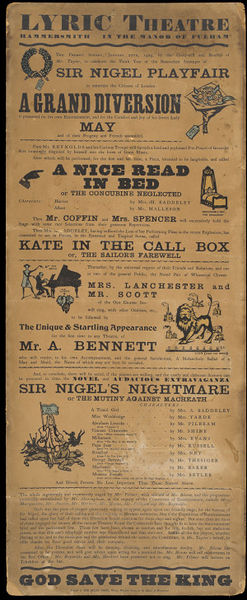
The newspapers say that I was 'the star' at the celebration of ten years of Playfair's management at the Lyric on Sunday night. I truly was. Funny! I wasn't a bit nervous about singing, though it was my first appearance on any stage. It has always puzzled me that my stammer disappears when I sing. Sometimes, when it is really bad and I just can't get the word out, I sing it. Disconcerts some people but always works. 

I spent three hours at the Savoy Grill last Thursday arguing with 'the greatest English producer', Alfred Hitchcock, about my second film-story. He wanted to alter it but I wouldn't agree and I won't. Thorpe, the manager of British International Pictures, took my side. At the end I was very hoarse. I should have sung more!

Sunday, 13 April 2014

A new direction

Friday, April 13th., Cadogan Square, London.

Thorpe, of British International Films, and Dupont, the German producer of "Vaudeville" and "Moulin Rouge" came to see me yesterday about writing a film story about Piccadilly, under the title "Piccadilly", for Dupont to produce; I agreed to write, and promised the first sketch for Tuesday. Today, I got away early, and began to think about the film. 

Then I walked to Dent's in Cockspur Street, where yesterday I had seen a bed-table watch, which I had the notion of giving to Dorothy. The price, £15, annoyed and repelled me, but in the end I yielded to the damned thing and bought it. Dorothy called for me at the Club, and at 3.50 I began to write my sketch for the film story.

It was interrupted by a grand nursery tea, this being Virginia's second birthday. It was all over at 5.30, after which I finished all the preliminary part of my film story. I hope to write the actual sequence of events tomorrow morning.

For more on the film "Piccadilly" see 'Back to Riceyman Steps'

Additionally for April 13th., see 'New life'

My daughter, Virginia, was born today at 7.50 a.m.
I went up to Welbeck Street at 9.30 and saw the child at 10 a.m., when she was two hours old. She weighed 8lb. 1 oz. and had a big head.
I was most dramatically struck when I saw the bassinette or cradle full of clothes lying all ready outside Dorothy's door.
I shall shortly be 59 years old, so today's event is profound indeed.

Saturday, 15 June 2013

Back to Riceyman Steps

Sunday, June 15th., Cadogan Square, London.

Riceyman Steps 1924
Coming down from the Pentonville region into Clerkenwell recently I was reflecting in the back-parlour of my mind on 'convention' and 'revolt' in literature. Convention was on the slopes. He that knoweth not Percy Circus (distant view of the romantic towers of St Pancras) should know it. It is a hundred times more conventional than Piccadilly Circus. Also Great Percy Street should be known. Also the Norman arches of Baker Street (W.C.1 not W.1). Also Helena Street, with its antique woodwork all painted verdant green and its ruined chapel. Also Lloyd Square, the most withdrawn square in London. Also Riceymen Steps, formerly Plum Pudding Steps, where was performed a feat of transport surpassing anything ever done in that line in USA, namely the moving of an entire bookseller's shop with all its books and dust from a south coast port to the foot of the Steps. So I descended to King's Cross Road and the new factories and warehouses. It is the latter which represent Revolt. The latest industrial perpendicular style of architecture contrasts uncompromisingly with the conventional blocks of dark "dwellings" which it hems in. And so into Farringdon Road where the book-barrows are.

The object of my excursion was to visit and ransack the book-barrows. With a vengeance do they represent Convention. I have known them for over forty years, and instead of advancing they have receded. To begin with, the majority of them were shut-up and sheeted down in their black tarpaulins. This at four o'clock on Saturday afternoon! Influence no doubt of the sinister weekend habit invented by the book-reading classes! And those that were still "open" might be divided into two classes: barrows stocked with too-excited literature, arcane publications and works by obscure authors; barrows heaped pell-mell with books in a disorder so acute that you could not possibly examine more than ten percent of them without employing a housebreaking and demolition firm. I did, in fact, detect one or two pleasing items but to prove the sincerity of my remarks to the barrow-man I refused to buy any of them - he didn't care! The book-barrow trade ought to look to itself, and if I do my duty I shall write to the Secretary of the National Union of associations of Book-barrow Dealers. Half an hour in Farringdon Road has served to raise my opinion of shop-based booksellers!

I have had the opportunity to see the film "Piccadilly", for which I wrote the screenplay last year, and was pleased with it. Dupont has done an excellent job in bringing the story to life on the screen.
See also, 'Life and Death' - June 4th., http://earnoldbennett.blogspot.co.uk/2013/06/life-and-death.html
The quality of the acting was, I thought, good. There was considerable use of close-up shots of the actors' faces and they were generally successful in conveying their emotions with subtle changes of expression. This surprised me. A surprisingly large amount of the dialogue is discoverable by lip-reading the actors. Dupont seems to have managed to locate and use a large number of characterful extras which added to the authenticity of the film, as did the use of scenes shot in the streets of London.  The contrast between the privileged world of the wealthy and that of the working-classes was brought out excellently: the audience in the Piccadilly Club seemed bland, homogeneous and uninteresting in comparison with the denizens of the Limehouse public house who were diverse, colourful and full of life, with a barely veiled edge of violence and sexuality. Anna May Wong was excellent in the role of Shosho, though her Chinese dance didn't seem likely to have excited male appetites to the extent implied by the story-line. Jameson Thomas as Valentine Wilmot was suitably sinister. I was pleased that all the characters I created retained their flaws in transition from paper to the silver screen. The film is no great work of art, but it is decidedly watchable.
http://www.youtube.com/watch?v=BzpcgLPIBFI

Jameson Thomas and Anna May Wong
A film noir before the term was in use, Piccadilly is one of the true greats of British silent films, on a par with the best work of Anthony Asquith or Alfred Hitchcock in the period. In essence a simple tale of ambition, desire and jealousy, what marks Piccadilly out is the astonishing confidence of its direction. Dupont was a recent arrival from Germany, who had made just one previous film in Britain, the elegant Moulin Rouge (1928), and Piccadilly is notable for qualities not typically associated with British silent films: opulence, passion and a surprisingly direct approach to issues of race - one remarkable scene has a white woman expelled from a bar for dancing with a black man, mirroring the social taboo of the film's central relationship. Dupont was subsequently associated with the shortlived vogue for multi-language films, and Piccadilly has a similarly international bent - its lead actresses are Chinese-American and Polish-American; its leading men are British and Chinese; its cinematographer and designer are, like its director, German. For all its style and grace, the film's strongest suit is Chinese-American actress Anna May Wong. Wong appeared in four other British films, but she was arguably never better used than here. As Shosho, the scullery maid who becomes a dance sensation and an object of desire for impresario Valentine (Jameson Thomas), she displays the cold ambition and manipulative sexuality of the classic femme fatale, while revealing - just occasionally - the vulnerability of a young girl. Shosho's exoticism gives her an alarming sexual power over the men who watch her dance - "I danced once before in Limehouse but there was trouble, men, knives...", she tells the transfixed Valentine, in a title which prefigures the narrative's tragic end. To Wong's frustration, Shosho and Valentine's kiss was cut to appease the US censor.

Tuesday, 4 June 2013

Life and death

Monday, June 4th., Cadogan Square, London.

I worked in the morning on proofs and instructions concerning my Mediterranean book. Good sleep after lunch. I went on with work on the Mediterranean book. At last decided on a title for the book, "Mediterranean Scenes". Then I finished up the proofs, illustrations, etc.

I've been reading "Endymion". Opening too descriptive and too generally narrative, not individual enough in event and description. But it can be read.

Yesterday Dorothy and I went down to Beaverbrook's at Cherkley for lunch, and found a lot of gloomy and silent people there. We enlivened them somewhat, but not enough. However we had a nice drive.
See also, 'Leading the High Life' - September 18th. http://earnoldbennett.blogspot.co.uk/2012/09/leading-high-life.html

It was a great relief for me to learn from the managing director and the producer, Dupont, of British International Films Ltd. that "Piccadilly" the film which I have written for them is absolutely perfect from their point of view. I have never before seen men so enthusiastic about any work of mine as they were. They immediately asked me to write another film for them. But my policy in such a case is always to hang fire, to make difficulties, to say that I cannot etc. But I shall probably write them another film all the same. The difficulties and the delays only whet their appetite.


Piccadilly is a 1929 British silent drama film directed by Ewald André Dupont, written by Arnold Bennett and starring Gilda Gray, Anna May Wong, and Jameson Thomas. The film was produced by British International Pictures and released by Wardour Films Ltd. in the UK, and distributed in the US by Sono Art-World Wide Pictures. It is best remembered for the performance by Anna May Wong as a vamping dancer, Shosho, who becomes the star of the Piccadily Club and the obsession of Valentine Wilmot (Jameson Thomas), the owner of the club.


I had an article in the Daily News on Saturday entitled "Where are the Dead?" It amounted to a sort of response to, an article the previous day by E. A. Knox, formerly Bishop of Manchester, who propounded a conventional Christian view of the 'afterlife'. I of course expressed little interest in congregations of spirits. Believing, as I do, that matter and spirit are inseparable, two sides of the same coin, I conclude that dissolution of material organisation means dissolution of spiritual. It seems to me that any normally intelligent person, not unduly constrained by social convention, can see at a glance that ideas of resurrection and 'eternal life' are laughable. The stories of organised religion would not deceive a sensible ten year old child were they not wrapped up in an envelope of  ritual, tradition and mumbo-jumbo.

The Daily News was a national daily newspaper in the United Kingdom. It was founded in 1846 by Charles Dickens, who also served as the newspaper's first editor and was conceived as a radical rival to the right-wing Morning Chronicle. The paper was not at first a commercial success. Dickens edited 17 issues before handing over the editorship. Charles Mackay, Harriet Martineau, George Bernard Shaw, H. G. Wells, G.K. Chesterton and Arnold Bennett were among the leading reformist writers who wrote for the paper during its heyday. In 1901, Quaker chocolate manufacturer George Cadbury bought the Daily News and used the paper to campaign for old age pensions and against sweatshop labour. As a pacifist, Cadbury opposed the Boer War – and the Daily News followed his line. In 1906, the News sponsored an exhibition on sweated labour at the Queen's Hall. This exhibition was credited with strengthening the women's suffrage movement. In 1909, H. N. Brailsford and H. W. Nevinson resigned from the paper when it refused to condemn the force feeding of suffragettes