Welcome to our blog!


It's better than a bat in the eye with a burnt stick!


This blog makes liberal use of AB's journals, letters, travel notes, and other sources.


And make sure to visit The Arnold Bennett Society for expert information and comment on all aspects of the life and work of AB.

Showing posts with label George Gissing. Show all posts

Friday, 29 January 2021

Re-reading

Friday, January 29th., Chiltern Court, London.

I followed my own advice, as given to my readers in the Evening Standard, to 'take a book at random from your library and read in it'. The book I took was "Howards End" by E.M. Forster. I read this when it was first published and felt it added to Forster's reputation. Now I am not so sure. Certainly it has added to his reputation, but is it good? My experience was that as I read I found myself becoming irritated, thought of giving up, and then a phrase 'caught' me and I carried on. Only to become irritated again! Why?

For one thing it is so mannered, and we have become used to a more realistic type of fiction. And then there is the author's voice. Now, I don't mind an author's voice; I have often introduced my own voice into my fiction. But this voice felt intrusive to me. It was just a little too knowing, for example in describing a performance of Beethoven's Fifth Symphony I couldn't make out if he was being serious or sarcastic. And then what is all the stuff about female equality, empire building, money, cultural distinctions etc. about? If Forster is wanting to make a point about inequality, whether social or sexual, why not just make it, go straight for it, as Gissing would have done. Why write about privileged people if you want to say they are only privileged because of the poverty of the majority. Just write about the majority! And Leonard Baste. Is he a credible character? The relationship with Jackie seems contrived to me but, having contrived it, Forster doesn't seem to make much of it, when there is surely potential to advance his class theme. And I didn't get as far as the relationship between Baste and Helen, but that didn't ring true the first time.

So, I doubt I will read any more. I have much respect for Forster in spite of his observation about "The Old Wives' Tale" that "it misses greatness". That hurt a bit. Forster is ten or so years younger than me but I don't think you would realise it from his writing. As I write this I am thinking to myself that perhaps some of the criticisms I have directed at "Howards End" might equally have been made about "Imperial Palace". Perhaps. I can't say. What would Swinnerton tell me I wonder? 

Worthwhile going back to books though. Must do it more often.

Friday, 18 December 2020

Flaneur

 Monday, December 19th., Rue de Calais, Paris.

I sent off the last act of "An Angel Unawares" yesterday morning. In the afternoon I went to have tea with Miss Thomasson. I find that she is disturbing me, so much so that today I could not settle to anything definite. There is an element of sexual frustration in this.

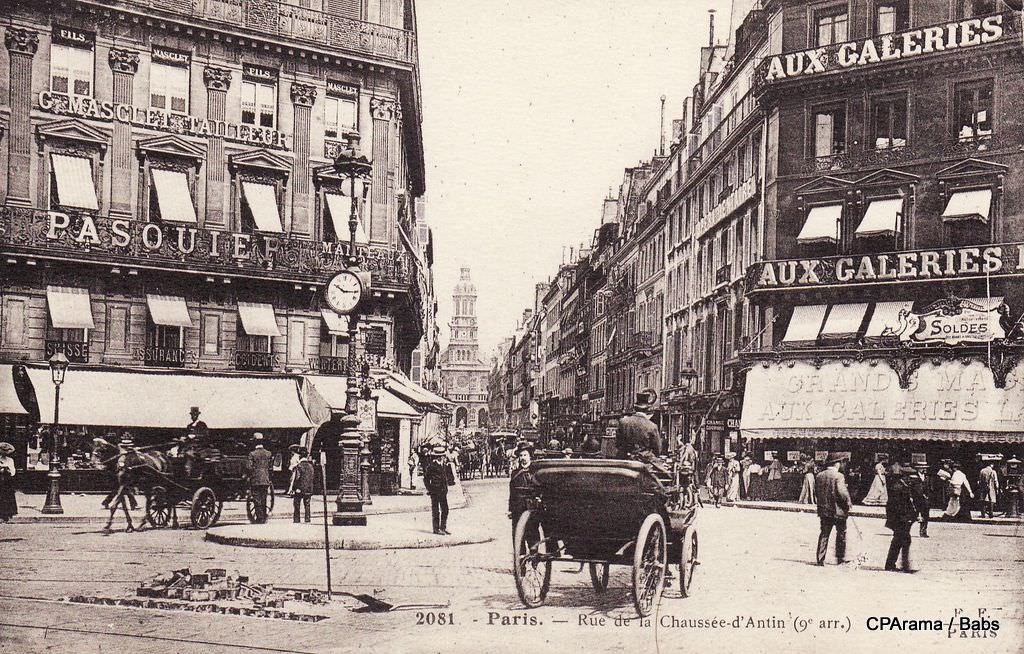
So, this evening I had to go out and walk about. Perhaps I was looking for an 'adventure'? I turned down the steep Rue Blanche and at the foot of it passed by the shadow of the Trinite, the great church of illicit assignations, at whose clock scores of frightened and expectant hearts gaze anxiously every afternnoon. And through the Rue de la Chausee d'Antin, where corsets are masterpieces beyond price and flowers may be sold for a sovereign apiece. Then into the full fever of the grand boulevard with iots maddening restlessness of illuminated signs. This was the city. This was what the race had accomplished after eighteen Louis' and nearly as many revolutions, and when all was said that could be said it remained a prodigious and comforting spectacle. Every doorway shone with invitation; every satisfaction and delight was offered, on terms ridiculously reasonable. So different it seemed from the harsh and awkward timidity, the self-centred egotism and aristocratic hypocrisy of Piccadilly.It seemed strange to be lonely amid multitudes that so candidly accepted human nature as human nature is. Sex was in the air, but I could not grasp it.

So I continued southwards, down the narrow, swarming Rue Richelieu, past the National Library on the left and the Theatre Francais, where nice plain ppeople were waiting to see "L'Aventuriere", and across the arcaded Rue de Rivoli. And then I was in the dark desert of the Place du Carrousel, where the omnibuses are diminished to toy-omnibuses. The wind, heralding winter, blew coldly across the spaces. The artfully arranged vista of the Champs Elysee, rising in flame against the silhouette of Cleopatra's Needle, struck me as a meretricious device, designed to impress tourists and monarchs. Everything seemed meretricious. I could not even strike a match without being reminded that a contented and corrupt inefficiency was corroding this race like a disease. I could not light my cigarette because somebody, somewhere, had not done his job like an honest man.

I wanted to dine but all the restaurants had ceased to invite me. I was beaten down by the overwhelming sadness of one who for the time being has no definite arranged claim to any friendly attention in a huge city. I might have been George Gissing. I re-wrote all his novels for him in an instant! I persisted southwards. The tiny walled river, reflecting with industrious precision surrounding lights, had no attraction, except as a potential solution. The quays where all the bookshops were closed and all the bookstalls locked down, and where there was never a cafe, were as inhospitable and chill as Riga. Mist seemed to heave over the river, and the pavements were oozing with damp. I turned for home.

To think that in three days I shall be in Burslem!

Wednesday, 13 March 2019

Anticlimactic

Sunday, March 13th., Rue de Calais, Paris.

I finished "A Great Man" at 11.30 this morning having written about 10,000 words in the last five days. I am exhausted, but more satisfied with it than I thought I should be. I began it with an intention merely humorous, but the thing has developed into a rather profound satire. At least that is how I perceive it now, though it may not appear so to my readers (if there are any). I began the book about the 10th. of December; during two weeks of the time between then and now (Xmas) I put it aside, and during three other weeks I put it aside to write the play with Eden. So that I have been engaged on it nine weeks altogether. It is 60,000 words in length, and my eighth novel of one sort or another.

On Friday and Saturday I had an extremely severe cold in the head, but nothing could prevent me finishing that novel. I was in the exact mood for writing, and had all the ideas arranged in my head. On completion I felt that I had been thoroughly drained and could focus my attention on nothing, but by evening I felt better and was hungry not only for food but for humanity.

Ext. Night Rain by stefanparis on DeviantArtI wanted to dine, and there were a thousand restaurants within a mile; but they had all somehow ceased to invite me. I was beaten down by the overwhelming sadness of one who for the time being has no definite arranged claim to any friendly attention in a huge city - crowded with preoccupied human beings. I might have been George Gissing. I rewrote all his novels for him in an instant. I persisted southwards. The tiny walled river, reflecting with industrious precision all its lights, had no attraction. The quays, where all the bookshops were closed and all the bookstalls locked down, and where there was never a cafe were as inhospitable and chill as Riga. Mist seemed to heave over the river, and the pavements were oozing damp. I went up a familiar entry and rang a bell, thinking to myself: "If she isn't in, I am done for!" But at the same moment I caught the sound of feminine laughter, and knew I was saved, and by a miracle Paris was herself again.


Wednesday, 31 July 2013

Death of Gissing

Sunday, July 31st., Spade House, Sandgate.


Spade House was the home of the science fiction writer H. G. Wells from 1901 to 1909. It is a large mansion overlooking Sandgate, near Folkestone, in southeast England.


Wells at Sandgate
I had a lot of curious sensations on returning to England after an absence of seven months - especially on waking up in an English house shaking off France, and re-adjusting my perspective of England and finding how fine England was, and how I was full of sympathy for it, and all that sort of thing. But I was too tired and too idle and too busy with Wells to bother about putting them down. nearly all Wells's conversation would make good table talk and one has a notion that it ought not to be wasted; it is so full of ideas and of intellectual radicalism. It seems a pity that it should not be gathered up. But after all there is a constant supply of it. You might as well be afraid of wasting the water from a brook. I read the proofs of "The Food of the Gods" these last two days, and gave him my views on it. He was very keen and restless and nervous to hear them.

Talking of education he said there was a particular time in human growth when each particular thing should be taught - before which it would be too soon and after which it would be too late.

The Rationalist Press Association would have liked to issue a 6d. edition of "Anticipations". However, Watts broke it gently to Wells that "God" was mentioned several times in the book and their subscribers would not like it. "Of course," said Watts, "I know you only use the word figuratively." "Not so figuratively as all that," said Wells.

The Rationalist Press Association (RPA) was founded in 1899 by Charles Albert Watts, the son of the prominent freethinker Charles Watts, to “assist in securing the amendment of the law which sanctions the confiscation of property left for anti-theological purpose, and to promote the issuing, advertising, and circulation of publications devoted to Freethought and Advanced Religious reform.” At the time, bequests of donations to Freethought organizations were confiscated because of the widely held assumption that a morally sound person would not want to donate to them. The RPA became the most significant publishing organization for rationalist and freethought organizations.

Sketch of Gissing by Wells
Mr. and Mrs. Wells gave me between them a history of Gissing's tragedies. Gissing lived connubially with a French woman. Wells gave me an account, full of queer details, of how he went over to St. Jean de Luz when Gissing was dying. Gissing's mouth had to be wiped out with lemon water, and his body sponged over with absolute alcohol. Wells did this. The woman was incompetent and stupid. The alcohol gave out and he had to use methylated spirits. There was only one towel. One corner had to be used for the mouth-washing, another for the methylated spirits business. The corners got mixed up. Gissing, delirious, resisted. Then Wells had to insist, the woman objecting, on handkerchiefs being used; she said the handkerchiefs would get dirty at once - etc. etc. similar incredible stupidities.

According to Pierre Coustillas (The Heroic Life of George Gissing, Part III: 1897-1903), H G Wells was a prime villain in the case. Arriving at Gissing’s sickbed on Christmas Day 1903, Wells force-fed the patient pints of champagne, beef tea and coffee, and more or less killed him on the spot.