W. G. Fay came to dine with me last night. He entered the hotel and then the restaurant with almost as much modesty and diffidence as if he had never had any experience at all. He said he was not interested in money and had kept all his simple habits. He told me how he and his brother had started a theatre in Liverpool with £5 capital each which they previously had to work for and save. They took a hall and made the seating themselves. He said his father was a civil servant and he was to have been one, but he failed at the preliminary and hated it. During his first theatrical enterprise he worked as an electrician in Dublin from 8 to 6. Then worked on his theatre from 8 to 11, and then would go and talk to Yeats or Martin or Russell till 2 or 3 a.m. He said the opposition to the "Playboy" was indirectly due to the opposition to "The Well of the Saints". The opposition to the latter made Synge say: "I'll write something that will make 'em sit up." He wrote the "Playboy" and it did make'em sit up. He said that at the first night not a word could be heard after the first three minutes. All had to be in dumb show. Later he had policemen to chuck out the worst rowdies. Then the theatre was empty. But he kept open playing to £2 or £3 a week. He stopped all newspaper advertisements and hoarding advts. and kept on. He used to invite the audience to collect in the first row of the stalls. He lost many of his friends and has never got some of them back. After 6 months the newspapers asked for seats. He said they must pay. They said they wanted his advts. back. He said they would have the advts. on condition that they didn't say in the paper that his theatre was empty. He would let them slang his plays and his players, but not say that his theatre was empty. Then the hoarding people came and made peace. . He won out. It seems that Yeats, Lady Gregory and Synge were directors at this time.
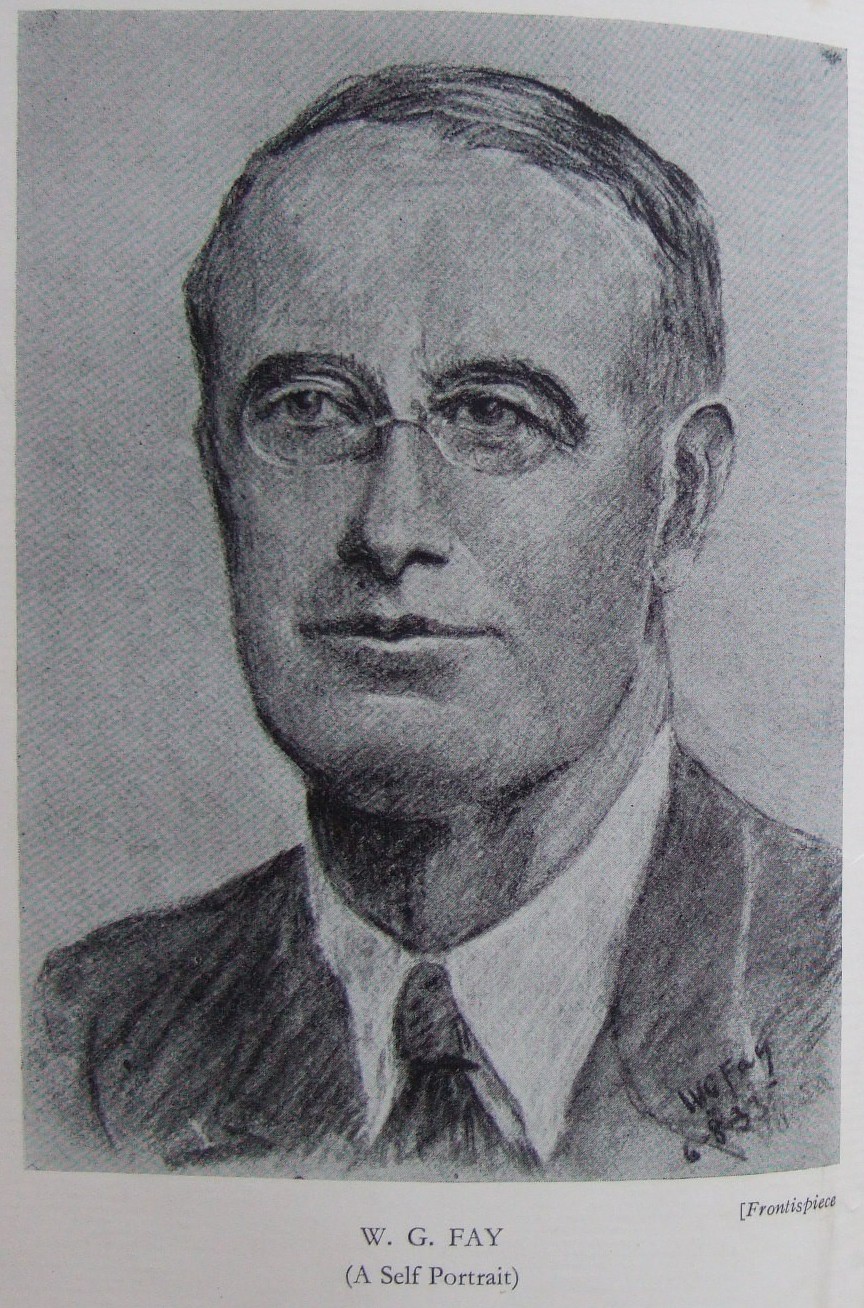
William George "Willie" Fay (1872 – 1947) was an actor and theatre producer who was one of the co-founders of the Abbey Theatre. Fay was born in Dublin, where he attended Belvedere College. He worked for a time in the 1890s with a touring theatre company in Ireland, Scotland and Wales. When he returned to Dublin, he worked with his brother Frank, staging productions in halls around the city. Finally, they formed W. G. Fay's Irish National Dramatic Company, focused on the development of Irish acting talent. The brothers participated in founding the Abbey Theatre and were largely responsible for evolving the Abbey style of acting. After a falling-out with the Abbey directors in 1908, the brothers emigrated to the United States to work in theatre there. He moved to London in 1914 worked as an actor on the stage and in films. One of his most notable film roles was as Father Tom in Carol Reed's Belfast-set Odd Man Out (1947), whose cast was dense with actors from the Abbey Theatre. His memoir, The Fays of the Abbey Theatre, appeared in 1935. Willie Fay died in London in 1947, aged 74.
 |
| Stork Hotel, Queen's square, Liverpool. |
This morning I went with Iris Hoey to choose a jeune fille costume for the first act.
See also, September 19th., 'Love in Liverpool' - http://earnoldbennett.blogspot.co.uk/2012/09/love-in-liverpool.html
Additionally for September 6th., see 'A lazy day afloat and ashore' - http://earnoldbennett.blogspot.co.uk/2012/09/a-lazy-day-afloat-and-ashore.html
We stepped off at Duingt because Noel Coward had given such an enthusiastic account of it to Dorothy. Not bad, but suffering from the disadvantage of being seriously cut off by hills from the sun both east and west. Noel must have been there in love some hot August.


