Welcome to our blog!


It's better than a bat in the eye with a burnt stick!


This blog makes liberal use of AB's journals, letters, travel notes, and other sources.


And make sure to visit The Arnold Bennett Society for expert information and comment on all aspects of the life and work of AB.

Showing posts with label Liverpool. Show all posts

Tuesday, 3 October 2017

Saviour of society?

Tuesday, October 3rd., Cadogan Square, London.

Well, what a kerfuffle has arisen from my article "What I Believe" published in the Express last month. It was the first in a series of articles by 'eminent persons' stating their beliefs. I confessed myself unable to believe in the divinity of Christ, heaven, hell, the immortality of the soul, or the divine inspiration of the Bible. To be frank I find it hard to understand how any intelligent thinking person can believe in these things. But it appears that I may have touched a nerve!
 
https://i.pinimg.com/236x/c2/a8/05/c2a805457b6b025371ac93737f5a9ccc--public-transport-historical-pictures.jpg A relative of mine in Liverpool tells me that on the day of publication at about 6.30 p.m. (after working overtime) he visited a number of newsagents and asked at each for a copy of The Daily Express. Each one replied "Sold out". At the fifth ( W H Smith in Lime Street) he asked "Why is the Express sold out?" He was told in a non-commital way "You won't find an unsold copy in Liverpool. Again he asked "Why?" The reply was "There is an article by Arnold Bennett". Such is fame, or is it notoriety?
 

Image result for Blumenfeld express
R D Blumenfeld
I have now written to the editor of the Express, Blumenfeld, because I am beginning to suspect a certain amount of hanky panky in the selection of letters about Christian dogma for publication. I have myself received quite a number of letters from people who are all of my way of thinking, and who complain that they have not been able to obtain publication of their letters in the Express. On the other hand I have not received a single letter from dogmatists complaining that their letters have been suppressed. Secondly, the number of letters from dogmatists published far exceeds the number of letters from anti-dogmatists published, whereas I have received many more favourable letters from anti-dogmatists than unfavourable letters from dogmatists. Wherever I go I am acclaimed as the saviour of society, and complete strangers stop me and supplicate for the honour of shaking my hand. How is this? I suspect Blumenfeld of jockeying the correspondence to suit what he imagines (quite wrongly) to be the popular view. Indeed I consider that the man who made me strike out from my article references to the Immaculate Conception would be capable of any dialectical iniquity.

Wednesday, 2 September 2015

Septembers (2)

September 2nd., 1897

Received a letter from my mother today (dated August 30th.) informing me of the death by drowning of my sister Tertia's fiance, Willie Boulton.They are holidaying at Barmouth and it seems he was swept out to sea by a strong current. The body has not yet been recovered.

I threw the letter over to Kennerley to read, and walked away to the lock.
In a few minutes it occurred to me that of course I was going by the Newhaven steamer that night. Nothing else was possible.

As the time approached for the appearance of the steamer, little groups of people collected round the darkness of the lock, in which small craft had already encamped. At some distance on the other side of the channel, were a few electric lights where some earthworks had begun to be thrown up. Save for these and one or two other scattered lamps, all was mysterious gloom. At last the hoot of the steamer came eerily down the canal, and as the vessel rounded the last corner, its electric headlight, like a great eye dropping a tear in the still water, illuminated the vista of the canal, and though it was yet a mile away, threw a deep black shadow behind our figures.
Then suddenly I felt that this passage of a channel steamer through the Ouistreham lock was going to be an impressive transaction.
I was filled with the presence of an inexorable power. With tremendous majesty the great ship crept gradually forward to the accompaniment of hoarse calls and hoots, and so at last into the lock. It was an hour before the water of the lock had subsided and her bulwarks were level with the sides of the lock. She moved out silently, save for the pilot's call, and with the same dignity as she appeared, disappeared with us into the blackness of the sea.
Such scenes as this are the poetic apotheosis of machinery. The spectacle accorded with and soothed my feelings.


September 2nd., 1910

On Tuesday I went to Paris. Lunch at Martin's (his cousin Eugene was there). I met Lee Mathews at Hotel St. James at 6.10. We discussed plays and his projects till 7.20. Caught 7.55 home, for  bread and milk at 9 p.m. I bought nothing.
See also, 'French excursion' - 
September 24th., http://earnoldbennett.blogspot.co.uk/2012/09/friday-september-24th.html

Couldn't work next day or yesterday. Not sure why. Sometimes one is oppressed by a sense of pointlessness; why make another effort, or even exert oneself to be pleasant? Fortunately, with experience comes the knowledge that the feeling will pass and life will resume its normal optimistic course. In the meantime go through the motions.
So, I resumed "Seeing Life in Paris" this morning, and did 1,200 words.
Yesterday afternoon I just did a New Age article. 

By first post I received news that Pinker could sell serial use of "The Honeymoon" to McClure's Magazine for £200. I cabled to accept, provided dramatic rights not jeopardised.

September 2nd., 1919

At the Midland Adelphi Hotel in Liverpool.
I came here from Dublin yesterday. Pouring rain. Packed steamer. Couldn't move on it except with the greatest difficulty. People placidly getting soaked through while being ill. I felt sure my luggage would reach Liverpool with me. It didn't. Great melancholy. Fruitless expeditions by hotel people to lost luggage office. At 9 p.m. I strolled up there myself and the trunk came in at that identical moment. It was like a miracle. How dependant our moods are on our particular circumstances - from dejected to delighted as the result of the arrival of an inanimate object!

On Sunday we drove over Wicklow mountains and things to Glendalough; ancient ecclesiastic city. Much of the scenery was superb. I drank one and a half bottles of stout which gravely incommoded me. 

Yesterday I sat in wet boots after leaving the boat, 12.30 a.m. to 9.30 p.m. No alternative. Yet did not catch cold.  

September 2nd., 1927

At 75 Cadogan Square, London.
I wrote 1,100 words of "Under the Hammer" in one and a half hours. Great going.
Considering that I only slept two hours last night I was in astonishing creative form today


Friday, 6 September 2013

Irish theatricals

Saturday, September 6th., Midland Adelphi Hotel, Liverpool.

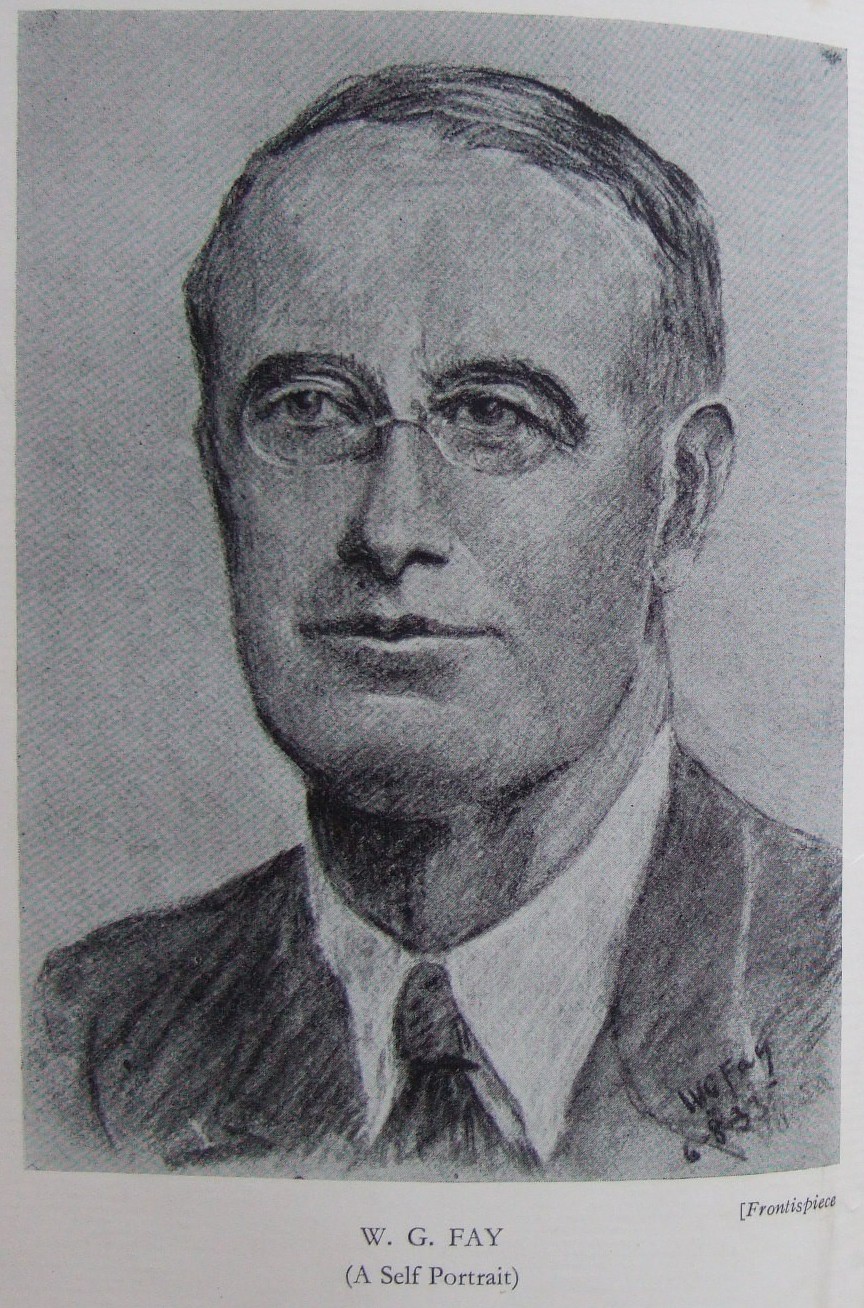
W. G. Fay came to dine with me last night. He entered the hotel and then the restaurant with almost as much modesty and diffidence as if he had never had any experience at all. He said he was not interested in money and had kept all his simple habits. He told me how he and his brother had started a theatre in Liverpool with £5 capital each which they previously had to work for and save. They took a hall and made the seating themselves. He said his father was a civil servant and he was to have been one, but he failed at the preliminary and hated it. During his first theatrical enterprise he worked as an electrician in Dublin from 8 to 6. Then worked on his theatre from 8 to 11, and then would go and talk to Yeats or Martin or Russell till 2 or 3 a.m. He said the opposition to the "Playboy" was indirectly due to the opposition to "The Well of the Saints". The opposition to the latter made Synge say: "I'll write something that will make 'em sit up." He wrote the "Playboy" and it did make'em sit up. He said that at the first night not a word could be heard after the first three minutes. All had to be in dumb show. Later he had policemen to chuck out the worst rowdies. Then the theatre was empty. But he kept open playing to £2 or £3 a week. He stopped all newspaper advertisements and hoarding advts. and kept on. He used to invite the audience to collect in the first row of the stalls. He lost many of his friends and has never got some of them back. After 6 months the newspapers asked for seats. He said they must pay. They said they wanted his advts. back. He said they would have the advts. on condition that they didn't say in the paper that his theatre was empty. He would let them slang his plays and his players, but not say that his theatre was empty. Then the hoarding people came and made peace. . He won out. It seems that Yeats, Lady Gregory and Synge were directors at this time.


William George "Willie" Fay (1872 – 1947) was an actor and theatre producer who was one of the co-founders of the Abbey Theatre. Fay was born in Dublin, where he attended Belvedere College. He worked for a time in the 1890s with a touring theatre company in Ireland, Scotland and Wales. When he returned to Dublin, he worked with his brother Frank, staging productions in halls around the city. Finally, they formed W. G. Fay's Irish National Dramatic Company, focused on the development of Irish acting talent. The brothers participated in founding the Abbey Theatre and were largely responsible for evolving the Abbey style of acting. After a falling-out with the Abbey directors in 1908, the brothers emigrated to the United States to work in theatre there. He moved to London in 1914 worked as an actor on the stage and in films. One of his most notable film roles was as Father Tom in Carol Reed's Belfast-set Odd Man Out (1947), whose cast was dense with actors from the Abbey Theatre. His memoir, The Fays of the Abbey Theatre, appeared in 1935. Willie Fay died in London in 1947, aged 74.


Stork Hotel, Queen's square, Liverpool.
This man was a hero and never shows. He is full of creative ideas about the theatre. Afterwards we went down to the theatre, and later we went with Clive Brook (lead in "Over Sunday") and Clift (Business manager) and I saw these people eat supper at their hotel "The Stork", where you could get drink afterwards.

This morning I went with Iris Hoey to choose a jeune fille costume for the first act. 
See also, September 19th., 'Love in Liverpool' - http://earnoldbennett.blogspot.co.uk/2012/09/love-in-liverpool.html


Additionally for September 6th., see 'A lazy day afloat and ashore' - http://earnoldbennett.blogspot.co.uk/2012/09/a-lazy-day-afloat-and-ashore.html

We stepped off at Duingt because Noel Coward had given such an enthusiastic account of it to Dorothy. Not bad, but suffering from the disadvantage of being seriously cut off by hills from the sun both east and west. Noel must have been there in love some hot August.