Welcome to our blog!


It's better than a bat in the eye with a burnt stick!


This blog makes liberal use of AB's journals, letters, travel notes, and other sources.


And make sure to visit The Arnold Bennett Society for expert information and comment on all aspects of the life and work of AB.

Showing posts with label R L Stevenson. Show all posts

Saturday, 13 March 2021

Laughing matters

Friday, March 14th., Cadogan Square, London.

Yesterday, Reform lunch. Talking about gambling. It was defended by James Currie and even by Lord Buckmaster. Stated to be the one distraction of the people! There is, however, fornication. I felt quite cross to listen to all these well fed and self-satisfied Tories taking about 'the people' as if they have any idea about the lives of ordinary men and women. They do not. Nor do I, but I don't go about the world pretending that I do. They also take it as read that their lives are necessarily 'better' and more important than those of the working classes. I doubt it. I should think there is more genuine feeling and life in the streets of Hammersmith than in any of the genteel homes the toffs return to when they leave their clubs. 

I say Hammersmith because, apropos of all this, when I was coming home from there in the Tube yesterday evening, two workmen got in, one about 35 and the other 18 or 20.They might have been father and son I suppose. It was a pleasure to watch them.

Hammersmith Broadway, 1910 - Tube Station on the right

They carried paint pots and 'turps' pots wrapped in paper and covered at the  top (paint pots, i.e.) with paper with a hole for brush handle to poke through. Dirty. Shabby. Dirty hands. Dirty caps with big peaks. The young one wore black leggings. They pushed the cans as far as possible under seats. The young man was smoking a cigarette. He carried a coil of rope within his buttoned jacket. It stuck up towards his neck. As soon as they sat down each of them pulled a new packet of chewing-gum from his pocket, stripped off the paper, broke the packet in half and put one half into his mouth. I didn't notice any actual jaw motion of chewing. The young man kept on smoking. The chewing-gum business was obviously a regular thing, and much looked forward to. Obvious satisfaction on their faces as they opened the packets. After a few minutes the young man pulled a novelette from his pocket and went on reading it. The elder just sat, contented and relaxed after a hard day's work. So here were some minor distractions of the people: cigarettes, chewing-gum, novelettes. And they probably called in for a pint or two on their way home. 

I think I have lost my sense of humour. I say this because the other evening, browsing on my book shelves, I came upon Stevenson's "Travels with a Donkey". It must be twenty years, if not more, since I read it last and I recalled how much pleasure it had given me. Not now. I doubt I even managed a smile and after three chapters I gave up. On its own this would be no evidence but I have noticed my failure to be amused in several contexts lately, and I feel sad about it. When did I last have a good 'belly laugh'? I would like to bet that there is plenty of laughter in Hammersmith of an evening.

 

Wednesday, 6 January 2021

Bad!

Thursday, January 6th., Cadogan Square, London.

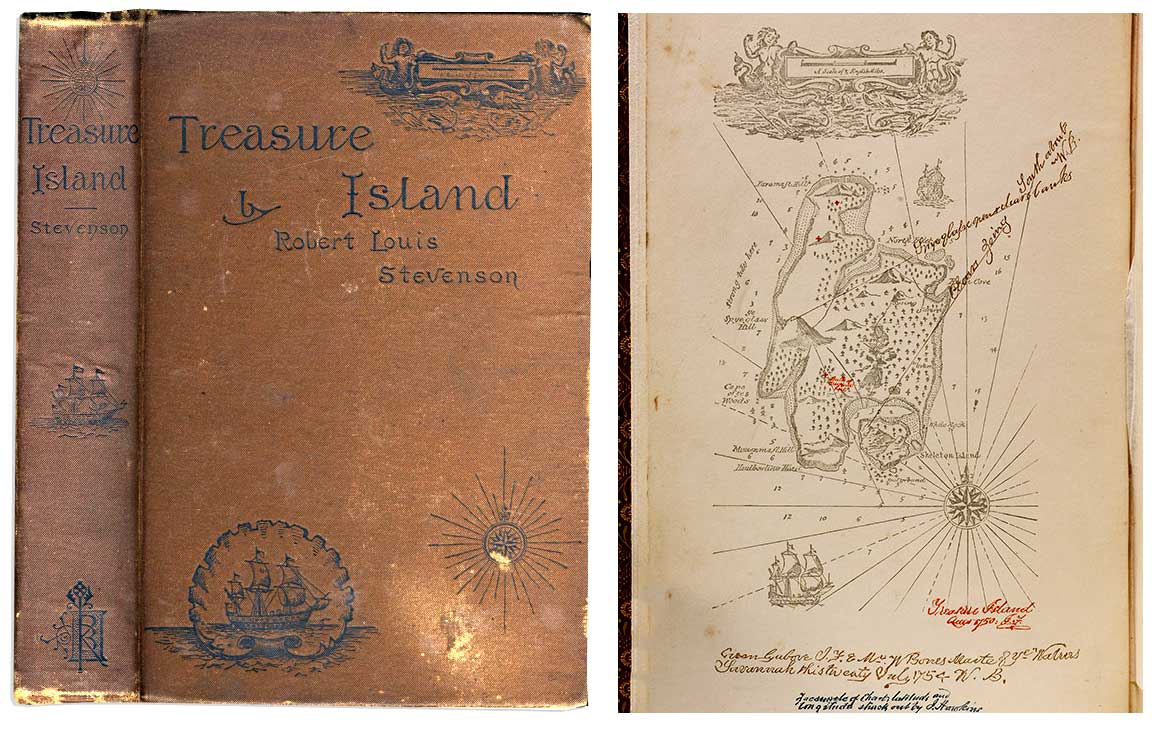
I bought "Treasure Island" yesterday, as I had lately heard such praise of it. All I remember of my first reading, many years ago, is that I liked it. I read a lot of it yesterday afternoon and a little more this morning. All I can say is that I thought it wasn't so bad. I have a soft spot for a rollicking good story, like Haggard's early stuff for example. Sometimes you just want to be carried away by the story, not caring about obvious gaps in the plot or inconsistent characterisation. Whatever you say about Stevenson, he did know how to tell a story. And think of the influence he has had with this book on how people think. Ask anybody what they think of when they think of pirates and they will say things like: "peg-leg", "parrot", "buried treasure", "pieces of eight".

Of course the moral and artistic value of any particular book published now is unknowable to us. Posterity alone will judge our books. I hope it will judge mine favourably. We can however immediately judge the value of our books considered as physical objects. And this consideration has importance. Most books, and especially most novels, are bad examples of the art and craft of making books. They are badly set-up from bad founts of type in a badly designed page, printed on bad paper, badly bound, and enveloped in bad dust covers. They offend the eye of taste; they offend an honest partiality for sound workmanship, and when you have read them they look as misshapen as if they had been thrown down in Piccadilly and run over by a motor bus. I think I may be turning into William Morris in my old age!


Sunday, 13 January 2019

Listless

Wednesday, January 13th., Rue de Calais, Paris.

Horrible muddy weather yesterday and the same again today. A sort of thick mist filled the air, not substantial enough to be called rain but effective at wetting one's person, and depressing one's soul. I long for some warmth and some sunshine. I did nothing all day but prepare to depart for Menton. 

Of course I had a list. I am one of those people who cannot proceed in the absence of a list. Whenever I have some scheme in prospect the first thing I do is to make a list. I like to have it handy, by me, so as to be able to add or subtract as my inclinations develop. To be honest I cannot understand how others manage without lists. I have come across people (men and women) who assert that they would rather die than waste time making lists. Needless to say they generally turn out to be the same people who find themselves missing some essential item. And who do they then turn to? In the face of repeated experience they are generally incorrigible.

I bought two Stevensons recently and have read a lot of "Island Nights". Good sound work, but, strictly judged, decidedly mediocre - though marked by the most charming justice of 'values' as they say in painting. I am in need of a really 'good' book to read and have failed to find one, not for want of trying. Of course I could re-read something I know to be first-rate, but I have a desire for something new and exciting. This is symptomatic I think of a general staleness which I hope this working holiday will dissipate.


Tuesday, 20 May 2014

In praise of Stevenson

Thursday, May 20th., Victoria Grove, Chelsea.

I regard it as a serious and disquieting symptom, that, now that I have finished "In the Shadow", I have a positive wish to work. No man, healthy in mind and body, ever wants to work. He knows that work is good for him and will probably produce happiness, but that he should actually want to work is incredible, except of course after a too protracted holiday.

Stevenson's "Weir of Hermiston, an unfinished romance" appeared today. Chapter VI "A leaf from Christina's psalm-book" contains about 40 pages of the subtlest, surest, finest psychological analysis that I can remember. I am quite sure that there exists nowhere a more beautiful or more profoundly truthful presentation of the emotional phenomena (both in the man and in the woman) which go to the making of 'love at first sight'. On page 178 Stevenson, with secret pride I swear, says: "Thus even that phenomenon of love at first sight, which is so rare and seems so simple and violent, like a disruption of life's tissue, may be decomposed into a sequence of accidents happily concurring." ... Yes, it may, by a Stevenson; perhaps by a Meredith; but by none else of modern writers. "Weir of Hermiston" is as far beyond anything that Hardy, for example, could compass as "The Woodlanders" is beyond my "In the Shadow". Which is to say much! The mere writing of "Weir of Hermiston" surpasses all Stevenson's previous achievements.

Samoan stamp marking the 75th anniversary
 of Stevenson's death
Weir of Hermiston (1896) is an unfinished novel by Robert Louis Stevenson. Many have considered it his masterpiece. It was cut short by Stevenson's sudden death in 1894 from a cerebral haemorrhage. The novel is set in Edinburgh and the Lothians at the time of the Napoleonic Wars. The novel tells the story of Archie Weir, a youth born into an upper-class Edinburgh family. Because of his Romantic sensibilities and sensitivity, Archie is estranged from his father, who is depicted as the coarse and cruel judge of a criminal court. By mutual consent, Archie is banished from his family of origin and sent to live as the local laird on a family property in the vicinity of Hermiston. While serving as the laird, Archie meets and falls in love with Kirstie (Christina). As the two are deepening their relationship, the book breaks off. Confusingly, there are two characters in the novel called Christina.

For more on Stevenson see 'Reflections on the Writer's Craft'

Saturday, 11 May 2013

Reflections on the writer's craft

Monday, May 11th., Victoria Grove, Chelsea.

I read through in the type-written copy some of the later chapters of my novel, and they seemed to be ineffective and sketchy. Which severely depressed me, and to recover myself I had to read certain other chapters which I knew would not come out badly. I happened to see in an old Idler today "Q's" article on his first book. In it he says that he wrote "Dead Man's Rock" without a trace of feeling. His view is that if on revision, the work moves its author, then there is surely some good in it. Amen! Parts of my novel have had that blessed effect on me.

In "Vailima Table Talk", an article by Isobel Strong (Stevenson's step-daughter and amanuensis) in May Scribner, it is said: "He dictates with great earnestness, and when particularly interested unconsciously acts the part of his characters. When he came to the description of the supper Anne has with Flora and Ronald ('St. Ives'), he bowed as he dictated Anne's polite speeches, and twirled his mustache ..." I do that sort of thing myself, but not unconsciously - rather because it amuses me, and deceives me into a belief that I can see the scene which I am describing. But I never can see the scene, or even a single character. Yet, (thanks be to Gawd!) it needs a constant, or at least a repeated, mental effort to grasp the fact that certain stories which I have written, and the novel I am now finishing, aren't really true. I frequently have to say to myself, as it were: "But of course it's not true, really!"