Wednesday, April 11th., Yacht Club, London.
Last week I had an immense burst of work. I did not go to London. I wrote about 5,000 words of my novel (including 2,500 in one day), and finished penultimate chapter of it. On Monday I wrote Daily News article, and more Statesman stuff.
I slept badly the whole time, but a dinner at the Greys on Saturday, where we met the ultra-blonde Danish dancer Karina, and her husband Captain Janssen, did me good. Karina ran over Janssen in her auto and broke both his legs, and then married him. He looks after Karina so completely that he even cuts out leather for her shoes. She is very pretty and agreeable. I sat next to her and enjoyed it.
http://www.britishpathe.com/video/dance-of-the-dying-swan
Hard frost driving home.
Additionally for April 11th., see 'Indecent exposure?'
But the charm of the play is the nudity of Lillah McCarthy when she assassinated Holofernes (after kissing him) in the tent. Upwards, from a line drawn round the body one inch above the clitoris the lady is absolutely nude except for a black velvet band (4 inches wide) round the body hiding the breasts, & a ditto going down perpendicularly from between the breasts to the skirt & so hiding the navel. Two thin shoulder straps held this contrivance in position. Bracelets and rings of course. The skirt was slit everywhere and showed the legs up to the top of the thigh when she lay down there at Holofernes's feet. She looked a magnificent picture thus. The manager of the theatre had some fear of prosecution. I asked him if he had seen Chu Chin Chow. However, I think Lillah beats anything in Chu Chin Chow. Marguerite wanted the skirt a little higher - not for decency, but for beauty. But Ricketts did not agree with her. Lillah gave an exceedingly fine performance - as good as could be wished for.
Welcome to our blog!
It's better than a bat in the eye with a burnt stick!
This blog makes liberal use of AB's journals, letters, travel notes, and other sources.
And make sure to visit The Arnold Bennett Society for expert information and comment on all aspects of the life and work of AB.
Friday, 11 April 2014
Thursday, 10 April 2014
In praise of Lawrence
Thursday, April 10th., Cadogan Square, London.
I recently received a posthumous collection of D. H. Lawrence's journalistic works, and decided before I opened it that I would not like it. Which just shows how wrong one can be. For I like it very much.
Lawrence was a novelist, a dramatist, a poet, a critic, a descriptive writer, and often first-rate in every branch. And he was a first class journalist too. He chose his subjects well. He handled them well - clearly, succinctly, picturesquely, beautifully. He didn't flourish his pen before beginning, and when he had finished he knew he had finished, and stopped. Not a word wasted. The subjects chosen were important, elemental, fundamental, and he struck at once deep down into the core of them.
His remarks on sex are in the nature of an apologia. He is supposed to have been obsessed by sex. The fact is that at his best he was no more obsessed by sex than any normal human being. But he wrote more frankly and more cleanly about it than most. He tried to fish up sex from the mud into which it has been sunk for several hypocritical and timid English generations past. He had a philosophy of sex which is more or less illustrated in all his novels. But he also had a philosophy of friendship, quite as profound and revealing as his philosophy of sex.
I am a tremendous admirer of Lawrence. In my opinion Lawrence lacked one quality - the power to discipline and control his faculties. Especially in his earlier books he let those superlative faculties - for instance his descriptive faculty - get the bit between their teeth and gallop around with a thunder of hoofs and a lightning of glances very exciting to hear and see; but extravagant. Lawrence seemed to me sometimes to suffer from a delusion similar to the delusion of a sick man who thinks that if a given quantity of medicine will do him good, twice the quantity will do him twice as good.
Still I would say that no finer work has been done in our time than Lawrence's finest. He is not yet understood, even by the majority of his admirers. But he will be; and meanwhile his works must accept injustice. In the future no first editions of present day writers will be more passionately and expensively sought for than Lawrence's, except perhaps Joyce's. I regard this as certain.
A few years ago I was forwarded a letter from Lawrence by Pinker who was his agent as well as mine. It read as follows:
My dear Pinker,
I am sorry to tell you that I am coming to the last end of all my resources, as far as money goes. Do you think that Arnold Bennett or somebody like that, who is quite rich out of literature, would give me something to get along with? It is no use my trying to delude myself that I can make money in this world that is. But there is coming a big smash-up, after which my day will begin. And as the smash-up is not far off, so I am not very far from a walk-in ...
Do try and tempt a little money out of some rich, good-natured author for me will you - or I don't know what I shall do. And really, you know, one can't begin taking one's hat off to money, at this late hour of the day. I'd rather play a tin whistle in the street. What a lively world! ...
D. H. Lawrence
I recently received a posthumous collection of D. H. Lawrence's journalistic works, and decided before I opened it that I would not like it. Which just shows how wrong one can be. For I like it very much.
Lawrence was a novelist, a dramatist, a poet, a critic, a descriptive writer, and often first-rate in every branch. And he was a first class journalist too. He chose his subjects well. He handled them well - clearly, succinctly, picturesquely, beautifully. He didn't flourish his pen before beginning, and when he had finished he knew he had finished, and stopped. Not a word wasted. The subjects chosen were important, elemental, fundamental, and he struck at once deep down into the core of them.
His remarks on sex are in the nature of an apologia. He is supposed to have been obsessed by sex. The fact is that at his best he was no more obsessed by sex than any normal human being. But he wrote more frankly and more cleanly about it than most. He tried to fish up sex from the mud into which it has been sunk for several hypocritical and timid English generations past. He had a philosophy of sex which is more or less illustrated in all his novels. But he also had a philosophy of friendship, quite as profound and revealing as his philosophy of sex.
I am a tremendous admirer of Lawrence. In my opinion Lawrence lacked one quality - the power to discipline and control his faculties. Especially in his earlier books he let those superlative faculties - for instance his descriptive faculty - get the bit between their teeth and gallop around with a thunder of hoofs and a lightning of glances very exciting to hear and see; but extravagant. Lawrence seemed to me sometimes to suffer from a delusion similar to the delusion of a sick man who thinks that if a given quantity of medicine will do him good, twice the quantity will do him twice as good.
Still I would say that no finer work has been done in our time than Lawrence's finest. He is not yet understood, even by the majority of his admirers. But he will be; and meanwhile his works must accept injustice. In the future no first editions of present day writers will be more passionately and expensively sought for than Lawrence's, except perhaps Joyce's. I regard this as certain.
A few years ago I was forwarded a letter from Lawrence by Pinker who was his agent as well as mine. It read as follows:
My dear Pinker,
I am sorry to tell you that I am coming to the last end of all my resources, as far as money goes. Do you think that Arnold Bennett or somebody like that, who is quite rich out of literature, would give me something to get along with? It is no use my trying to delude myself that I can make money in this world that is. But there is coming a big smash-up, after which my day will begin. And as the smash-up is not far off, so I am not very far from a walk-in ...
Do try and tempt a little money out of some rich, good-natured author for me will you - or I don't know what I shall do. And really, you know, one can't begin taking one's hat off to money, at this late hour of the day. I'd rather play a tin whistle in the street. What a lively world! ...
D. H. Lawrence
I offered to let him have £3 a week if Wells and Galsworthy did the same. Pinker informed Lawrence, and returned with the report that he regarded the offer as an insult. So, I confined my assistance to the preaching of Lawrence's dazzling merits.
Additionally for April 10th., see 'Living with a martyr'
What would she say if I put on a martyr act as she does? A change is absolutely essential because my life is being poisoned and all her charm and all her talent will not be enough to prevent a catastrophe. She scolds, she criticises, she whines, and I don't know if she realises what she is doing, but she will have to confront her behaviour this time!
If, as always, she finds that she is completely in the right and I am completely in the wrong, she will force me to leave her.
I am not just a machine for making money, and she would be well advised to treat me with a little consideration as I am becoming dangerous.
Additionally for April 10th., see 'Living with a martyr'
What would she say if I put on a martyr act as she does? A change is absolutely essential because my life is being poisoned and all her charm and all her talent will not be enough to prevent a catastrophe. She scolds, she criticises, she whines, and I don't know if she realises what she is doing, but she will have to confront her behaviour this time!
If, as always, she finds that she is completely in the right and I am completely in the wrong, she will force me to leave her.
I am not just a machine for making money, and she would be well advised to treat me with a little consideration as I am becoming dangerous.
Wednesday, 9 April 2014
Done in the eye
Friday, April 9th., Clarendon Road, Putney.
Wednesday. Dinner at Ford Madox Hueffer's. John Galsworthy and wife there. Slight gene on my part on first encounter with Galsworthy, seeing my recent articles on him. However we did well together and he asked me to dinner. Hueffer said that Henry James dictated so slowly that he insisted on his amanuensis having a novel open before her to read while he dictated. He said that Conrad was still as late as ever with his copy.
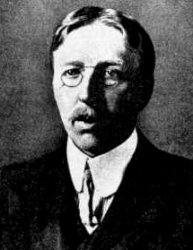
I wonder at myself accepting Hueffer's invitation. Earlier this year he played a dirty trick on me by agreeing with Pinker to buy a short story of mine at a fraction of its worth. He told Pinker that I had originally agreed to do a serial and the short story was by way of some compensation for reneging on this agreement. A pack of lies presented as half-truths. I wrote to him to express my feelings and soon afterwards he invited me to dinner. I replied in sorrow that I could not come to dinner, as I considered that he had done me in the eye over the price of the short story. He wrote to ask me by how much I considered that he had done me in the eye. I answered by at least ten pounds. He sent me a cheque for ten pounds. I attended his dinner. Such is the way the world works.
All these days magnificent weather. East wind having gradually died down. Putney Bridge and High Street at 11 a.m. Talk about road to Delhi. "I met a hundred men on the road to Portsmouth and they were all my brothers" (Indian proverb).
Additionally for April 9th., see 'Parisian life'
Cornillier called yesterday morning, and I was telling him about a good early picture by Tissot that Ullman had bought for 200 francs. He said that a long time ago Tissot had a mistress, with whom he had continued relations for a considerable period. He decided to break the liaison, and he wrote one letter to his mistress, giving her the gentlest possible hint that the affair must ultimately come to an end, and another letter to an intimate friend, a man, saying brutally that he was sick of the thing and wanted to marry. he mixed the letters up, and the mistress received the wrong one. She committed suicide. Tissot was deeply affected, regarded himself as her murderer, and became devot. This was really the origin of his journeys to Palestine, and the ruin of his art.
Wednesday. Dinner at Ford Madox Hueffer's. John Galsworthy and wife there. Slight gene on my part on first encounter with Galsworthy, seeing my recent articles on him. However we did well together and he asked me to dinner. Hueffer said that Henry James dictated so slowly that he insisted on his amanuensis having a novel open before her to read while he dictated. He said that Conrad was still as late as ever with his copy.
The writer Ford Madox Hueffer, now known as Ford Madox Ford, was a prolific novelist, poet, critic, editor, and reminiscer. He is one of the most intriguing, versatile, and often still misunderstood of the great Modernist writers. He was brought up in London, the grandson of Ford Madox Brown, the painter closely associated with the Pre-Raphaelites. At the turn of the century he lived on the Romney Marsh, befriending Henry James and Stephen Crane, and beginning a ten-year collaboration with Joseph Conrad. In the years before the First World War he moved to London, where he founded the English Review, bringing together many of the best established writers of the day – James, Thomas Hardy, Conrad, H. G. Wells, and Arnold Bennett – with his new discoveries, many of whom would help redefine modern literature, such as Ezra Pound, Wyndham Lewis, and D. H. Lawrence. Ford’s best-known and most highly-regarded novel was The Good Soldier (1915). During the war he wrote propaganda; but in 1915 enlisted, serving in France in 1916-17 during the Battle of the Somme and at the Ypres Salient. He was invalided back to Britain in 1917, remaining in the army and giving lectures. After a spell recuperating in the Sussex countryside after the war, Ford lived mostly in France during the 1920s, first in Provence, then in Paris. He published his other major fictional work, the series of four novels known as Parade’s End, between 1924 and 1928. These were particularly well-received in America, where Ford spent much of his time from the later 1920s to his death in 1939.
I wonder at myself accepting Hueffer's invitation. Earlier this year he played a dirty trick on me by agreeing with Pinker to buy a short story of mine at a fraction of its worth. He told Pinker that I had originally agreed to do a serial and the short story was by way of some compensation for reneging on this agreement. A pack of lies presented as half-truths. I wrote to him to express my feelings and soon afterwards he invited me to dinner. I replied in sorrow that I could not come to dinner, as I considered that he had done me in the eye over the price of the short story. He wrote to ask me by how much I considered that he had done me in the eye. I answered by at least ten pounds. He sent me a cheque for ten pounds. I attended his dinner. Such is the way the world works.
All these days magnificent weather. East wind having gradually died down. Putney Bridge and High Street at 11 a.m. Talk about road to Delhi. "I met a hundred men on the road to Portsmouth and they were all my brothers" (Indian proverb).
Additionally for April 9th., see 'Parisian life'
Cornillier called yesterday morning, and I was telling him about a good early picture by Tissot that Ullman had bought for 200 francs. He said that a long time ago Tissot had a mistress, with whom he had continued relations for a considerable period. He decided to break the liaison, and he wrote one letter to his mistress, giving her the gentlest possible hint that the affair must ultimately come to an end, and another letter to an intimate friend, a man, saying brutally that he was sick of the thing and wanted to marry. he mixed the letters up, and the mistress received the wrong one. She committed suicide. Tissot was deeply affected, regarded himself as her murderer, and became devot. This was really the origin of his journeys to Palestine, and the ruin of his art.
Tuesday, 8 April 2014
Dining out
Saturday, April 8th., Les Sablons,
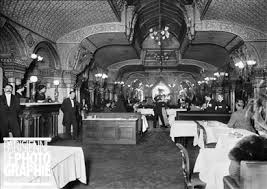
Mrs. Devereux dined with me at Noel and Peters. For the first time in the history of our acquaintance she was prompt. At least not prompt but in front of time. Women are never exact. I was exact and so she had to wait. I must admit that I like to be seen out with her. Her higher social status embellishes her magnetism for me, but she is in any case an attractive woman. I told her recently that it was singular that I had never got up a passion for her. She also supposed it was and said, "because in some ways, I suppose, I must be the most attractive woman you have ever known in your life." Quite a claim, but she may be right.
For more on Mrs. Devereux see 'Back to work'
I have been 'driven' this week, and have not been able either to practise the piano much, or to keep this journal. On Tuesday I got all my ideas together for the third instalment of the serial. But I dined with Misses Thomasson and Hegersheimer in the evening, and Miss Thomasson spent an hour in her studio, lighted by a single small lamp, in making a mayonnaise. Consequently the dinner was 75 minutes late, though excellent. The mayonnaise succeeded admirably. I ate too much of it, and what with this and the dinner being late, I had a bilious attack the next day, the first for about a year.
For more on Miss Thomasson see 'Ideas on women'
I have had our French play typewritten. The typist brought it herself this morning. She told me, incidentally, that French theatrical managers were very conservative and had a prejudice against typewriting. As a matter of fact they are not in the least conservative. They are routinier, which is not the same thing.
Additionally for April 8th., see 'Playing hard to get'
Beaverbrook has invited us for the weekend. I knew that if I kept quiet the chap would make overtures to me. He told me through Blumenfield, the Editor of the Express, that I had quite deserted him. I sent him a very stiff message through the same intermediary. These millionaires always think that everyone is the same as the over-eager crowd around them. But I find Max very congenial. He has the faults of his qualities - and of his money. And I will need him soon for my next novel. He will be indispensable to me for it. All the same, of course, I refused his invitation. I will see him in London one day. He is very touchy. It will do him good for me to treat him as just anybody. After all, why shouldn't I?
![]() |
| Interior of Noel Peters, Passage des Princes |
For more on Mrs. Devereux see 'Back to work'
I have been 'driven' this week, and have not been able either to practise the piano much, or to keep this journal. On Tuesday I got all my ideas together for the third instalment of the serial. But I dined with Misses Thomasson and Hegersheimer in the evening, and Miss Thomasson spent an hour in her studio, lighted by a single small lamp, in making a mayonnaise. Consequently the dinner was 75 minutes late, though excellent. The mayonnaise succeeded admirably. I ate too much of it, and what with this and the dinner being late, I had a bilious attack the next day, the first for about a year.
For more on Miss Thomasson see 'Ideas on women'
I have had our French play typewritten. The typist brought it herself this morning. She told me, incidentally, that French theatrical managers were very conservative and had a prejudice against typewriting. As a matter of fact they are not in the least conservative. They are routinier, which is not the same thing.
Additionally for April 8th., see 'Playing hard to get'
Beaverbrook has invited us for the weekend. I knew that if I kept quiet the chap would make overtures to me. He told me through Blumenfield, the Editor of the Express, that I had quite deserted him. I sent him a very stiff message through the same intermediary. These millionaires always think that everyone is the same as the over-eager crowd around them. But I find Max very congenial. He has the faults of his qualities - and of his money. And I will need him soon for my next novel. He will be indispensable to me for it. All the same, of course, I refused his invitation. I will see him in London one day. He is very touchy. It will do him good for me to treat him as just anybody. After all, why shouldn't I?
Monday, 7 April 2014
Social philosophy
Monday, April 7th., Comarques, Thorpe-le-Soken.
Last week, being in need of inspirational bucking-up, I dropped "War and Peace" and read Balzac's "Cure de Tours" and "Pierrette". Latter better than Saintsbury says it is. Balzac was an ignorant and crude man, often childish in his philosophising. But if he had been properly educated and influenced he would have been a great social philosopher. His apercus are often astounding. And his vitality is terrific. he is full of inspiring and agreeable ornament. Nothing of the kind in Tolstoy. All a flat recital. Often dull, unless you give yourself to it. But if you do he is never dull. Some of Tolstoy's long descriptions (such as of the wolf-hunt on Count Ilza's estate) are extremely beautiful. Natasha is the most beautiful character - anyway up to page 700 or so, where I now am.
Will I be thought of as any sort of social philosopher in the future? I should certainly think that my Five Towns books will be useful as social history, but have my characters any universal significance? I would like to think so. And when I think for example about the marriage of Edwin and Hilda, as described in "These Twain", it seems to me, and others have told me, that I have captured something important, if not profound. Also death has featured in several of my books and I think I have shown something of the variety of human response to that most troubling of experiences.
Additionally for April 7th., see 'Identity and disguise'
Since the war I have naturally become a target for satire, and I know it. It is partly the price of fame and partly because I have deliberately courted publicity and made myself into a 'character'. I have become a popular cartoon subject, turning up in various guises - at first nights, in the barber's and in the cartoon above. All publicity is essentially good publicity and I have given the press and cartoonists things to seize on - very fine lace shirts, the quiff of my hair, and my fob. I consider these to be both an identity and a disguise.
Last week, being in need of inspirational bucking-up, I dropped "War and Peace" and read Balzac's "Cure de Tours" and "Pierrette". Latter better than Saintsbury says it is. Balzac was an ignorant and crude man, often childish in his philosophising. But if he had been properly educated and influenced he would have been a great social philosopher. His apercus are often astounding. And his vitality is terrific. he is full of inspiring and agreeable ornament. Nothing of the kind in Tolstoy. All a flat recital. Often dull, unless you give yourself to it. But if you do he is never dull. Some of Tolstoy's long descriptions (such as of the wolf-hunt on Count Ilza's estate) are extremely beautiful. Natasha is the most beautiful character - anyway up to page 700 or so, where I now am.
Will I be thought of as any sort of social philosopher in the future? I should certainly think that my Five Towns books will be useful as social history, but have my characters any universal significance? I would like to think so. And when I think for example about the marriage of Edwin and Hilda, as described in "These Twain", it seems to me, and others have told me, that I have captured something important, if not profound. Also death has featured in several of my books and I think I have shown something of the variety of human response to that most troubling of experiences.
Additionally for April 7th., see 'Identity and disguise'
Since the war I have naturally become a target for satire, and I know it. It is partly the price of fame and partly because I have deliberately courted publicity and made myself into a 'character'. I have become a popular cartoon subject, turning up in various guises - at first nights, in the barber's and in the cartoon above. All publicity is essentially good publicity and I have given the press and cartoonists things to seize on - very fine lace shirts, the quiff of my hair, and my fob. I consider these to be both an identity and a disguise.
Sunday, 6 April 2014
Popping pills
Monday, April 6th., Cadogan Square, London.
Some weeks ago Mrs. S. M. recommended to me some anti-fat pills made and sold by a chemist at Nice. The course was six boxes. I got the six boxes from Nice and began. Mrs. S. M. positively assured me that they were quite harmless and very effective. After I had taken a little more than two boxes, I began to notice that I perspired very freely and also was short-winded after any exertion. Also that my heart made a too loud noise and was rather irregular. So much so that I could not sleep on my left side on account of the thumping row. Fjellsted, my masseur, told me my heart had been affected by something - he thought it was due to veronal, of which I had taken one dose for insomnia. (By the way my sleep grew heavier but much more broken, and no better as regards total quantity.) I hadn't and haven't told him about the anti-fat pills as his feeling against all pills is so strong.
I then sent for Dr. Griffin. He examined me and said my heart was organically quite all right, but that it had been upset by the pills and that I must at once cease to take them. He came a second time on Sunday, and said that the improvement, though noticeable, was very slight. I still have to walk upstairs very slowly and to avoid any physical strain. Dr. Griffin had the pills analysed. The analysis on the box (in accordance with French law) says: "Iodothyrine", "Hypophyse", "Surrenales", and "Genesiques". He said that the quantity of thyroid (cheap) was larger than in the formula on the box. He said that I oughtn't to take medicines without consulting him. And of course he is quite right. It is perfectly staggering the idiotic things even a wise man will do.
Additionally for April 6th., see 'Trouble and strife'
My wife is deceiving me.
At the end of March Marguerite went off to Frascati, ostensibly for a holiday, ostensibly alone. Then I discover from her letters that she has 'by chance' met Legros there, 'with his mistress'. She must think me a simpleton! We were introduced to Legros in 1920 by Robert Nichols, the poet. Legros is French and has lectured in French at Bedford College, where Marguerite gave a recital. He is also the tenant of Marguerite's flat in Thackeray Mansions. He is 16 years younger than Marguerite but she has clearly become infatuated with him.
Some weeks ago Mrs. S. M. recommended to me some anti-fat pills made and sold by a chemist at Nice. The course was six boxes. I got the six boxes from Nice and began. Mrs. S. M. positively assured me that they were quite harmless and very effective. After I had taken a little more than two boxes, I began to notice that I perspired very freely and also was short-winded after any exertion. Also that my heart made a too loud noise and was rather irregular. So much so that I could not sleep on my left side on account of the thumping row. Fjellsted, my masseur, told me my heart had been affected by something - he thought it was due to veronal, of which I had taken one dose for insomnia. (By the way my sleep grew heavier but much more broken, and no better as regards total quantity.) I hadn't and haven't told him about the anti-fat pills as his feeling against all pills is so strong.
Barbital or barbitone, marketed under the brand names Veronal for the pure acid and Medinal for the sodium salt, was the first commercially available barbiturate. It was used as a sleeping aid from 1903 until the mid-1950s.
I then sent for Dr. Griffin. He examined me and said my heart was organically quite all right, but that it had been upset by the pills and that I must at once cease to take them. He came a second time on Sunday, and said that the improvement, though noticeable, was very slight. I still have to walk upstairs very slowly and to avoid any physical strain. Dr. Griffin had the pills analysed. The analysis on the box (in accordance with French law) says: "Iodothyrine", "Hypophyse", "Surrenales", and "Genesiques". He said that the quantity of thyroid (cheap) was larger than in the formula on the box. He said that I oughtn't to take medicines without consulting him. And of course he is quite right. It is perfectly staggering the idiotic things even a wise man will do.
Additionally for April 6th., see 'Trouble and strife'
My wife is deceiving me.
At the end of March Marguerite went off to Frascati, ostensibly for a holiday, ostensibly alone. Then I discover from her letters that she has 'by chance' met Legros there, 'with his mistress'. She must think me a simpleton! We were introduced to Legros in 1920 by Robert Nichols, the poet. Legros is French and has lectured in French at Bedford College, where Marguerite gave a recital. He is also the tenant of Marguerite's flat in Thackeray Mansions. He is 16 years younger than Marguerite but she has clearly become infatuated with him.
Saturday, 5 April 2014
Habit of work
Sunday, April 5th., Les Sablons.
I finished this morning at 8.30 a.m. the "Snake Charmer", melodrama in One Act. It is intended as a music-hall sketch. I have no real expectations of it ever being played. I make £25 out of it, down, and that is all I am sure of.
Habit of work is growing on me. I could get into the way of going to my desk as a man goes to whisky, or rather to chloral. Now that I have finished all my odd jobs and have nothing to do but 10,000 words of a novel a week and two articles a week, I feel quite lost, and at once begin to think, without effort, of ideas for a new novel. My instinct is to multiply books and articles and plays. I constantly gloat over the number of words I have written in a given period.
All I want now is about 5,000 francs extra to fix us in the Fontainebleau house.
Additionally for April 5th., see 'A parliamentary occasion'
Looking from left, I could just see Ll. G., Churchill, Bonar Law, Cecil, Balfour etc., on right. House full. 12 or so standing between cross benches. (Gallery opposite full. Side galleries half full.) Two M.P.s wearing hats. As the M.P.s left they bowed awkwardly to Speaker in getting up if in front rows or on reaching central space if not; and on coming in they bowed either on entering, or on reaching open space. Speaker under a canopy.
I finished this morning at 8.30 a.m. the "Snake Charmer", melodrama in One Act. It is intended as a music-hall sketch. I have no real expectations of it ever being played. I make £25 out of it, down, and that is all I am sure of.
Habit of work is growing on me. I could get into the way of going to my desk as a man goes to whisky, or rather to chloral. Now that I have finished all my odd jobs and have nothing to do but 10,000 words of a novel a week and two articles a week, I feel quite lost, and at once begin to think, without effort, of ideas for a new novel. My instinct is to multiply books and articles and plays. I constantly gloat over the number of words I have written in a given period.
All I want now is about 5,000 francs extra to fix us in the Fontainebleau house.
Additionally for April 5th., see 'A parliamentary occasion'
Looking from left, I could just see Ll. G., Churchill, Bonar Law, Cecil, Balfour etc., on right. House full. 12 or so standing between cross benches. (Gallery opposite full. Side galleries half full.) Two M.P.s wearing hats. As the M.P.s left they bowed awkwardly to Speaker in getting up if in front rows or on reaching central space if not; and on coming in they bowed either on entering, or on reaching open space. Speaker under a canopy.
Subscribe to:
Posts (Atom)