Friday, December 28th., Chiltern Court, London.
The weather continues grey and cold and damp but I find myself to be surprisingly cheerful. My digestion is better than it has been for some time and my neuralgia is much less troublesome. Now that we are settled here I feel more content though financially the place is a considerable burden. I have spent more than I ever expected to adapt the place to suit Dorothy, and I still think she does not like it, though she has ceased to make a fuss. I look back nostalgically to those halcyon days at Cadogan Square, after parting from Marguerite, when I had only myself to please.
Is it possible to effectively translate a work of fiction from one language to another? My instinctive response is negative. This question comes to mind because of a visit for tea today by S. K. and her husband. S. has lived in this country for 40 years, coming originally from Argentina, and I have known her for two decades. She is a person of lively, indeed sparkling, and challenging intelligence and, alongside her main employment, has worked as an interpreter (Spanish/English). More recently she has been developing an academic interest in translation and we have been exchanging views. It has seemed to me that the language in which something is conceived and written is so fundamental, indeed integral, to its effectiveness as a work of art that any translation, however good, must necessarily be a diminution. However, S. has gone some way to persuading me that I may be wrong. Thinking about it now it seems to me that a translation may be entirely successful if the translator is able to straddle not only the two languages, but also the two cultures (which may be chronologically separated as well as geographically). Is this possible? Well, S. thinks so and indeed has herself engaged in translation of an Argentinian author with apparent success. She knows a lot more about this than I do and I am prepared to be persuaded, though not without a fight.
Of course I have read and reviewed many books in translation myself and it occurs to me now that when I have found them to be good, or occasionally excellent, I have really had no idea how far, if at all, they capture the spririt of the original. I don't know why I haven't thought of this before, and I may work up an article on the subject. A good case in point is Feuchtwanger's "Jew Suss". I am largely credited with popularising that book in this country and I feel just a little embarrassed now to acknowledge that I never even thought of asking a native German speaker to give me an opinion on the authenticity of the translation I used. Of course, in a sense, the translation may become a work of art in its own right; it could even be an 'improvement' on the original. There is more to think about here than I had previously realised.
Showing posts with label Jew Suss. Show all posts
Showing posts with label Jew Suss. Show all posts
Friday, 28 December 2018

Saturday, 13 January 2018
He may be a Jew himself
Saturday, January 13th., Cadogan Square, London.
"Jew Suss" by Lion Feuchtwanger, a German author previously unknown to me, is a good historical novel dealing with the political and social life of a German state in the eighteenth century. It will interest people who usually cannot bring themselves to read historical novels, for the reasons that it deals with the whole life of the State, that it is not sentimentalised, that it is outspoken in all matters, and that it has throughout genuine and admirably sustained imaginative power.
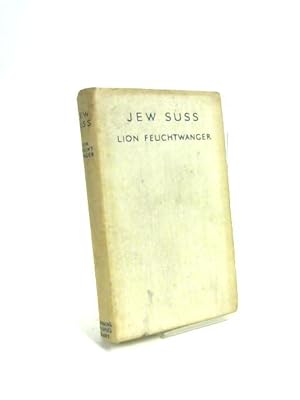 In fact, this book is remarkable, full of food for vigorous minds. The picture drawn of existence in in a civilised counrty less than 200 years ago is terrible. Such a combination of intrigue, corruption, tyranny, injustice, ignorance, cruelty, uncleanliness and fornication that I have seldom, if ever, come across before. The hero is a Jew (or reputed Jew), a great refined rascal, debauchee and grinder of the faces of the poor. But he is a sympathetic fellow, and his execution by hanging amid circumstances of fantastic terror will move the heart of the staunchest upholder of morality. The author treats the Jewish community with extraordinary insight and fairness; he may be a Jew himself.
I myself hesitated to begin the book, because I have been too often deceived and let down by historical novels, whose authors as a rule do not fully know their subjects. Feuchtwanger must have immersed himself in his period with the thoroughness and impartiality of an historical student. It is a rare combination to find someone who knows an historical period and can write convincingly about it. When very well done historical novels are hard to beat because of the total immersion of the reader in an 'alien' world. For myself I find it hard to revert to normal life when engrossed by such a work.
"Jew Suss" is a splendid story, but it is also a complete picture of a complex social organism from top to bottom. It entertains, it enthralls, and simultaneously it teaches; it enlarges the field of knowledge. To the ordinary reader it brings home, far better than any history could do, the realities of the eighteenth century, and enables him - nay, compels him - by partly unconscious comparison with the realities of today, to perceive the strange rapidity of the evolution of mankind.
"Jew Suss" by Lion Feuchtwanger, a German author previously unknown to me, is a good historical novel dealing with the political and social life of a German state in the eighteenth century. It will interest people who usually cannot bring themselves to read historical novels, for the reasons that it deals with the whole life of the State, that it is not sentimentalised, that it is outspoken in all matters, and that it has throughout genuine and admirably sustained imaginative power.
I myself hesitated to begin the book, because I have been too often deceived and let down by historical novels, whose authors as a rule do not fully know their subjects. Feuchtwanger must have immersed himself in his period with the thoroughness and impartiality of an historical student. It is a rare combination to find someone who knows an historical period and can write convincingly about it. When very well done historical novels are hard to beat because of the total immersion of the reader in an 'alien' world. For myself I find it hard to revert to normal life when engrossed by such a work.
"Jew Suss" is a splendid story, but it is also a complete picture of a complex social organism from top to bottom. It entertains, it enthralls, and simultaneously it teaches; it enlarges the field of knowledge. To the ordinary reader it brings home, far better than any history could do, the realities of the eighteenth century, and enables him - nay, compels him - by partly unconscious comparison with the realities of today, to perceive the strange rapidity of the evolution of mankind.
Subscribe to:
Posts (Atom)