Welcome to our blog!


It's better than a bat in the eye with a burnt stick!


This blog makes liberal use of AB's journals, letters, travel notes, and other sources.


And make sure to visit The Arnold Bennett Society for expert information and comment on all aspects of the life and work of AB.

Sunday, 21 March 2021

More Cointreau needed

Saturday, March 21st., Cadogan Square, London.

We were at Lady Colefax's supper to meet John Barrymore on Thursday night. There were no Asquith's there which was surprising as Asquiths seemed to occupy all the boxes on the first night of Barrymore's "Hamlet" at the Haymarket. Also they were photographed in their boxes. Barrymore, at the supper where he arrived after 1 a.m., seemed to be partly exhausted. He looked distinguished but didn't talk distinguished. During songs he closed his eyes and seemed to sleep. Then he exclaimed: "Oh, for some Cointreau!" very urgently, and it was brought quickly to him. He is very shrewd and perspicacious. Needless to say he was much admired by the ladies, not excepting Dorothy.

I am inclined to be 'unwell'; some people, I know, think me something of a hypochondriac because I generally look well enough whilst complaining of a variety of symptoms not visible to them. In fact I think that people admit themselves 'unwell' oftener than they used to. This is because they know a little more about the greatest of all physical marvels and mysteries, the human body. I former days an indisposition was looked upon as the act of God and regarded fatalistically. Now it is known to be the act of man and therefore perhaps cuarable if officially proclaimed and treated. The champions of the past in this matter say that we are a generation of mollycoddles.

Still, we live appreciably longer than our ancestors. Some will assert that since life is a nuisance, then longer life is a still greater nuisance. I do not subscribe to this view in spite of my notorious ill health. In some ways we have retained the foolishness of the past. Today, just as in former times, there are certain diseases, especially those affecting physical attractiveness, as to which women will unfailingly become hysterical. And men are as apt as ever to become hysterical if their digestive organs go wrong. I am guilty of this. On the other hand a man will still as of old deny to himself the existence of an obvious  chronic malady, and carry on his existence as if his proper place was not in bed. And then die suddenly, and have the effrontery to be surprised thereat.

And what remarkable faith we can generate, in the face of all good sense, in patent remedies. I am guilty of this as well. Not only will people try all sorts of quack medicines, they will convince themselves they are working, and broadcast their success, until their failure becomes manifest and there is no alternative to a quiet reversion often accompanied by a declaration that they didn't really expect it to work in any case.

Saturday, 20 March 2021

In the country

Saturday, March 20th., Trinity Hall Farm, Hockliffe.

Out early this morning after a decent night. Nearly five hour first sleep. Feeling pretty fit and very glad to be away from towns and cities, though they pull me still. I suppose it is to do with having been raised in an urban setting. Though I feel happy here I shall never feel that I belong. I am tolerated and humoured by the people I meet locally. They are too polite to tell me I am not one of them, but I know it.

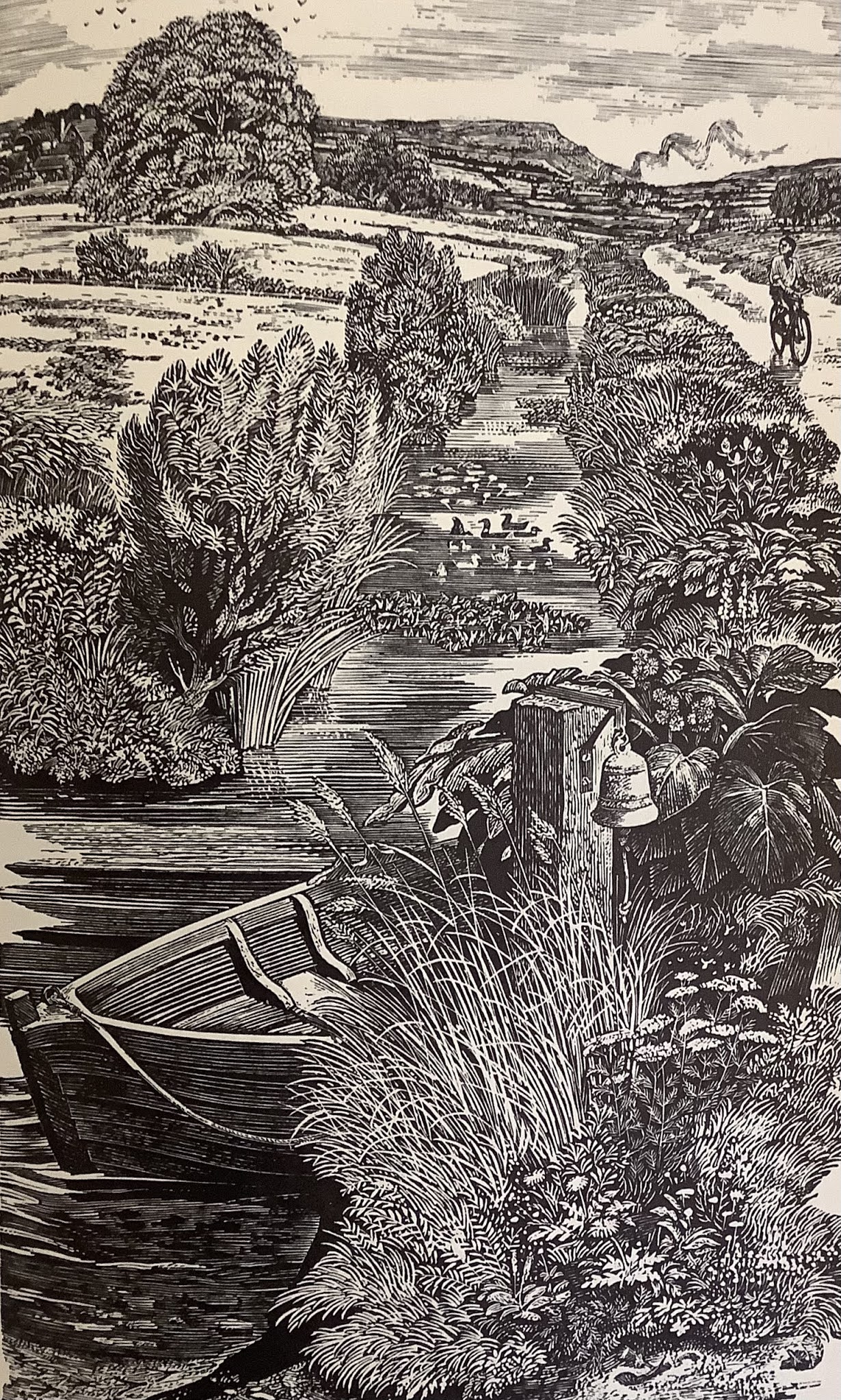
Speaking of belonging, I have just finished reading an excellent short novel which has that as one of its themes. "A Month in the Country" by J.L. Carr. I think it spoke more clearly to me living here than it would have done had I been still living in London or, God forbid, Paris. It is a remembrance by a man named Birkin of a golden summer when he was a young man, not long back from the horrors of the War. He is a restorer of wall paintings in old churches and is commissioned to a job in Yorkshire. There he meets another ex-soldier, lives in the belfry of the church, becomes involved in aspects of local life, and falls in love with the vicar's wife. All in the space of a few weeks of summer. Carr draws his characters for us sparely but sufficiently. We can feel Birkin coming alive again before our eyes. It is a portrait of an ideal, imaginary, England such as we would like to believe in, inhabited by decent people, a place of hope and comfort. Hopelessly nostalgic of course but none the worse for that; I was happily absorbed by it. Only a novella really though presented as a novel in the edition I read which was additionally beautifully illustrated (engravings) by Ian Stephens. A pleasure to read and to look at.


Friday, 19 March 2021

Two bibliophiles

Friday, March 24th., Hotel Majestic, Paris.

This is an excellent hotel, but not the one I would have chosen. It is all we could get. Rosenbach and I have a terrific apartment here: Drawing-room, two bedrooms and two bathrooms for £3.10/- a day. You wouldn't get it in London for twice that. But I shall leave it because the Champs Elysee is such a hades of a length.

We had an excellent journey here, no problem with the crossing. Rosenbach is one of those exhaustless persons. He would go to a music-hall last night  because of the row going on here about nude women on the stage. There is danger of them being forbidden so we had to see them before they were. Well, we saw them all right! Some with a frail girdle, some with nothing whatever. Then he wanted to go forth for 'supper', but I dissuaded him and got him back here by 12.30, and this morning he thanked me heartily for that. Who would have thought that a bibliophile would turn out to be such a lively character? We first met in the U.S.A. in 1911 and at that time he seemed to me to be a typical Jewish intellectual, or at least my stereotype of one. He is known in London as "The Terror of the Auction Rooms", and here as "The Napoleon of Books". Knowing this I suppose I should have guessed that his character would be rather larger than life.

What to make of the nude revues now that I have seen one for myself? What they are not is titillating. They aim I think to be artistic, and perhaps they are, but it is indubitably the nudity that is the attraction. They undoubtedly objectify women and that must be a bad thing. Of course that is what men have always done. Many of the great masters of painting, Titian as an example, did the same thing. Where lies the difference? I did feel uncomfortable, as a man, staring at naked women on stage. I won't be going again.

Rosenbach tells me that he is hopeful of purchasing the manuscript of "Ulysses"  from Joyce. He is confident that it will increase in value, and he certainly seems to be reliable in his judgement as far as books are concerned. For him, it seems to me, the two aspects of books are more clearly defined than for anyone else I have met. He is a man who understands and appreciates literature, but he also acknowledges books as objects, unsentimentally. I think it ironic that there is apparently more money to be made trading in books, if you know what you are doing, than in writing them.

Thursday, 18 March 2021

Self examination

Thursday, March 18th., Cadogan Square, London.

Two good sleeps last night. One of four and a quarter hours. Felt quite rested this morning and did some deep breathing and stretching exercises as Holden recommended. My shoulders were a bit stiff after yesterday's exertions and this helped. I am trying to get some sort of exercise each day. Seems to be helping me feel more relaxed in mind and body. Walked down to the river late morning and then along the Chelsea Embankment and back via King's Road. Fairly mild though grey. Daffodils appearing here and there which is a good sign.
 

Got to thinking about self-indulgence and self-denial. I don't know why. It occured to me (I don't know why I haven't thought this before) that both are rewarding, but in different ways. Suppose one had just finished a good meal, felt satisfied, and were then offered a sweet treat such as a chocolate; would there be more reward in indulgence or denial? Alternatively, if one were hungry, having been deprived food for a period, indulgence would seem likely and in fact would not seem to be indulgence at all. But wouldn't self-denial in that situation be even more rewarding if one were inclined in that direction? I should think that either, but especially self-denial, can be addictive particularly if some moral value can be attached. Hence the ascetics who crop up from time to time throughout history.

I suppose that there is a sort of continuum and we all fall somewhere along it, in the sense of our characteristic response. Obviously we all are able to self-indulge or self-deny to extreme on occasion. For myself, I think I tend towards the self-indulgent, though I have detected some movement towards self-denial as I have grown older, especially where alcohol is concerned. I think that as one ages one becomes more bodily aware, less reilient, and less likely to over-indulge, knowing what the consequences will be. I became quite engrossed in these thoughts, and hardly noticed my walking at all.


Beginning again

Wednesday, March 17th., Hotel Bristol, Paris.

We drove to Andre Maurois's house at Neuilly. Nice ground-floor flat with garden and two children (boys 4 and 5); the daughter aged 12 had gone to her cours. Portrait of the dead mother on the table in drawing-room. She was beautiful. Something tragic about this. Maurois, slim, slight, Jewish; charming; with an open mind; interested, admirably urbane. Agreeable talking. It was all very nice. We left at 3.50, and Maurois drove us to Faubourg St. Honore in his car. I dozed.

At 6.30 I went out to sample the Champs Elysee in the half-light, and began to like Paris again. Dined at the hotel. Good. Then to the Theatre Femina. Crowded. Heated. People came in half an hour late, noisily. Play began 17 minutes late. Ended 11.45. The first act terribly Bernsteinish and old-fashioned. Nothing to it. But in 2nd act, when it appears that Irene's frison is a Lesbian attachment, things begin to look up a bit. But the play was always wooden and antique in treatment; especially in dialogue. It was admirably acted by three women. Mdme. Sylvie as the heroine Irene was very fine indeed.

I had sandwiches at the hotel. Muriel Foster came along and talked a bit. Alfred Sutro and wife had come along at dinner time.

Tuesday, 16 March 2021

Prowling round

Monday, March 16th., Villa des Nefliers, Avon S/M.

Worried about the finances of Fontainebleau lately. Still I kept myself in hand very well until the moment arrived last night for me to receive a crucial letter from Pinker. I had given him carte blanche to dispose of "Buried Alive" exactly as he thought best, and had made it clear that my priority was more money! The letter was handed to me in a dark street. I had some difficulty not stopping to read it under a gas lamp. I read it at the station with a commendable show of nonchalance, though nobody there had the least interest in me or my business. Strange the compulsion to 'perform' even when there is no audience. It was alright. No mistake, the constant practice of Marcus Aurelius and Epictetus has had its gradual effect on me.

Have never worked better than these last few days. 4,000 words of "The Old Wives' Tale" in three days plus two articles and some verse. And I have a general scheme of a long article on the London theatrical situation. And ideas for a big play about journalism for the Stage Society, designed to thrill London. Of course I cannot go on at this level or I will be ill. Marguerite is due to return from Paris today and will no doubt make me slow down by deployment of her feminine wiles.

Lovely weather but chilly. Chilblains on hands. Immense pleasure, pretty nearly ecstatic sometimes, in looking at the country, in being in it, particularly by the Seine and in the forest. I said to myself the other morning that the early savage used to prowl about from his cave like that and that I might almost meet one in the forest; whereupon it occurred to me that I was exactly the early savage over again, prowling round his cave, with the same sniffing sensations of instinctive joy in nature. We have lost a great deal in the acquisition of civilisation. Perhaps too much. Of course the life of primitive man was short and beset by hardship and violence, but how much richer it must have been in many respects. Is the worth of a life to be measured by the number of days lived, or by the way one lives today? Very curious this getting down to the bedrock of existence.


Monday, 15 March 2021

Users of words

Monday, March 15th., Chiltern Court, London.

I am myself a chronic user of words and, I like to think, have acquired some reputation for using them well. But there are others more adept than I, and I give way willingly.

C.E. Montague
Among the major modern experts and virtuosi in writing must be counted the late C.E. Montague, a man with a passion for the proper use of words, a man who turned leading articles into literature. A few years before the war, being acutely intrigued by the literary performances of this Manchester man, I went up to Manchester to make his acquaintance. A temeraraious excursion, rather like going over the top! He was just about the most reserved man I ever met. He had the air of a secondary school teacher or a Wesleyan preacher, but when he talked, he did talk. I soon perceived that he knew a hundred times more than I knew, and had an infinitely more complex taste. He did not traffic in simplicities. His reputation was that he was 'cold'. Well, he was, but he had a heart which he carried in a padlocked secret pocket, never on his sleeve.
 

Another fine user of words is Edith Sitwell, one of the most original poets of our day, who now stands forth as a literary biographer and critic. Her "Alexander Pope" (illustrated and with designs by Rex Whistler) has the qualities one would expect from her. It is brilliantly written, it is challenging, and it is ruthless. She sets out to prove that Pope was a lovable and kindly man as well as a great writer and, by and large, she succeeds. The final chapter is criticism of a very illuminating, unusual sort. If you would see what a vitruoso can see in a given collocation of words, read this chapter. It is revealing and as fresh as the dawn. The plum of the book to my mind is the tirade in the opening chapter upon the "general blighting and withering of the poetic taste" during the first quarter of the twentieth century. She uses strong words, and good words. Her book would be much admired and appreciated by Montague.