Welcome to our blog!


It's better than a bat in the eye with a burnt stick!


This blog makes liberal use of AB's journals, letters, travel notes, and other sources.


And make sure to visit The Arnold Bennett Society for expert information and comment on all aspects of the life and work of AB.

Showing posts with label J M Barrie. Show all posts

Thursday, 4 March 2021

Making up the numbers

Saturday, March 4th., Comarques, Thorpe-le-Soken.

Went to London Wednesday. Lunch and sleep at Marriott's. Then national 'Economy' meeting at Guildhall where I sat next but one to Barrie. McKenna spoke well but too slowly. Kitchener read badly a speech which had evidently been prepared for him. Balfour was pleasing. I found myself thinking that it was all so much theatricality. Everybody going through the motions, playing their part, feeling important, and it all amounted to what? Simply a show to put a stamp of joint purpose on policies which are already decided and in train. But it looked good in the papers yesterday! I don't know why I was there. To make up the numbers I suppose.

Some of the Labour people were funny. The representative of one branch of workers drank too much. Another slanged trade unions. Turner of the Shop Assistants was good. 

Another quarrel with Marguerite. Once again she has instructed the maids that they must get up at 5.30 to start their work. Once again I have explained to her that my peace of mind, my work, my sleep, my general well-being are of primary importance. The management of the house must be organised to fit in with me, not the other way round. Marguerite knows this, she has admitted as much, and yet she persists in making changes which go against my wishes, and upset me. I don't want to get involved in the management of the house and the indoor servants; at the outset we agreed that she should do those things and I would look after the garden. But I will not be disturbed!

Saturday, 23 March 2019

Goings on

Tuesday, March 23rd., Yacht Club, London.

We brought Knoblock to town yesterday morning in the car. Previously I had got rid of the temporary cook, who only arrived on Saturday - drunkard! Increasingly difficult to manage things at Comarques and do my work. Especially as Marguerite seems to find problems everywhere she looks. I think she forgets that there is a war on.

I had lunch at the Reform where I met Clutton-Brook. We had a good talk. I think he is the most educated person, except perhaps H.G., that I have yet met. I stayed in all afternoon reading Hueffer's "When Blood is Their Argument", which is not good.

Pinterest • The world’s catalog of ideasThen to the premiere of Barrie's revue "Rosie Rapture" which was good here and there, but conventional. Not very well received though tons of flowers for Gaby Deslys at the end. Apparently Barrie wrote it specially for Deslys who seems to me better noted for her physical charms than for her histrionic talents. I must admit she has rather shapely legs. Apparently she was making $4,000 a week in the U.S.A. before the war. Gordon Selfridge, who is known to be having an affaire with Deslys, was in a box with his family. Bit rich I thought. On entering the theatre I was greeted by cries in the pit of my name. I think this never before happened to me. I was rather put about but tried to appear nonchalant. Much difficulty in getting car after the show. Wet night.

Also met Vedrenne, Algar Thorold, Spencer and Charlton, editor of Sunday Pictorial, who said he was, and really seemed to be, very pleased with my article last week. He said that circulation of their second number was a million and a half. Probably an exaggeration, but I couldn't help feeling impressed. Good news for me in any case.

Saturday, 24 November 2018

A dinner party

Wedesday, November 24th., 12b George Street, London.

At work on film all morning. Lunched with Pinker and Swinnerton at Reform, and then I got information from Shufflebotham about nursing home for my film.

Barrie, Elgar, Massingham, Hy. Head and Sassoon to dinner, and Rivers came afterwards. Massingham had forgotten the date, had to be rung up and arrived forty five minutes late. Effects of the drinking of course. I don't think I have ever seen such a rapid decline in a man. He held up well enough but was by no means the witty dinner guest of old. 

Large quantities of interesting things were said at this dinner. None of them by me. Some of the fellows stopped until 12.25. I smoked too much. But I have survived it all right. Barrie said he never went out at all except to dine with me once a year. Elgar is fine, though in fact they all were.  


Saturday, 16 December 2017

Work and play

Sunday, December 16th., Yacht Club, London.

I worked most of yesterday at "The Pretty Lady" and got to the end of another chapter. Saw Chalmers Mitchell, H.G. Wells and Massingham at the Reform. Dined at flat with Marguerite and Richard who is back from school at Oundle.

Wyndhams Theatre
Then to Barrie's "Dear Brutus" where we had seats in the back row of the dress circle. A great success and deserved. For a fanciful play the idea is A1 and it is worked out with much invention. As soon as I saw the scheme of the play I feared for the last Act. However the last Act was very good. I enjoyed the play nearly thoughout.

On coming away, vast jostling crowds in the streets, and the feel of a tremendous city in the dark. How to keep in mind that not so far away there are young men crouching in trenches, shivering in the cold, and apprehensive that they may be called upon to 'go over the top' tomorrow. I sometimes find it impossible to make any sense of the world.

Monday, 5 May 2014

Impressions

Wednesday, May 5th., George Street, London.

I went for weekend to Beaverbrook's on Saturday and returned on Monday. Max has now two crazes - playing tennis all day - and sleeping at night in the garden. He gave me the full history of his relations with his father, as material for my next 'big' novel. (But I am afraid that I shall have to write a little one first) he also promise to tell me stories of 'deals' as material for short stories. Especially Strathcona's life in England.
For more on Beaverbrook see 'A visit to Berlin' and 'Leading the high life'

He had a series of Mutt and Jeff cartoons in which Ll. George and Bonar Law were Mutt and Jeff, and Ll. George was always playing tricks on B. Law. Ll. George expressed curiosity earnestly to see these things, and so Max asked him and Mrs. Ll. George to come to Cherkley to see them on his private screen. It was an ordeal. practically the whole Bonar Law family came down in batches while I was there. All perfectly delightful - papa, two girls and two boys.

Monday night: "Mary Rose", Barrie's new play at the Haymarket. Tedious. The papers for the most part hailed this work as a great masterpiece.

Mary Rose is a play by J.M. Barrie, who is best known for Peter Pan. It first played in London in April 1920. It tells the fictional story of a girl who vanishes twice. As a child, Mary Rose's father takes her to a remote Scottish island. While she is briefly out of her father's sight, Mary Rose vanishes. The entire island is searched exhaustively. Twenty-one days later, Mary Rose reappears as mysteriously as she disappeared ... but she shows no effects of having been gone for three weeks, and she has no knowledge of any gap or missing time. Years later, as a young wife and mother, the adult Mary Rose persuades her husband to take her to the same island. Again she vanishes: this time for a period of decades. When she is found again, she is not a single day older and has no awareness of the passage of time. In the interim, her son has grown to adulthood and is now physically older than his mother. Barrie, who normally wrote with his right hand, wrote Mary Rose with his left hand due to a "writer's cramp".

Last night "The Skin Game", Galsworthy's new play at the St. Martin's. This play may be a melodrama, but it is a very good one indeed and it holds you absolutely. It is very well acted. It is a tale, an incident, whose effect depends on coincidence, and it has no general significance. The writing and the observation are excellent.

The Skin Game is a play by John Galsworthy. It was first performed at the St Martins Theatre, London in 1920. It was included in Burns Mantle's The Best Plays of 1920-1921. The plot tells the story of the interaction between two very different families in rural England just after the end of the First World War. One, the Hillcrists is “old money”, although their finances are at a bit of low ebb. The other family is the “nouveau riche” Hornblowers, headed by the single-minded and rich industrialist Hornblower who plans to surround the Hillcrist’s rural estate with factories.

Lillah McCarthy


After this show we went to Lillah and Fred Keeble's reception after their marriage. Lillah most beautiful. Lady Wyndham was there; aged. I thought: "Lillah will be like that one day." But perhaps she never will be like that. And how do I appear to others? Do I look my age, or older, or younger? The mirror fails to enlighten me on this important subject. 
For more on Lillah McCarthy see 'Indecent exposure?'

The usual crowd.

Additionally for May 5th., see 'The noble savage'

I have been reading some Rider Haggard. Though a popular and sensational writer there are good thing in his work. He can certainly tell a tale. "King Solomon's Mines", for example, carries the reader inexorably forward and is hard to put down. He is at his best when writing of the Zulus. Though he retains some of the prejudice towards 'natives' which characterise the white man, he is clearly an admirer of the Zulus. There is real poetry in some of his descriptive passages and my sense is that this derives from his knowledge of Zulu language and culture. Women are incidental to the story. Even "Nada the Lily" for example is about the hero Umslopogaas, not about Nada, and he is prone to idealise white women. Overall not to be sniffed at;  a useful relief from 'literature'!

Thursday, 25 July 2013

Writers talking

Wednesday, July 25th. Yacht Club, London.


Great raid over Felixstowe and Harwich on Sunday morning about 8.15. Heavier bombardment than we have ever heard before. For the first time, the females fled to the cellar, and the temporary cook (who had been in a previous raid at Felixstowe) almost had hysterics. I was just beginning to shave, and so I did shave, but the row was disturbing. It ceased in a few minutes (during which over 40 people had been killed or injured). No firing nearer than 7 miles from us. The 'air raid warning' came through from the comic War Office about half an hour after the raid was over.


I came to London yesterday, lunched at Webbs, where was Glynne Williams, the new editor of the Statesman. Company tres sympathique; wrote my article in the afternoon, and went to dine at Barrie's with Thomas Hardy and wife.


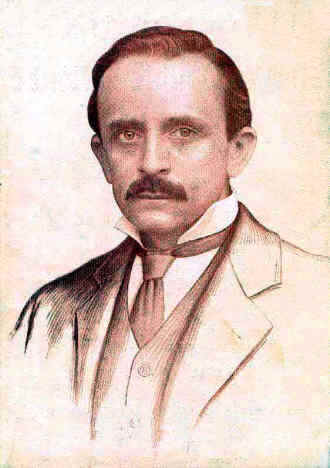
Sir James Matthew Barrie, 1st Baronet, OM (1860 – 1937) was a Scottish author and dramatist, best remembered today as the creator of Peter Pan. The child of a family of small-town weavers, he was educated in Scotland. He moved to London, where he developed a career as a novelist and playwright. There he met the Llewelyn Davies boys who inspired him in writing about a baby boy who has magical adventures in Kensington Gardens (included in The Little White Bird), then to write Peter Pan, or The Boy Who Wouldn't Grow Up, a "fairy play" about this ageless boy and an ordinary girl named Wendy who have adventures in the fantasy setting of Neverland. This play quickly overshadowed his previous work and although he continued to write successfully, it became his best-known work, credited with popularising the name Wendy, which was very uncommon previously. Barrie unofficially adopted the Davies boys following the deaths of their parents. Barrie was made a baronet by George V in 1913, and a member of the Order of Merit in 1922. Before his death, he gave the rights to the Peter Pan works to London's Great Ormond Street Hospital, which continues to benefit from them.

Barrie has an ugly little manservant and the finest view of London I ever saw. Mrs. Hardy a very nice woman with a vibrating attractive voice. Hardy was very lively, talked like anything. Apropos of Tchekoff he started a theory that some of Tchekoff's tales were not justifiable because they told nothing unusual. He said a tale must be unusual and the people interesting. Of course he soon got involved in the meshes of applications and instances; but he kept his head and showed elasticity and common sense, and came out on the whole well. He has all his faculties, unimpaired. Quite modest and without the slightest pose.


Thomas Hardy, OM (1840 – 1928) was an English novelist and poet. A Victorian realist, in the tradition of George Eliot, he was also influenced both in his novels and poetry by Romanticism, especially by William Wordsworth. Like Dickens, he was highly critical of much in Victorian society, though Hardy focused more on a declining rural society. While Hardy wrote poetry throughout his life, and regarded himself primarily as a poet, his first collection was not published until 1898. Initially therefore he gained fame as the author of such novels as Far from the Madding Crowd (1874), The Mayor of Casterbridge (1886), Tess of the d'Urbervilles (1891), and Jude the Obscure (1895). The bulk of his fictional works, initially published as serials in magazines, were set in the semi-fictional region of Wessex and explored tragic characters struggling against their passions and social circumstances. Hardy's Wessex is based on the medieval Anglo-Saxon kingdom in south west England.

They both had very good and accurate appraisements of such different people as Shorter and Philpotts.

Later in the evening Barrie brought along both Shaw and the Wellses by 'phone. Barrie was consistently very quiet, but told a few A1 stories. At dusk we viewed the view and the searchlights. Hardy, standing outside one of the windows, had to put a handkerchief on his head. I sneezed. Soon after Shaw and the Wellses came Hardy seemed to curl up. He had travelled to town that day and was evidently fatigued. He became quite silent. I then departed and told Barrie that Hardy ought to go to bed. He agreed. The spectacle of Wells and G.B.S. talking firmly and strongly about the war, in their comparative youth, in front of this aged, fatigued, and silent man - incomparably their superior as a creative artist - was very striking.

Sunday, 9 December 2012

Self-examination

Wednesday, December 9th., Victoria Grove, Chelsea.

I have just finished reading J.M. Barrie's account of his mother, "Margaret Ogilvy". This book is a picture of a grave, mighty, passionate family of men and women.
 <http://www.gutenberg.org/ebooks/342>

This little book, is Barrie's adulatory account of his mother's life and his relationship with her, published after her death in 1896. It's a fairly maudlin read, but tells us much about Barrie's early emotional life. J. M. Barrie was born in the village of Kirriemuir, in Forfarshire (now Angus), the son of a handloom weaver. His mother, Margaret Ogilvy was the daughter of a stonemason. The couple had ten children, of whom Barrie was the ninth. Jamie, as he was called, heard tales of pirates from his mother, who read her children adventure stories in the evenings. Barrie's father Barrie rarely makes any appearance in his autobiographical works, and in this book is only mentioned at the very end. Before her marriage, Margaret Ogilvy belonged to a religious sect called the Auld Lichts, or Old Lights, and many of the stories concerning it inspired Barrie's later work. When Barrie was seven, his brother David died in a skating accident. David had been the mother's favourite child, and his death plunged her into the depression from which she never fully recovered. Apparently, her only comfort was in the thought that David would never grow up and leave her and it is suggested by some that this thinking may have inspired Barrie's creation of Peter Pan, the boy who never grew up. Barrie tried to comfort his mother and gain her affection by dressing up in the dead boy's clothes, but for a period after David's death she took little interest in him or anything else. This book memorialises the obsessive relationship which over time grew up between them, a relationship which remained a strong influence throughout Barrie's life.

Instinctively, and all the time, I was comparing it with my own, and in particular comparing Margaret Ogilvy and J.M. Barrie with my mother and myself. Again and again, I had to acknowledge inferiority - inferiority of essential 'character', apart from inessential talent - a lack of bigness, and a presence of certain littlenesses. yet at the same time, I found us sturdy enough not to be ashamed of shortcomings. What we are, we are! "I exist as I am, that is enough." To hold such a creed religiously is in one way to be great.
A proud and self-unconscious self-esteem; that is what few people have. If at times it deserts me amd mine, it always returns the stronger for having retreated. We are of the North, outwardly brusque, stoical, undemonstrative, scornful of the impulsive; inwardly all sentiment and crushed tenderness. We are of the North, incredibly, ruthlessly independent; and eager to say "Damn you" to all the deities at the least hint of condescension.
When I was only an assistant-editor, on leaving the office I could forget the office with absolute certainty and effectiveness. Now that I am editor, do what I will, watch myself as I may, the office dogs me everywhere, night and day.