Tuesday, November 9th., Les Sablons.
Today I rose in excellent health, began my last act, and at 5.30 had written one third of it.
I received a complete bound set of my Tauchnitz works from the Baron. Though ugly, the format was not too ugly to please me. I put the row of twelve volumes in Marguerite's secretaire. Pauline seized "A Great Man" out of the lot, and has been reading it at every spare moment and smiling to herself the whole time. Not to be outdone, I began to read "Buried Alive", and also smiled the whole time. I don't think I have ever read a funnier book than this unless it's Wells's "The History of Mr. Polly".
Dark early of course but I determined to go out for a night walk, and did. I have always enjoyed getting out when it is dark, starting when I was young and needed to get out from under my extensive family. Very different walking here from walking the streets of Burslem. Two ideas came into my mind as I walked. One was to ask the question, "Has any author successfully conveyed the sensation of night walking?" The other was to think about how different the experience of darkness must have been before the advent of artificial lighting. Just imagine at this time of year how people managed with candles, or oil lamps, or just the light from a fire. Did the darkness make them melancholy? Bears thinking about.
Showing posts with label Pauline Smith. Show all posts
Showing posts with label Pauline Smith. Show all posts
Saturday, 9 November 2019

Thursday, 22 March 2018
Socialising
Friday, March 21st., Cadogan Square, London.
At Ethel Sands in Chelsea at tea yesterday - Norman Leslie, brother of Shane, sat next to me on the sofa. The brothers are from a wealthy Anglo-Irish land-owning family, and are first cousins to Winston Churchill. In a sense they are renegade to their class having converted to Roman Catholicism and embraced Irish home rule. Interesting. After a time Leslie said to me, "Are you interested in Russia at all?" After my reply he went on to say that he had been there last autumn, and I must say that he replied very intelligently and carefully to all my questions. But what struck me was the crudity of his gambit. He wanted to talk about Russia. He was full of Russia, and he opened in that way. Not much subtlety for a man with a public school education, Eton at that!
He left and Cynthia Noble took his place. A very fashionable young woman. Apparently she is the great grand-daughter of I.K.Brunel, engineer. She is probably only about 21 or 22, with a perfectly made-up face etc. I almost immediately began with her on my subjects of late hours, drugs (aspirin chiefly), cocktails, liqueurs, and salts; all of which I cursed. I was glad to find that she was prepared to talk about salts. She agreed with me as to cocktails, but not in much else. However what struck me a long time afterwards was that I had opened on my subject just as young Leslie had opened on his. What an old bore I must have seemed to her! I feel embarrassed to think about it.
Speaking of young women, I am trying to get Pauline Smith's short stories published and have written to Jonathan Cape recommending her. I am optimistic, given my personal celebrity, that they will give the go-ahead. Particularly if I offer to write an introduction. Pauline is a gifted writer, and is working on a novel at the moment. Sadly her work is not such as would be likely to catch the attention of publishers in the absence of a sponsor such as myself. She is rather ill at the moment. In fact her health is not good generally. I would like to do something for her.
 |
| Ethel Sands |
He left and Cynthia Noble took his place. A very fashionable young woman. Apparently she is the great grand-daughter of I.K.Brunel, engineer. She is probably only about 21 or 22, with a perfectly made-up face etc. I almost immediately began with her on my subjects of late hours, drugs (aspirin chiefly), cocktails, liqueurs, and salts; all of which I cursed. I was glad to find that she was prepared to talk about salts. She agreed with me as to cocktails, but not in much else. However what struck me a long time afterwards was that I had opened on my subject just as young Leslie had opened on his. What an old bore I must have seemed to her! I feel embarrassed to think about it.
Speaking of young women, I am trying to get Pauline Smith's short stories published and have written to Jonathan Cape recommending her. I am optimistic, given my personal celebrity, that they will give the go-ahead. Particularly if I offer to write an introduction. Pauline is a gifted writer, and is working on a novel at the moment. Sadly her work is not such as would be likely to catch the attention of publishers in the absence of a sponsor such as myself. She is rather ill at the moment. In fact her health is not good generally. I would like to do something for her.
Thursday, 25 January 2018
Desolated
 |
| Matheson Lang |
Yesterday we took Jean Godebski to the Aladdin panto at the Hippodrome. Goodish. I met Harry Preston there. In two minutes he had given me a cigar, invited me to a dinner and invited me to a boxing match. The man is a sort of whirlwind in human form and it is difficult not to be swept away by him.
I picked up Pauline Smith's "The Little Karoo" last evening and read the first story. It was good. Better than my introduction I think which I found to be a bit terse. It may be that as she is a sort of protege of mine I tried too hard not to sound 'paternal'. I was caught by the story as when I first read it. Simple. Affecting. Well done Pauline!
Tuesday, 22 October 2013
Glimpses
Friday, October 22nd., Villa des Nefliers, Fontainebleau.
Extraordinarily beautiful morning in the forest and ideas for the second act arrived one after the other in a manner very creditable to them.
Letters from Frank Harris and Wells and his friend about "The Glimpse". But really I have had very few letters about it. Wells describes it as 'a glimpse into an empty cavern' of my mind. Not sure what that is meant to mean!
I am not convinced about the second part of the book myself, but I am sure that the 1st and 3rd parts are as good as the best I can do. Some people who like the 2nd don't care for the 3rd: which unfortunately shows that they have not understood the 2nd. Also I am now supposed to be a Theosophist, a Hegelian and all sorts of things. The second part is simple Theosophy, nothing else, and taken bodily therefrom (with improvements); but I have now made Theosophy serve my turn, & I have done with it. I read Mrs. Besant three times, and made fresh notes every time, in order to do the 2nd part; a fearful grind; & the Theosophical Society ought now to reprint my 2nd part as one of their official publications; it is infinitely more graphic and coherent than any of their own tracts. I liked 'Bond Street'. Enough. What interests me now is the sales.
I shall positively appear in the Five Towns early in December, and remain there at least two weeks. I must have at least two weeks with Mr. Dawson, the bookseller and printer. My next hero's father is the pater + Mr. Beardmore = a steamprinter. Dawson has printed three Christmas books for me and is a prime source of information about the Potteries. He is also a magistrate and a student profoundly versed in the psychology of the Five Towns.
Pauline Smith is here, is beginning a novel, and has half an hour's remarks from me every night. My remarks are really rather good. Strange girl. She can write. But she won't talk. However we make her, at least Marguerite does. She says: "Now Pauline, you have let the conversation fall." She is already better.
See also 'A bad night' - November 14th., -
http://earnoldbennett.blogspot.co.uk/2012/11/a-bad-night.html
Additionally for October 22nd., see 'Famous men' -
http://earnoldbennett.blogspot.co.uk/2012/10/marital-breakdown.html
This is my idea of fame:
At an entertainment on board H.M.S. Majestic, Rudyard Kipling, one of the guests, read "Soldier and Sailor Too", and was encored. He then read "The Flag of England". At the conclusion a body of subalterns swept him off the stage, and chaired him round the quarter-deck, while "For he's a jolly good fellow" was played by the massed bands of the Fleet and sung by 200 officers assembled.
Extraordinarily beautiful morning in the forest and ideas for the second act arrived one after the other in a manner very creditable to them.
Letters from Frank Harris and Wells and his friend about "The Glimpse". But really I have had very few letters about it. Wells describes it as 'a glimpse into an empty cavern' of my mind. Not sure what that is meant to mean!
Nothing in Mr. Arnold Bennett's former work has prepared his readers for the point of view from which his new novel is written. Leaving the affairs of this world with which he has hitherto been exclusively occupied, Mr. Bennett kills his hero in the tenth chapter, although he causes him to return again to his body in the last book of the story. The author's account of the flight of the soul at death cannot be called very convincing, though it is at all times interesting to know the theories which people form on this subject ; but whether such matters are fit themes for fiction is another question. The book, apart from these psychical chapters, is decidedly disagreeable in tone, but makes strongly for a moral standpoint, for the soul of the hero returns to earth with the conviction that nothing in this life matters save the quickening of - spiritual understanding. Ordinary criticism of a work of fiction seems out of place when dealing with such a subject as this, and the only thing which remains for the reviewer is to describe the scope and aim of the book and to leave it to the reader to determine its quality.
Review of "The Glimpse" in The Spectator, November 1909.
I am not convinced about the second part of the book myself, but I am sure that the 1st and 3rd parts are as good as the best I can do. Some people who like the 2nd don't care for the 3rd: which unfortunately shows that they have not understood the 2nd. Also I am now supposed to be a Theosophist, a Hegelian and all sorts of things. The second part is simple Theosophy, nothing else, and taken bodily therefrom (with improvements); but I have now made Theosophy serve my turn, & I have done with it. I read Mrs. Besant three times, and made fresh notes every time, in order to do the 2nd part; a fearful grind; & the Theosophical Society ought now to reprint my 2nd part as one of their official publications; it is infinitely more graphic and coherent than any of their own tracts. I liked 'Bond Street'. Enough. What interests me now is the sales.
Theosophy refers to systems of esoteric philosophy concerning, or investigation seeking direct knowledge of, presumed mysteries of being and nature, particularly concerning the nature of divinity. Theosophy is considered a part of the broader field of esotericism, referring to hidden knowledge or wisdom that offers the individual enlightenment and salvation. The word esoteric dates back to the 2nd century CE. The theosophist seeks to understand the mysteries of the universe and the bonds that unite the universe, humanity, and the divine. The goal of theosophy is to explore the origin of divinity and humanity, and the world. From investigation of those topics, theosophists try to discover a coherent description of the purpose and origin of the universe. Annie Besant (1847 – 1933) was a prominent British socialist, theosophist, women's rights activist, writer and orator and supporter of Irish and Indian self-rule.In 1890 Besant met Helena Blavatsky and over the next few years her interest in theosophy grew while her interest in secular matters waned. She became a member of the Theosophical Society and a prominent lecturer on the subject. In 1907 she became president of the Theosophical Society, whose international headquarters were in Adyar, Madras, (Chennai).
I shall positively appear in the Five Towns early in December, and remain there at least two weeks. I must have at least two weeks with Mr. Dawson, the bookseller and printer. My next hero's father is the pater + Mr. Beardmore = a steamprinter. Dawson has printed three Christmas books for me and is a prime source of information about the Potteries. He is also a magistrate and a student profoundly versed in the psychology of the Five Towns.
Pauline Smith is here, is beginning a novel, and has half an hour's remarks from me every night. My remarks are really rather good. Strange girl. She can write. But she won't talk. However we make her, at least Marguerite does. She says: "Now Pauline, you have let the conversation fall." She is already better.
See also 'A bad night' - November 14th., -
http://earnoldbennett.blogspot.co.uk/2012/11/a-bad-night.html
Additionally for October 22nd., see 'Famous men' -
http://earnoldbennett.blogspot.co.uk/2012/10/marital-breakdown.html
This is my idea of fame:
At an entertainment on board H.M.S. Majestic, Rudyard Kipling, one of the guests, read "Soldier and Sailor Too", and was encored. He then read "The Flag of England". At the conclusion a body of subalterns swept him off the stage, and chaired him round the quarter-deck, while "For he's a jolly good fellow" was played by the massed bands of the Fleet and sung by 200 officers assembled.
Wednesday, 15 May 2013
Florentine scenes
Sunday, May 15th., Pension White, Florence.

Yesterday I was on the Ponte Vecchio when children were going to school (8.45), & I noticed more than ever how Italian little girls have the look & the form of women. Marguerite & I have been noticing them in their short skirts for weeks. They look just like women unsuitably dressed. They are quite formees.

This pension is really too 'English' for Marguerite. She has no natural outlet for her energies. At Fontainebleau she could make her beautiful dresses, or go hunting for mushrooms and concoct wonderful dishes; here she is free from the difficulties of domesticity, but has not its reliefs and rewards. I have encouraged her to seek occupation in the writing of short stories and she has thrown herself vehemently, and typically, into this new form of creation, fighting fiercely against any criticism. Her stories, written in French, are as good, she holds, as her dresses and mushrooms had been. In particular there is a story about a cat. I found three quarters of this pleasing but the last fourth is not good and should be re-written. For days the discussion about the damned cat has continued. I refuse to call good what I know to be bad, and Marguerite refuses to believe bad what she knows to be parfait! Life in this so-extraordinarily English pension is full of difficulties for a Frenchwoman.
Speaking of women, this is a curious instance of how women, when they are afraid, will argue in general, instead of in particulars, as usual. Pauline may have to have an incision behind her ear. It is called an operation. If the doctor and the specialist say it ought to be done, of course it must be done, and at once. Supposing I telegraphed to Pauline's mother, she could only reply that she left it to us on the spot, and if she replied against an operation, the operation would still have to be done. Any other course would be absurd. yet when all this is arranged and understood and agreed, Marguerite comes to me and puts this abstract question: "Have you the right to let a girl be operated on without obtaining her mother's permission?"
See also, 'A bad night' - November 14th. <http://earnoldbennett.blogspot.co.uk/2012/11/a-bad-night.html> ;
and, 'Friends in Florence' - April 13th. <http://earnoldbennett.blogspot.co.uk/2013/04/friends-in-florence.html>
We dined with Mr. Mock at Lapi's, in the cellar in the Via Tornabuoni. Here the cooking is done in full view of the audience. each dish prepared specially for each client. All by one man. About 35, dark, personable, extraordinarily quick and graceful. if he left his recess for a moment to go upstairs he would slide down the rail to come back again. Charcoal stove. He blew it up constantly with a fan. Sparks fly. He put on charcoal with his hand. Everything goes through that hand. He would fan with one hand and stir with another. He made an omelette in a moment: very quick his gesture in turning it over like a pancake, in the pan. Very careful & slow in making our coffee. Orders called out in a loud voice by the landlord or the boy waiter - who was not dressed as a waiter. All professional conversation very loud, and constantly going on. Things not in stock, such as ham, sent for & brought down in a paper. When a dish is ready the chef would plank it down on a ledge and whistle, or call out its name. When we arrived the landlord was finishing his dressing in the further saloon, which was darkened. Later, the boy-waiter - perhaps his son - took a pair of loose cuffs from a hat-hook and slipped them on, at once giving him an air of grande toilette. Still later, the landlord, evidently bethinking himself, did the same, from another hook. About 10 or 12 or 15 customers, and all cooked for by one man. Arched roof all papered with coloured posters of all sorts. Graceful leave-takings from all the personnel as we left. Bill and tip eight and a half lire for three people.

"Lohengrin". We saw two acts. Italian audience still the worst I have encountered.
The night effects on the lower reach of the Arno are unlike anything else I ever saw.
1,000 words of "Clayhanger" today.

Yesterday I was on the Ponte Vecchio when children were going to school (8.45), & I noticed more than ever how Italian little girls have the look & the form of women. Marguerite & I have been noticing them in their short skirts for weeks. They look just like women unsuitably dressed. They are quite formees.

This pension is really too 'English' for Marguerite. She has no natural outlet for her energies. At Fontainebleau she could make her beautiful dresses, or go hunting for mushrooms and concoct wonderful dishes; here she is free from the difficulties of domesticity, but has not its reliefs and rewards. I have encouraged her to seek occupation in the writing of short stories and she has thrown herself vehemently, and typically, into this new form of creation, fighting fiercely against any criticism. Her stories, written in French, are as good, she holds, as her dresses and mushrooms had been. In particular there is a story about a cat. I found three quarters of this pleasing but the last fourth is not good and should be re-written. For days the discussion about the damned cat has continued. I refuse to call good what I know to be bad, and Marguerite refuses to believe bad what she knows to be parfait! Life in this so-extraordinarily English pension is full of difficulties for a Frenchwoman.
Speaking of women, this is a curious instance of how women, when they are afraid, will argue in general, instead of in particulars, as usual. Pauline may have to have an incision behind her ear. It is called an operation. If the doctor and the specialist say it ought to be done, of course it must be done, and at once. Supposing I telegraphed to Pauline's mother, she could only reply that she left it to us on the spot, and if she replied against an operation, the operation would still have to be done. Any other course would be absurd. yet when all this is arranged and understood and agreed, Marguerite comes to me and puts this abstract question: "Have you the right to let a girl be operated on without obtaining her mother's permission?"
See also, 'A bad night' - November 14th. <http://earnoldbennett.blogspot.co.uk/2012/11/a-bad-night.html> ;
and, 'Friends in Florence' - April 13th. <http://earnoldbennett.blogspot.co.uk/2013/04/friends-in-florence.html>
We dined with Mr. Mock at Lapi's, in the cellar in the Via Tornabuoni. Here the cooking is done in full view of the audience. each dish prepared specially for each client. All by one man. About 35, dark, personable, extraordinarily quick and graceful. if he left his recess for a moment to go upstairs he would slide down the rail to come back again. Charcoal stove. He blew it up constantly with a fan. Sparks fly. He put on charcoal with his hand. Everything goes through that hand. He would fan with one hand and stir with another. He made an omelette in a moment: very quick his gesture in turning it over like a pancake, in the pan. Very careful & slow in making our coffee. Orders called out in a loud voice by the landlord or the boy waiter - who was not dressed as a waiter. All professional conversation very loud, and constantly going on. Things not in stock, such as ham, sent for & brought down in a paper. When a dish is ready the chef would plank it down on a ledge and whistle, or call out its name. When we arrived the landlord was finishing his dressing in the further saloon, which was darkened. Later, the boy-waiter - perhaps his son - took a pair of loose cuffs from a hat-hook and slipped them on, at once giving him an air of grande toilette. Still later, the landlord, evidently bethinking himself, did the same, from another hook. About 10 or 12 or 15 customers, and all cooked for by one man. Arched roof all papered with coloured posters of all sorts. Graceful leave-takings from all the personnel as we left. Bill and tip eight and a half lire for three people.

The "Buca Lapi" is the oldest restaurant in Florence. It was founded in 1880 in the Palazzo Antinori cellars and still shows evidence of more than a century of history, thanks to a very careful restoration.
The first room is frescoed and the kitchen is visible.
"Lohengrin". We saw two acts. Italian audience still the worst I have encountered.
The night effects on the lower reach of the Arno are unlike anything else I ever saw.
1,000 words of "Clayhanger" today.
Friday, 10 May 2013
Under the weather in Florence
Tuesday, May 10th., Pension White, Florence.
We ought all to have gone to Vallombrosa today but were prevented by the weather. Moreover Pauline is ill again, and under the doctor.

Sunday afternoon Marguerite and I went to Boboli Gardens. It was too chilly for elaborate sketching. We met Jowett in the Gardens, and with him savoured the sculptures and the vistas. Then we all three went to the Piazza V. Emanuele, and drank, and listened to 'Zampa' and such things. Heavy sky, but swifts flying high. The Square was a great party of families.
Yesterday & this morning I wrote 3,600 words of "Clayhanger".
Most of the women are wearing half mourning in this hotel. This is because we received the news on Saturday of the death of the King. The moved silence in which it was received in the coffee-room was most remarkable. One middle-aged man had apparently some difficulty in not crying. Gaiety however is now unchecked, though many people are ill. I think that one of the things that have struck me in Florence & Brighton is the unpleasant expressions, & the ungainliness of the Anglo-Saxon women; their extraordinary unattractiveness. I saw three middle-aged American women meet & greet each other this morning, and the sight & sound were rather trying. (It is true I am slightly unwell.) What looks, what gestures, and what voices! But then I often feel that I myself, when alone, go about with a fixed unpleasing expression of disgust. I don't know why.
Yesterday morning Mr. Mock, Marguerite & I went up to S. Miniato again, and I finished my pastel.
 In the evening we went to the Teatro Verdi, and saw two acts of Suppe's "Boccaccio". The house was not a sixth full. We have never seen this theatre even half full. It must be a sort of Chat Moss for burying money. The first act of "Boccaccio" was amusing (3 encores for a comic trio, & the audience would have the third one, stopping the performance & defeating the conductor in order to get it). But we got tired of not understanding in the second act. The music was really much better than I expected. It always had a certain vague distinction. Rain all the evening.
This morning, being desoriente, I went to the Pitti. In the main it left me cold. It is an unpleasant & difficult place in which to see pictures, & quite half the pictures are n.g. Crowds of people in the place.
We ought all to have gone to Vallombrosa today but were prevented by the weather. Moreover Pauline is ill again, and under the doctor.
Sunday afternoon Marguerite and I went to Boboli Gardens. It was too chilly for elaborate sketching. We met Jowett in the Gardens, and with him savoured the sculptures and the vistas. Then we all three went to the Piazza V. Emanuele, and drank, and listened to 'Zampa' and such things. Heavy sky, but swifts flying high. The Square was a great party of families.
The Boboli Gardens, behind the Pitti Palace, the main seat of the Medici grand dukes of Tuscany at Florence, are some of the first and most familiar formal 16th century Italian gardens. The mid-16th century garden style, as it was developed here, incorporated longer axial developments, wide gravel avenues, a considerable "built" element of stone, the lavish employment of statuary and fountains, and a proliferation of detail, coordinated in semi-private and public spaces that were informed by classical accents. The openness of the gardens, with an expansive view of the city, was unconventional for its time. The gardens were very lavish, considering no access was allowed outside the immediate Medici family, and no entertainment or parties ever took place in the gardens.
Most of the women are wearing half mourning in this hotel. This is because we received the news on Saturday of the death of the King. The moved silence in which it was received in the coffee-room was most remarkable. One middle-aged man had apparently some difficulty in not crying. Gaiety however is now unchecked, though many people are ill. I think that one of the things that have struck me in Florence & Brighton is the unpleasant expressions, & the ungainliness of the Anglo-Saxon women; their extraordinary unattractiveness. I saw three middle-aged American women meet & greet each other this morning, and the sight & sound were rather trying. (It is true I am slightly unwell.) What looks, what gestures, and what voices! But then I often feel that I myself, when alone, go about with a fixed unpleasing expression of disgust. I don't know why.
King Edward VII usually smoked twenty cigarettes and twelve cigars a day. Towards the end of his life he increasingly suffered from bronchitis. In March 1910, the King was staying at Biarritz when he collapsed. He remained there to convalesce, while in London Asquith tried to get the Finance Bill passed. The King's continued ill health was unreported and he attracted criticism for staying in France whilst political tensions were so high. On 27 April he returned to Buckingham Palace, still suffering from severe bronchitis. Alexandra returned from visiting her brother, King George I of Greece, in Corfu a week later on 5 May. The following day, the King suffered several heart attacks, but refused to go to bed saying, "No, I shall not give in; I shall go on; I shall work to the end." Between moments of faintness, the Prince of Wales (shortly to be King George V) told him that his horse, Witch of the Air, had won at Kempton Park that afternoon. The King replied, "I am very glad": his final words. At 11:30 pm he lost consciousness for the last time and was put to bed. He died 15 minutes later.
Yesterday morning Mr. Mock, Marguerite & I went up to S. Miniato again, and I finished my pastel.

This morning, being desoriente, I went to the Pitti. In the main it left me cold. It is an unpleasant & difficult place in which to see pictures, & quite half the pictures are n.g. Crowds of people in the place.
Tuesday, 30 April 2013
Friends in Florence
Saturday, April 30th., Pension White, Florence.
After being laid aside I resumed work on Thursday, and wrote 5,000 words of "Clayhanger" in two days. The writing of this book is not the 'lark' which both "The Card" and "The Honeymoon" were, and my persistent, solitary search for ideas and inspiration have exhausted me physically more than I realised. During all this time - that is, for a week - no sight-seeing and almost no sketching. I have largely been confined to my small room looking out across the Arno to San Miniato. But on Thursday I began a watercolour. All I could really do was just to walk about and buy the 'Corriere della Sera' and gaze at fine women.
Pauline Smith is with us, but is not well as the cold winds have affected her weak throat, and against the depression of oncoming illness her work has made little progress. Yet my belief in her as an 'artist' persists. She asked me recently if she had not better give up writing altogether. I said: "Do you think I'd be ... such a damn fool ... as to waste all this time upon you if I didn't know ... the stuff's in you?" I ask her why if I believe in her she cannot believe in herself? I have also been attempting to encourage her development as a conversationalist, but with little success. My own behaviour does me little credit in this regard. I come down from writing and, reasonably, expect her to take part in conversation at table. She is silent. In the obstinate, expectant, and more and more gloomy silences which I maintain whilst awaiting a remark from her she becomes paralysed with nervousness. Slowly, I allow my head to sink onto my upraised hand and emit a deep protesting groan. Or sometimes I will pause in my own talk to break into her silences with a rebuking and embarrassing: "Yes, well ... but we will now await ... a remark from P."
See also, 'A bad night' - November 14th. http://earnoldbennett.blogspot.co.uk/2012/11/a-bad-night.html
Marguerite and I studied somewhat the activities of the men who take gravel out of the bed of the river. Some of them work in their boats in nothing but a shirt with a scolloped edge that comes down a few inches below the middle. I should say that one dredging machine could do as much in an hour as all this sweating does in about a week.
I got Gebhart's book on Florence out of the Library. They said it was good but it isn't. Rotten photographic illustrations and a lot of prettiness in the feeble writing. I haven't yet come across a good book on Florence.
Rickards walked casually in on Thursday evening, twelve hours in advance of his warning postcard, & he took up residence here yesterday morning for three days. he arrived from Carrara where he had been to see the quarrying of some of the marble to be used in one of his buildings. He said the Duomo was chiefly a great feat of engineering, and not really beautiful.
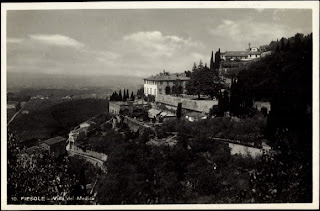 We went up to Fiesole in the afternoon. Crowded, wheel-shrieking, jerking tram to go, and the same to come back. Mrs. Mock introduced me into an old convent or something, a home for women convalescents kept by English & Irish nuns. Extraordinarily beautiful old garden. Cheap little statues of the virgin & of J.C., with a cup of fresh flowers suspended before him. But the whole effect with the views of Florence & all the Arno plain, and the Arno far off flashing like gold, and the hills towards Siena - perfectly enchanting.
Rickards instructed me in the excellence of drawing roofs seen from above, & then set me to trees. He would not let me draw in this Journal, insisted on something larger and 'freer'. We had tea up at Fiesole. Then he & I, after the grinding slide down, had aperitifs in the town.
In the Smoking Room Rickards gave such a violent & feverish description of Venice to us that both Mock & I wanted to start out at once for Venice. "It nearly broke my heart to leave it on Thursday morning", said Rickards in a tragic tone. He said this several times.
See also, 'Eating companions' - December 23rd. http://earnoldbennett.blogspot.co.uk/2012/12/eating-companions.html and 'An architectural experience' - December 28th. http://earnoldbennett.blogspot.co.uk/2012/12/an-architectural-experience.html
 |
| Sketch made today |
After being laid aside I resumed work on Thursday, and wrote 5,000 words of "Clayhanger" in two days. The writing of this book is not the 'lark' which both "The Card" and "The Honeymoon" were, and my persistent, solitary search for ideas and inspiration have exhausted me physically more than I realised. During all this time - that is, for a week - no sight-seeing and almost no sketching. I have largely been confined to my small room looking out across the Arno to San Miniato. But on Thursday I began a watercolour. All I could really do was just to walk about and buy the 'Corriere della Sera' and gaze at fine women.
Pauline Smith is with us, but is not well as the cold winds have affected her weak throat, and against the depression of oncoming illness her work has made little progress. Yet my belief in her as an 'artist' persists. She asked me recently if she had not better give up writing altogether. I said: "Do you think I'd be ... such a damn fool ... as to waste all this time upon you if I didn't know ... the stuff's in you?" I ask her why if I believe in her she cannot believe in herself? I have also been attempting to encourage her development as a conversationalist, but with little success. My own behaviour does me little credit in this regard. I come down from writing and, reasonably, expect her to take part in conversation at table. She is silent. In the obstinate, expectant, and more and more gloomy silences which I maintain whilst awaiting a remark from her she becomes paralysed with nervousness. Slowly, I allow my head to sink onto my upraised hand and emit a deep protesting groan. Or sometimes I will pause in my own talk to break into her silences with a rebuking and embarrassing: "Yes, well ... but we will now await ... a remark from P."
See also, 'A bad night' - November 14th. http://earnoldbennett.blogspot.co.uk/2012/11/a-bad-night.html
Marguerite and I studied somewhat the activities of the men who take gravel out of the bed of the river. Some of them work in their boats in nothing but a shirt with a scolloped edge that comes down a few inches below the middle. I should say that one dredging machine could do as much in an hour as all this sweating does in about a week.
I got Gebhart's book on Florence out of the Library. They said it was good but it isn't. Rotten photographic illustrations and a lot of prettiness in the feeble writing. I haven't yet come across a good book on Florence.
Rickards walked casually in on Thursday evening, twelve hours in advance of his warning postcard, & he took up residence here yesterday morning for three days. he arrived from Carrara where he had been to see the quarrying of some of the marble to be used in one of his buildings. He said the Duomo was chiefly a great feat of engineering, and not really beautiful.

Rickards instructed me in the excellence of drawing roofs seen from above, & then set me to trees. He would not let me draw in this Journal, insisted on something larger and 'freer'. We had tea up at Fiesole. Then he & I, after the grinding slide down, had aperitifs in the town.
In the Smoking Room Rickards gave such a violent & feverish description of Venice to us that both Mock & I wanted to start out at once for Venice. "It nearly broke my heart to leave it on Thursday morning", said Rickards in a tragic tone. He said this several times.
See also, 'Eating companions' - December 23rd. http://earnoldbennett.blogspot.co.uk/2012/12/eating-companions.html and 'An architectural experience' - December 28th. http://earnoldbennett.blogspot.co.uk/2012/12/an-architectural-experience.html
Thursday, 18 April 2013
Kaiser in the offing
Wednesday, April 19th., Comarques, Thorpe-le-Soken.
Dr. Slimon reports to me that at the meeting of Chairmen of Emergency Committees and Military Representatives at Chelmsford on Friday, which I could not attend, under the chairmanship of General Paget, Paget insisted on the strong probability of an invasion between Harwich and Maldon in July or August.
The naval opinion at Harwich, I hear, is that Harwich Flotilla could not deal with the covering ships of an invading force, and that, so far as the Navy was concerned, the force would land, and the convoy be taken in the rear. It is also said that the German submarines are trying to mine the course of the proposed expedition, and that we are sweeping their mines and mining contra.
See also:
'False Alarms' - February 20th. http://earnoldbennett.blogspot.co.uk/2013/02/sunday-february-27th.html and 'An Author's Observations' - November 20th. http://earnoldbennett.blogspot.co.uk/2012/11/an-authors-observations.html
Pauline Smith came on Saturday, having lost her luggage on the way. Voice perhaps feebler than ever. She is highly intelligent.
See also 'A Bad Night' - November 14th. http://earnoldbennett.blogspot.co.uk/2012/11/a-bad-night.html
I have been reading John Buchan. Specifically "Greenmantle". Now Buchan is a marvellous story teller, none better, but this is going too far! As usual he seizes us by the elbow and away we go into a world where every character is at least twice life size, and incredible coincidences are routine. But it is too much. I found myself skimming rather than reading, just to get to the end more quickly. And not because I wanted to 'find out what happens'; just to get the damned thing finished. If it had been any writer other than Buchan I would not have bothered to finish at all. A fast pace is one thing, but let there be at least some credible characterisation along the way. For my money the best drawn character in "Greenmantle" is the Kaiser!
Dr. Slimon reports to me that at the meeting of Chairmen of Emergency Committees and Military Representatives at Chelmsford on Friday, which I could not attend, under the chairmanship of General Paget, Paget insisted on the strong probability of an invasion between Harwich and Maldon in July or August.
The naval opinion at Harwich, I hear, is that Harwich Flotilla could not deal with the covering ships of an invading force, and that, so far as the Navy was concerned, the force would land, and the convoy be taken in the rear. It is also said that the German submarines are trying to mine the course of the proposed expedition, and that we are sweeping their mines and mining contra.
See also:
'False Alarms' - February 20th. http://earnoldbennett.blogspot.co.uk/2013/02/sunday-february-27th.html and 'An Author's Observations' - November 20th. http://earnoldbennett.blogspot.co.uk/2012/11/an-authors-observations.html
Pauline Smith came on Saturday, having lost her luggage on the way. Voice perhaps feebler than ever. She is highly intelligent.
See also 'A Bad Night' - November 14th. http://earnoldbennett.blogspot.co.uk/2012/11/a-bad-night.html
I have been reading John Buchan. Specifically "Greenmantle". Now Buchan is a marvellous story teller, none better, but this is going too far! As usual he seizes us by the elbow and away we go into a world where every character is at least twice life size, and incredible coincidences are routine. But it is too much. I found myself skimming rather than reading, just to get to the end more quickly. And not because I wanted to 'find out what happens'; just to get the damned thing finished. If it had been any writer other than Buchan I would not have bothered to finish at all. A fast pace is one thing, but let there be at least some credible characterisation along the way. For my money the best drawn character in "Greenmantle" is the Kaiser!
Wednesday, 14 November 2012
A bad night
Sunday, November 14th., Villa des Nefliers.
I finished "The Honeymoon" at noon yesterday.
I read the last act after dinner. It was a considerable success with Pauline Smith, but not with Marguerite as she could not follow it. I met Pauline last year at Vevey and she came to stay here in October. She is a timid girl, socially self-conscious, not very strong, with aspirations, and indeed a real talent as a writer, but very little self-assertion or confidence. I suppose I am a sort of mentor to her and intend to compel her to write a novel, and to make conversation. I am widening her taste in literature, revealing the world of modern literature, in France and Russia as well as in England.

Mdme Steinheil acquitted last night . I have kept the newspapers giving a full account of the whole process, as I had a sort of idea I might do something with it sometime. I could certainly contrive something very striking out of the description in to-night's Temps of the scene outside the Palais de Justice while the verdict was being awaited.

The dog woke me up last night after I had had 3 hours sleep. After that my nerves were too tightened for me to try even to sleep (as I had just finished my play). I lay awake and listened, rather frightened, to the various noises, all very faint, that I could hear. (I had quietened the dog with a slipper.) Marguerite, the clocks, another noise, regular, that I couldn't and don't understand, and still others beneath these. About 5 I went on with Taine on Balzac, and came across some magnificent pages of generalisations about the art of observation.
I finished "The Honeymoon" at noon yesterday.
I read the last act after dinner. It was a considerable success with Pauline Smith, but not with Marguerite as she could not follow it. I met Pauline last year at Vevey and she came to stay here in October. She is a timid girl, socially self-conscious, not very strong, with aspirations, and indeed a real talent as a writer, but very little self-assertion or confidence. I suppose I am a sort of mentor to her and intend to compel her to write a novel, and to make conversation. I am widening her taste in literature, revealing the world of modern literature, in France and Russia as well as in England.

Pauline Janet Smith (1882 – 1959) is known as one of South Africa's greatest writers. Pauline Smith was born on 2 April 1882 in Oudtshoorn, South Africa, and grew up in the Little Karoo. At the age of thirteen she was sent to boarding school in England and never lived permanently in South Africa again, though throughout her life she made a number of extended visits to the country. Her extended visit of 1913-1914, and the journal that she kept, formed the basis of many stories of "the Little Karoo" and her novel "The Beadle." In 1908 she met the English novelist Arnold Bennett, who encouraged her to write fiction about South Africa. Eventually she published the two works for which she’s best known: the story collection The Little Karoo (1925), and the novel The Beadle (1926). She died on 29 January 1959 in Dorset, England.
On 31 May 1908, Marguerite Steinheil's stepmother and husband were found dead in their home. Both had died of suffocation, the latter by strangling and the former by choking on her false teeth. Marguerite was found gagged and bound to a bed. She initially said that she had been tied up by four black-robed strangers, three men and a woman. Some newspapers speculated that they had come to her house in search of certain secret documents which President Faure (she had been his mistress and was with him when he died in 'unusual' circumstances) had entrusted to her keeping, possibly relating to the Dreyfus affair. The police immediately regarded her as a suspect in the killings but had no hard evidence and made a pretence of abandoning the investigation. But Steinheil herself would not let the affair rest. She made an attempt to frame her manservant, and after that fabrication was discovered, she blamed Alexandre Wolff, the son of her old housekeeper, but he was able to establish an alibi. She was arrested in November 1908 and taken to St. Lazare prison. The crime created a sensation in Paris. It was revealed that she had had a great number of admirers, including even King Sisowath of Cambodia. Opponents of the government tried to make political capital of the affair, the anti-Semitic Libre Parole even charging her with having poisoned President Faure. A sensational trial finally ended in her acquittal on 14 November 1909, although the judge called her stories "tissues of lies".
Subscribe to:
Comments (Atom)