Welcome to our blog!


It's better than a bat in the eye with a burnt stick!


This blog makes liberal use of AB's journals, letters, travel notes, and other sources.


And make sure to visit The Arnold Bennett Society for expert information and comment on all aspects of the life and work of AB.

Showing posts with label Dawson. Show all posts

Tuesday, 26 January 2021

Differences

Tuesday, January 26th., Waterloo Road, Burslem.

I woke before dawn this morning and could immediately tell that there was something afoot by the quality of the light from outside. Peering through the curtains I saw at once that it had snowed heavily. I wasn't surprised. Several people told me yesterday that "we were due for some snow". Some people seem to have a sort of sixth sense for that sort of thing. Dawson is one of them. Anyway, Waterloo Road was transformed and I was itching to get out to see familiar places made unfamiliar.

By the time I had breakfasted and found my father's old snow shoes most of the road was tramped down by people going to work so I cut across towards Middleport, heading for the canal, the way I used to go to school in Newcastle. The canal was hard frozen. A few daring boys were sliding on it. I felt quite nostalgic, not that I was ever daring, but still. The valley was almost tranquil and the skyline towards Porthill was nearly picturesque. Definitely worth getting out for! Of course it has thawed during the day and is now mostly dirty slush. I haven't been down to Burslem which will be a right mess I should think.

Yesterday I was up at Sneyd Green visiting Callear. He wanted to show me a telescope he is making. It is impressive! Says it has taken him three weeks so far, and probably as long again before it is finished. Beautiful 3 inch mirror, which he has ground himself, not secured into the body of the instrument yet. And he is presently working on the angled mirror which diverts the light into the viewing lens. Apparently Newton invented the reflecting telescope. I didn't know that. I am envious of people who can do things with their hands, apart from writing that is. It also helps that his family is comfortably off, and he has use of a workshop. He reckons that he will be able to see craters on the moon and possibly the rings of Saturn, and I think he said the moons of Jupiter. I kept nodding knowingly, but my knowledge of outer space is abysmal. I suppose he knows that but we collude not to draw attention to it. He has no interest in books. As my mother frequently says: "We are all different".


Wednesday, 1 January 2020

Playing politics

Saturday, January 1st., Royal York Hotel, Brighton.

We came here from London today, having been in the Potteries for two weeks over Xmas. I intend to write my next Five Towns novel, "Clayhanger", here and had been gathering all the information I needed in Burslem, mainly from Joseph Dawson. 

Hotel Video Reviews and Bookings Worldwide - Online ...Our first stroll along the front impressed me very favourably this afternoon. But I am obsessed by the thought that all this comfort, luxury, ostentation, snobbishness and correctness, is founded on a vast injustice to the artisan-class. I can never get away from this. The furs, autos, fine food, attendance, and diamond rings of this hotel only impress it on me more. I might have Edwin Clayhanger, the main character in my new book, come here and contrast in his own mind, as I am doing, this place and Burslem.

I left behind me in Burslem a sort of political manifesto. It came about when I was in Dawson's printing office acquiring stuff for "Clayhanger". Edmund Leigh called, and he orated for an hour with such persuasive effect that in the end I vounteered to write a personal manifesto, as a sort of exercise in thinking things through. I wrote it easily and read it out to them, to great effect, a few days later. The printing of it was put in hand instantly but it hadn't been finished when I came away so I have no copy to hand. Dawson is as remarkable as ever. He is as young at sixty as I am at forty. He told me once that he could never read Tennyson's "Idylls of the King" without tears coming into his eyes. Fancy that for a hard-nosed Potteries tradesman!

The main points were:
1) A written constitution is essential as the basis for law;
2) There should be an elected Head of State; there can be no justification in the 20th. century for an hereditary system;
3) Universal suffrage;
4) Elections by proportional representation; the present 'first past the post' system is undemocratic and tends towards unnecessarily violent swings in policy;
5) End of patronage, privilege and titles, and the House of Lords; how ludicrous they seem, 'Lord' this, 'Lady' that, 'Duke and Duchess' the other, like persons in a comic opera;
6) Universal education to age 16, and abolition of the so-called 'Public' schools;
7) Entrance to universities by merit in competitive examination, not by grace and favour;
8) Disestablishment of the Church of England;
9) A national insurance scheme funded from taxation to provide basic health care and retirement for all.

There was more but these were the main items. It occurs to me as I write them here that when the document is printed it may spontaneously combust. Or if not it is likely to produce conflagration in those who read it.


Saturday, 9 December 2017

Justice dispensed

Thursday, December 9th., 179 Waterloo Road, Burslem.


Yesterday I sat with Dawson and Cartledge on the magistrates bench. I made some notes. One hopeless case showing the criminality of the criminal system. A woman who had been in and out of prison since 1876 (when I was nine!), and she got another month. Probably she is inured to the system by now and really knows nothing else, but surely something could have been done all those years ago to divert her from this waste of a life. No doubt drink has become a factor and yet I feel confident that it is a consequence, not a cause. If someone took the trouble to really dig into her past, the circumstances of her birth and childhood, I would bet that the odds were stacked against her from the start.

I didn't really want to sit up on the bench. The body of the court would have been fine for me, if not better, but Dawson insisted and he is my primary source of information for "Clayhanger". He is a decent man, and so seems Cartledge, but how pompous and self-righteous they appear when hearing the cases and doling out punishments. It is not for me. Of course the Sentinel reported that I had been on the bench. They would.

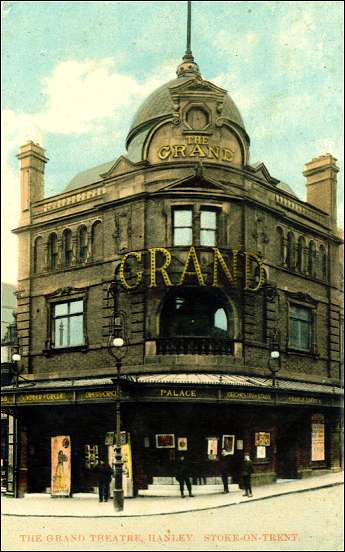
Image result for "Grand Theatre" Hanley historyI was at the dentist on Tuesday and now have a gold filling. The gold shines in my mouth. I suppose I will get used to it. I am picking up a lot of useful material and getting ideas. I went to the Grand after dinner yesterday and was profoundly struck by all sorts of things but especially the clog dancing. Its significance had never occurred to me before. I thionk I could do something on it for the Nation. And maybe I could work somthing into "Clayhanger". Towards the end I came across Warwick Savage and walked home with him. This was a pity because I had got into an extraordinary vein of 'second sight'. I perceived whole chapters. Of all the stuff I made sufficient notes.

Enthusiastic letter from Lee Matthews about the play. Let us hope that his enthusiasm is well founded.

Sunday, 8 December 2013

Getting information

Wednesday, December 8th., Waterloo Road, Burslem.

Dawson and dentist yesterday morning. I have been spending time with Joseph Dawson this week acquiring stuff for "Clayhanger". I have made real progress in getting information from him. 

After dinner I went to the Grand Theatre, 9.15 p.m. I was profoundly struck by all sorts of things. In particular by the significance of clog-dancing, which had never occurred to me before. I saw a 'short study' for the Nation in this. Towards the end I came across Warwick Savage and walked home with him. this was a pity because I had got into an extraordinary vein of 'second sight'. I perceived whole chapters. Of all the stuff I made sufficient notes.

The Grand Theatre (Trinity Street/Foundry Street) opened on 22 August 1898, at a cost of £25,000: £5,000 for the site, and £20,000 for the building. The building was constructed from brick, with stone facings and ornaments. The ornamental frontage was built in Renaissance style with a dome surmounting the entrance, and verandah of iron and glass. The principal entrance was at the corner of Trinity Street and Foundry Street, with the upper circle and pit entrances in Trinity Street. The vestibule had marble columns and a floor laid with encaustic tiles, the walls tiled shoulder height. The auditorium had three tiers - dress circle with four rows of chairs; upper circle of seven rows; and the gallery with twelve rows and a promenade. The rear of the grand circle was in line with the front of the upper circle, and the gallery was supported on four iron columns. To the sides of the balconies were four boxes surmounted with domes. The theatre had a sliding roof, and was lit by electricity. The stage could be converted for use as a circus with the removal of the stage and orchestra pit. There were busts of Shakespeare and Goethe.

Additionally for December 8th., see 'Heavyweight literature' -
http://earnoldbennett.blogspot.co.uk/2012/12/thursday-december-8th.html

The Bradenham edition is handsome and imposing. It is too imposing. It is almost exactly the size of a volume of the Dictionary of National Biography. Why should a novel be as unwieldy as a work of reference? This book cannot be held in one hand for reading. It could not be read in bed without employing a system of cranes. Why do publishers insist on ignoring the important fact that a book exists to be read in comfort, not merely to be beheld with pride on a shelf?

Tuesday, 22 October 2013

Glimpses

Friday, October 22nd., Villa des Nefliers, Fontainebleau.

Extraordinarily beautiful morning in the forest and ideas for the second act  arrived one after the other in a manner very creditable to them. 

Letters from Frank Harris and Wells and his friend about "The Glimpse". But really I have had very few letters about it. Wells describes it as 'a glimpse into an empty cavern' of my mind. Not sure what that is meant to mean!

Nothing in Mr. Arnold Bennett's former work has prepared his readers for the point of view from which his new novel is written. Leaving the affairs of this world with which he has hitherto been exclusively occupied, Mr. Bennett kills his hero in the tenth chapter, although he causes him to return again to his body in the last book of the story. The author's account of the flight of the soul at death cannot be called very convincing, though it is at all times interesting to know the theories which people form on this subject ; but whether such matters are fit themes for fiction is another question. The book, apart from these psychical chapters, is decidedly disagreeable in tone, but makes strongly for a moral standpoint, for the soul of the hero returns to earth with the conviction that nothing in this life matters save the quickening of - spiritual understanding. Ordinary criticism of a work of fiction seems out of place when dealing with such a subject as this, and the only thing which remains for the reviewer is to describe the scope and aim of the book and to leave it to the reader to determine its quality.
Review of "The Glimpse" in The Spectator, November 1909.

I am not convinced about the second part of the book myself, but I am sure that the 1st and 3rd parts are as good as the best I can do. Some people who like the 2nd don't care for the 3rd: which unfortunately shows that they have not understood the 2nd. Also I am now supposed to be a Theosophist, a Hegelian and all sorts of things. The second part is simple Theosophy, nothing else, and taken bodily therefrom (with improvements); but I have now made Theosophy serve my turn, & I have done with it. I read Mrs. Besant three times, and made fresh notes every time, in order to do the 2nd part; a fearful grind; & the Theosophical Society ought now to reprint my 2nd part as one of their official publications; it is infinitely more graphic and coherent than any of their own tracts. I liked 'Bond Street'. Enough. What interests me now is the sales.

Theosophy refers to systems of esoteric philosophy concerning, or investigation seeking direct knowledge of, presumed mysteries of being and nature, particularly concerning the nature of divinity. Theosophy is considered a part of the broader field of esotericism, referring to hidden knowledge or wisdom that offers the individual enlightenment and salvation. The word esoteric dates back to the 2nd century CE. The theosophist seeks to understand the mysteries of the universe and the bonds that unite the universe, humanity, and the divine. The goal of theosophy is to explore the origin of divinity and humanity, and the world. From investigation of those topics, theosophists try to discover a coherent description of the purpose and origin of the universe. Annie Besant (1847 – 1933) was a prominent British socialist, theosophist, women's rights activistwriter and orator and supporter of Irish and Indian self-rule.In 1890 Besant met Helena Blavatsky and over the next few years her interest in theosophy grew while her interest in secular matters waned. She became a member of the Theosophical Society and a prominent lecturer on the subject. In 1907 she became president of the Theosophical Society, whose international headquarters were in Adyar, Madras, (Chennai).

I shall positively appear in the Five Towns early in December, and remain there at least two weeks. I must have at least two weeks with Mr. Dawson, the bookseller and printer. My next hero's father is the pater + Mr. Beardmore = a steamprinter. Dawson has printed three Christmas books for me and is a prime source of information about the Potteries. He is also a magistrate and a student profoundly versed in the psychology of the Five Towns.

Pauline Smith is here, is beginning a novel, and has half an hour's remarks from me every night. My remarks are really rather good. Strange girl. She can write. But she won't talk. However we make her, at least Marguerite does. She says: "Now Pauline, you have let the conversation fall." She is already better.
See also 'A bad night' - November 14th., -
http://earnoldbennett.blogspot.co.uk/2012/11/a-bad-night.html

Additionally for October 22nd., see 'Famous men' -
http://earnoldbennett.blogspot.co.uk/2012/10/marital-breakdown.html

This is my idea of fame:

At an entertainment on board H.M.S. Majestic, Rudyard Kipling, one of the guests, read "Soldier and Sailor Too", and was encored. He then read "The Flag of England". At the conclusion a body of subalterns swept him off the stage, and chaired him round the quarter-deck, while "For he's a jolly good fellow" was played by the massed bands of the Fleet and sung by 200 officers assembled.