Welcome to our blog!


It's better than a bat in the eye with a burnt stick!


This blog makes liberal use of AB's journals, letters, travel notes, and other sources.


And make sure to visit The Arnold Bennett Society for expert information and comment on all aspects of the life and work of AB.

Showing posts with label Roger Fry. Show all posts

Monday, 7 December 2020

Reactionaries

 Monday, December 7th., Rue de Grenelle, Paris.

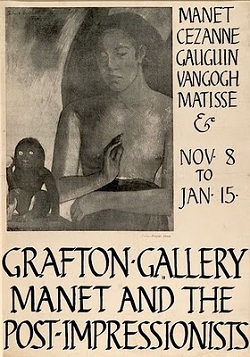
I have written to the Nation in protest at a recent letter by Mr. Robert Morley, a painter of landscapes and animals. He refers to the post-impressionist exhibition currently staged at the Grafton Gallery by Roger Fry. He says of the pictures: "It is impossible to take them seriously". What justification can he possibly offer for a statement so contrary to the facts? Hundreds of the most cultivated minds in Europe take them seriously. One thinks at once of Mr. Bernard Berenson whose position as the greatest living art critic is not often challenged. He takes them seriously  and, in particular, has professed a profound admiration for Matisse. Mr. Morley's assessment of the post-impressionists says rather more about him than it does about the artists in the exhibition.

Regrettably Morley is not a lone voice. Mr. Michael Sadler demands: "Did Van Gogh burn with the same passion when he painted his boulevard as Cimabue when he painted his madonna?" The answer is most emphatically "Yes!" Even a cursory examination into the life of Van Gogh reveals passion as its central motif. Sir William Blake Richmond, another reactionary voice, uses the word 'daub'.  This is simply offensive and I said so in my letter. We shall see if they have the spirit to enter into debate with me (and others - I am not alone) on this subject. 

In the meantime I can only congratulate Roger Fry for assembling this exhibition at the Grafton Gallery and bringing these great artists to the attention of the discerning public. For myself, if I have the opportunity to acquire one or two of the paintings in the exhibition I will feel confident in having made a safe investment, but that feeling will be secondary to the satisfaction of having great art in my home.

I had to take a good long walk this morning to cool down and was successful physically and metaphorically. A cold and misty day. But a pleasure to be out when adequately wrapped against the elements. I particularly enjoy seeing figures and vehicles emerging from and fading back into the mist; they have an intangible, dreamlike quality which might be captured by a post-impressionist!

Sunday, 8 December 2019

An excellent dodge

Thursday, December 8th., Rue de Grenelle, Paris.

I have been working daily at construction of "Hilda Lessways". I had thought, naively, that this would be simpler, having written "Clayhanger"; but in fact it is not because of the constant need to refer back to make the two 'fit'. Challenging but interesting to do.

Huntington French Conversation (Huntington, NY) | MeetupAs it was pouring with rain this afternoon, I went to the Gare d'Orsay and had tea on the platform-terrasse of the cafe, and walked about for two and three quarter hours, and really worked excellently at the first book, and was moreover all the time amused and diverted by the phenomena of the teminus. At the railway bookstall for example men came up, all sorts of men, threw down a sou, snatched a paper, and departed; scores of them. I remained, staring like a ploughman, vaguely ... This is a most excellent dodge for wet days.

ART and ARCHITECTURE, mainly: Modern art destroys British ...I have been incensed by a letter of one Robert Morley in the Nation. He refers to art works hung in an exhibition at the Grafton Gallery by Roger Fry. Works by Cezanne, Van Gogh, Picasso, Matisse and others which have, evidently, enraged numerous people, especially Mr. Morley. He states: "It is impossible to take them seriously". Idiot! Does he think the artists were having a joke? Does he think that Roger Fry is engaged in a comic enterprise? What about Mr. Bernard Berenson, distinguished art critic, possibly the greatest living, who has professed a profound admiration for Matisse? I wonder if Morley has actually attended the exhibition or is merely reflecting ill-informed, second-hand sentiments. What he means is that a new and fresh approach to art has jarred with his deeply embedded ideas, and he has not the flexibility of mind to engage with it. I have written in this vein to the editor of the Nation.

Thursday, 24 January 2019

Ideas

Wednesday, January 24th., Yacht Club, London.

I came to London yesterday morning. Hard frost and cold travelling.

Lunch with Pinker at Arts Club today, about the whole question of cinematograph rights, which I regard as a swindle on the author. Constant fine snow showers.

I dined at Madame Van der Velde's, Rossetti Gardens Mansions. Fry was there. Omega Flat. I saw the Omega Bed. Flat exceeding cold. 

I became involved in a discussion about Sophocles' "Antigone", or at least I was on the edge of the discussion, not having enough knowledge to contribute effectively. I have read "Antigone", though some time ago, but must go to it again. All those involved in the discussion emphasised the various aspects of the play, and drew different conclusions about its essential 'purpose'. One thought that power was the essence, especially in the character of Creon who abuses his power; thus the play is a warning to the Greeks about authoritarianism. Another emphasised the family aspect, the breach between Antigone and her sister, their brothers, and of course the father; so, is family loyalty important and does it take precedence over civic duty. A third thought the play was a call to avoid fanaticism in all its aspects and should be required viewing for all would-be politicians. All seemed to me to have validity and perhaps this was Sophocles' genius, to write a play which inspires deep consideration. And it remains relevant because it is about human nature. I think any person will find some aspect of his or her self there.

Tuesday, 18 December 2018

Finishing things

Tuesday, December 18th., Cadogan Square, London.

The Sea by John Banville — Reviews, Discussion, Bookclubs ...Last evening, at home for once, I finished reading "The Sea" by John Banville. Whole thing in two good sessions. Frankly I think that it would have benefitted from judicious editing to become a 'long' short story. Very good, elegant writing; some of the lengthy, complex, sentences reminded me of Henry James. Themes are loss and memory, fairly common but well treated by Banville. Setting is Ireland, probably north of the border. I had a little trouble with the central character/narrator who is really too anguished by the death of his wife; it is made clear that she had been dying for a year, so he would have had time to get used to the idea. Present and past events are nicely juxtaposed, and the subsidiary characters are well done. Overall a good read.

Today I finished correcting typescript of "Punch and Judy" film.

Geoffrey Russell, F. Swinnerton came to lunch on business; also Elena Sullivan, our first view of her since Bertie's death about three weeks ago. She behaved with Latin calm and dignity. Exactly the right touch.

After lunch I formally gave to Dorothy 47 volumes of my MSS. (34 of Journal; 2 "Old Wives' Tale"; 1 "Riceyman Steps"; 1 "Elsie"; and 9 "Clayhanger Family") in the presence of MissNerney, Fred Harvey, Swinnerton and Geoffrey Russell.

Roger Fry, Mrs. Anrep, Francis Birrell and the Edes came to dinner. Very good evening. Fry and Birrell were fine.

Monday, 13 January 2014

On seeing

Monday, January 13th., Cadogan Square, London.

I have been reading two essays on literary criticism: 'Tradition' in criticism is handled by Rebecca West; and 'Experiment' by T. S. Eliot. They are a formidable pair! West skates brilliantly over literary criticism from Aristotle to the present day, and I agree in the main with her views. But I have discovered little that is new to me in her witty remarks. As for Eliot, he gives in my opinion too much attention to the past and too little to present and future criticism. His chief point seems to me to be that criticism is and will be influenced by the master-idea of evolution. Well, of course! On the whole, taking everything into account, these two essays have a more striking resemblance to stone than to bread. Of constructive criticism they contain very little.

I was led to think about a remark of Roger Fry's, one of the greatest critical minds of the age. He said: "We learn to see only so much as is needful for our purposes: but this is in fact very little, just enough to recognise and identify each object or person; that done they go into an entry in our mental catalogue and are no more really seen. In actual life the normal person really only reads the labels as it were on the objects around him, and troubles no further ... we were given our eyes to see things, not to look at them." I feel this as a profound insight, though obvious enough once pointed out. The difficulty is maintaining that state of heightened awareness that permits seeing as a matter of course. 

Also see 'Interesting artistic experiences', November 24th., -
http://earnoldbennett.blogspot.co.uk/2012/11/interesting-artistic-experiences.html

The core of the business of all imaginative literature is here. And the duty of the literary critic is to insist all the time that that imaginative literature is negligible which does nothing to make the reader see people, places and phenomena as freshly as though he had never set eyes on them before. But a first-class book must have something more even than this quality. It must give an effect of beauty. It must cause the reader to see beauty where he could not have seen it before. A work of art, whether poem, novel, play or picture, ought to make you think that you are seeing the thing portrayed for the first time in your life, and also seeing beauty, or new beauty, in it for the first time.

Additionally for January 13th., see 'Scrupulously clean' -
http://earnoldbennett.blogspot.co.uk/2013/01/scrupulously-clean.html

I outlined in the bath this morning an idea of a play about a man being offered a title and his wife insisting on his accepting it against his will. Spender told me that such a man had once asked him for advice in just such a problem, and he had advised the man to suppress his scruples and accept the title. Ross said that this would be a good idea for a play, and it is.

Saturday, 24 November 2012

Interesting artistic experiences

Friday, November 24th., London.

H.G. Wells told me his scheme for a whole series of new books, some being novels. He wants monarchy destroyed, of course, and to have a new religion (that there is one God - and apparently he can be what you like) without priests and churches. He thought very little of British high command at the front, and had difficulties with the Censor about his articles on Front, and meant to say what he thought in a book to be issued in January.
I was still suffering yesterday from my stomach chill, but I wrote a thousand words.
I went up to the Omega workshops by appointment to see Roger Fry.

Roger Eliot Fry (1866 – 1934) was an English artist and art critic, and a member of the Bloomsbury Group. Establishing his reputation as a scholar of the Old Masters, he became an advocate of more recent developments in French painting, to which he gave the name Post-Impressionism. He was the first figure to raise public awareness of modern art in Britain, and emphasized the formal properties of paintings over the "associated ideas" conjured in the viewer by their representational content. He was described by the art historian Kenneth Clark as "incomparably the greatest influence on taste since Ruskin... In so far as taste can be changed by one man, it was changed by Roger Fry".


Arrived as arranged at 2.30. I was told he was out. Then that he was at his studio down Fitzroy Street. I went there and rang. He opened door.
"Come and have lunch," he said. "I've had lunch, it's 2.30," I said. "How strange!" he said. "I thought it was only 1.15." Then as he went upstairs he cried out to a girl above: "Blank (her Xtian name), it's 2.30," as a great item of news. Fry expounded his theories. He said there was no original industrial art in England till he started i.e., untraditional. He said lots of goodish things and was very persuasive and reasonable. Then he took me to the showrooms in Fitzroy Square, and I bought a few little things. I did not buy a fine still life by Duncan Grant. But I may, later. I gradually got to like a number of the things, especially the stuffs. He said manufacturing (English) firms roared with laughter at his suggestion that they should do business together. One firm quoted an impossible price when he asked them to make rugs to his design at his risks. But when a eulogistic article appeared in The Times they quoted a lower price, a reasonable one. He said that both French and German firms would take his stuff. I began to get more and more pleased with the stuff, and then I left with two parcels.
This morning I went to Carfax Gallery and bought a Sickert from the Sickert stand there, "Coster Girl".

William Rothenstein
In 1898 William Rothenstein co-founded the Carfax Gallery in St. James' Piccadilly with John Fothergill . During its early years the gallery was closely associated with such artists as Charles Conder, Philip Wilson Steer, Charles Ricketts and Augustus John. It also exhibited the work of Auguste Rodin, whose growing reputation in England owed much to Rothenstein's friendship and missionary zeal. The gallery was later the home for all three exhibitions of The Camden Town Group, led by Rothenstein's friend and close contemporary Walter Sickert.

Had some talk with the proprietor who was highly intelligent, and stuck to it that Claude Phillips, though he couldn't write, had real taste. The boss thought Sickert the greatest artist of the age.